
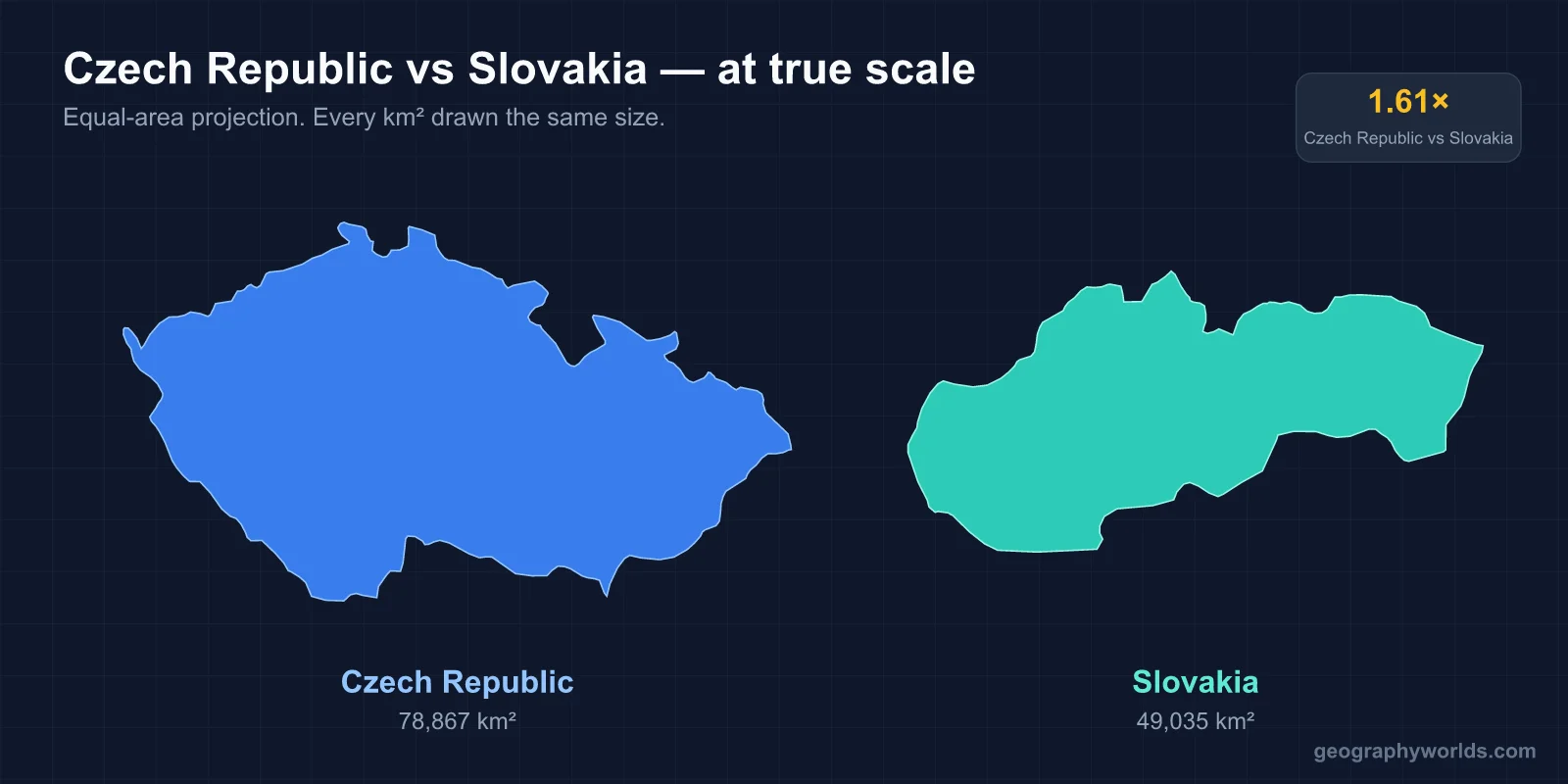
The Czech Republic is the bigger, more populous and richer of the two. It covers 78,871 km² against Slovakia’s 49,035 km², so it is about 1.6 times larger, and it had about 10.9 million people in 2025, roughly twice Slovakia’s 5.4 million (March 2026). IMF estimates for 2026 put nominal GDP per head at about $39,795 in the Czech Republic and $31,026 in Slovakia. The capitals are Prague and Bratislava, and the official languages are Czech and Slovak, which are close enough that most speakers understand each other. The two formed Czechoslovakia from 1918 until the Velvet Divorce took effect at the end of 1992, and for a visitor the biggest practical differences are the mountains, the money and the food.
From Sněžka at 1,603 m to Gerlach at 2,655 m
A traveller crossing from west to east climbs steadily. The western half of the Czech Republic, Bohemia, is a basin drained by the Elbe (Labe) and the Vltava and ringed by mostly low mountains. The highest of these, the Giant Mountains (Krkonoše) on the Polish border, rise to Sněžka at 1,603 m, the highest point in the country and in the whole Sudetes. Moravia, to the east, is hilly and drained by the Morava, and it also contains the source of the Oder. Because of this layout, water leaving the Czech Republic reaches three different seas: the North Sea via the Elbe, the Baltic via the Oder and the Black Sea via the Morava and the Danube.
Slovakia is the more mountainous of the two. The Carpathians extend across most of its northern half, in ranges such as the Tatras, the Greater and Lesser Fatra, the Slovak Ore Mountains and the Beskids. The High Tatras, on the Polish border, are topped by Gerlachovský štít, given as 2,655 m in some sources and 2,654.4 m in others. It is the highest summit in the entire Carpathian chain, more than a thousand metres above Sněžka. Forests cover 41% of Slovakia. The lowlands lie in the far south: the fertile Danubian Lowland around Bratislava and the Eastern Slovak Lowland near Košice.
Slovakia’s karst adds a landscape the Czech Republic lacks on the same scale. Slovak Paradise National Park, 197.63 km² in the north of the Slovak Ore Mountains, contains the Dobšiná Ice Cave, which has been part of the UNESCO-listed Caves of Aggtelek Karst and Slovak Karst since 2000.
Prague and Bratislava Month by Month
Both capitals have a central European climate with cold winters and warm summers, but Bratislava, further south-east on the Danube, runs slightly warmer in summer and colder at night in winter. The 1991–2020 averages show it clearly.
Winter, December to February
January is the coldest month in both. Prague’s Clementinum station averages a high of 3.9 °C and a low of −0.5 °C; Bratislava averages 3.1 °C by day and −2.8 °C at night. Winter is ski season in the High Tatras and the Low Tatras in Slovakia, and in the Krkonoše on the Czech side. Precipitation is light: Prague records only 18 mm in an average January and Bratislava 37 mm.
Spring, March to May
By April both cities reach average highs of 16–18 °C, with Bratislava a little ahead. April is still fairly dry in Prague, with about 25 mm of precipitation, against 36 mm in Bratislava.
Summer, June to August
July is the warmest month in both cities and the wettest in Bratislava; in Prague, June (69 mm) just edges July (67 mm). Prague averages a July high of 26.5 °C, Bratislava 28.0 °C with 62 mm of rain. Summer is the season for hiking the High Tatras, canoeing on the Vltava around Český Krumlov and walking the gorges of Slovak Paradise.
Autumn, September to November
October brings average highs of 14–16 °C in both capitals. Over a full year Bratislava receives about 574 mm of precipitation against Prague’s 454 mm, so the Slovak capital is the damper of the two, but neither is a very wet city.
Beyond Prague Castle: Brno, Český Krumlov, Košice and Spiš
Prague, on the Vltava, has about 1.4 million people, making it the twelfth-largest city in the European Union, and a metropolitan area of about 2.3 million. It was the seat of the Kingdom of Bohemia and of the Holy Roman Emperors Charles IV and Rudolf II. Prague Castle, founded in the 9th century and now the president’s official residence, covers almost 70,000 m² and is listed by Guinness World Records as the largest ancient castle in the world. The medieval Charles Bridge across the Vltava was begun in 1357 under Charles IV and finished in the early 15th century, replacing the Judith Bridge that a flood had wrecked in 1342. Brno, the Moravian capital at the meeting of the Svitava and Svratka, is second with about 404,000 people. Its best-known building is modern rather than medieval: Villa Tugendhat, designed by Ludwig Mies van der Rohe and Lilly Reich and built in 1928–30, joined the UNESCO World Heritage List in 2001.
Smaller Czech towns draw as many visitors as the cities. Český Krumlov, a town of about 13,000 in South Bohemia, wraps around a bend of the Vltava beneath a castle complex, and its historic centre has been a UNESCO World Heritage Site since 1992. In the west, Karlovy Vary grew into a spa resort for the European aristocracy in the 19th century and is still the most visited spa town in the country. East of Prague, the old silver-mining town of Kutná Hora, with about 22,000 people, has a centre that was listed by UNESCO in 1995 together with Sedlec Abbey and its ossuary.

Slovakia’s capital is smaller and more compact. Bratislava has about 479,000 people in the city proper and 1.3 million in its metropolitan area, spread across both banks of the Danube at the foot of the Little Carpathians. It is the only national capital that borders two other sovereign states, Austria and Hungary, and it lies closer to Vienna than any other pair of European capitals. On the city’s western edge, the ruins of Devín Castle stand on a cliff rising to 212 m above sea level where the Morava flows into the Danube, a site fortified since the Bronze Age. Košice, in the east on the Hornád near the Hungarian and Ukrainian borders, is the second city, with about 230,000 people.
Central Slovakia has its own smaller UNESCO sites. Banská Štiavnica, a town of fewer than 10,000 people, grew rich as a medieval mining centre inside the caldera of a collapsed volcano, and it was declared a World Heritage Site on 11 December 1993. Vlkolínec, a village of log houses first recorded in 1376 and now administered by Ružomberok, was listed in the same year.
Between the Tatras and Košice lies the Spiš region. The ruins of Spiš Castle stand on a hill above Spišské Podhradie and the village of Žehra, and they were added to the UNESCO World Heritage list in 1993 along with the surrounding monuments.

Svíčková, Bryndzové Halušky, Koruna and Euro
The two kitchens overlap heavily, but each has a signature dish. The Czech one is svíčková na smetaně: beef, usually topside, braised with carrot, parsley root, celeriac and onion, spiced with pepper, allspice, bay and thyme, finished with cream and served with houskové knedlíky, bread dumplings sliced like a loaf. One of Slovakia’s national dishes is bryndzové halušky, small potato dumplings tossed with bryndza, a soft sheep’s cheese, and often sprinkled with bits of smoked bacon or pork fat; it is traditionally washed down with žinčica, a whey drink, and the village of Turecká holds an annual festival with an eating contest.
Beer is a Czech speciality in the strictest sense. The first pale lager was served in Plzeň on 11 November 1842, and Pilsner Urquell gave its name to pilsner beer around the world. The Czech Republic has the highest beer consumption per head of any country. For something without alcohol, both countries share Kofola, a cola made by a company headquartered in Krnov that is the main rival to Coca-Cola and Pepsi in the Czech Republic and Slovakia.
Language barriers are minimal between the two. Czech and Slovak are West Slavic languages that form a dialect continuum across Moravia, and most varieties are mutually intelligible; the standard languages differ in spelling, vocabulary, pronunciation and word endings, which is why they are easy to tell apart on a page. Slovak has about five million native speakers.
Money is where the countries split. The Velvet Divorce took effect on 31 December 1992, and each new state went its own way on currency. Slovakia adopted the euro on 1 January 2009, replacing the Slovak koruna. The Czech Republic still uses the Czech koruna (CZK), in use since 1993, although it is legally bound to adopt the euro once it meets the convergence criteria. Both countries joined the Schengen Area on 21 December 2007, so there are no routine passport checks on the border. Travellers going from Prague to Bratislava therefore need to change currency but not show a passport. For more on the history behind the split, read about the Velvet Divorce, and for the capitals themselves, see our guides to Prague and Bratislava.