

A rainforest is a forest that gets a lot of rain — at least 2,000 millimetres a year, and often much more. Rainforests cover only about 6% of the Earth's surface but contain more than half of all the plant and animal species on the planet. They also make a large share of the world's oxygen and rainfall, which is why what happens to them matters to people who live thousands of kilometres away.
Two Kinds of Rainforest
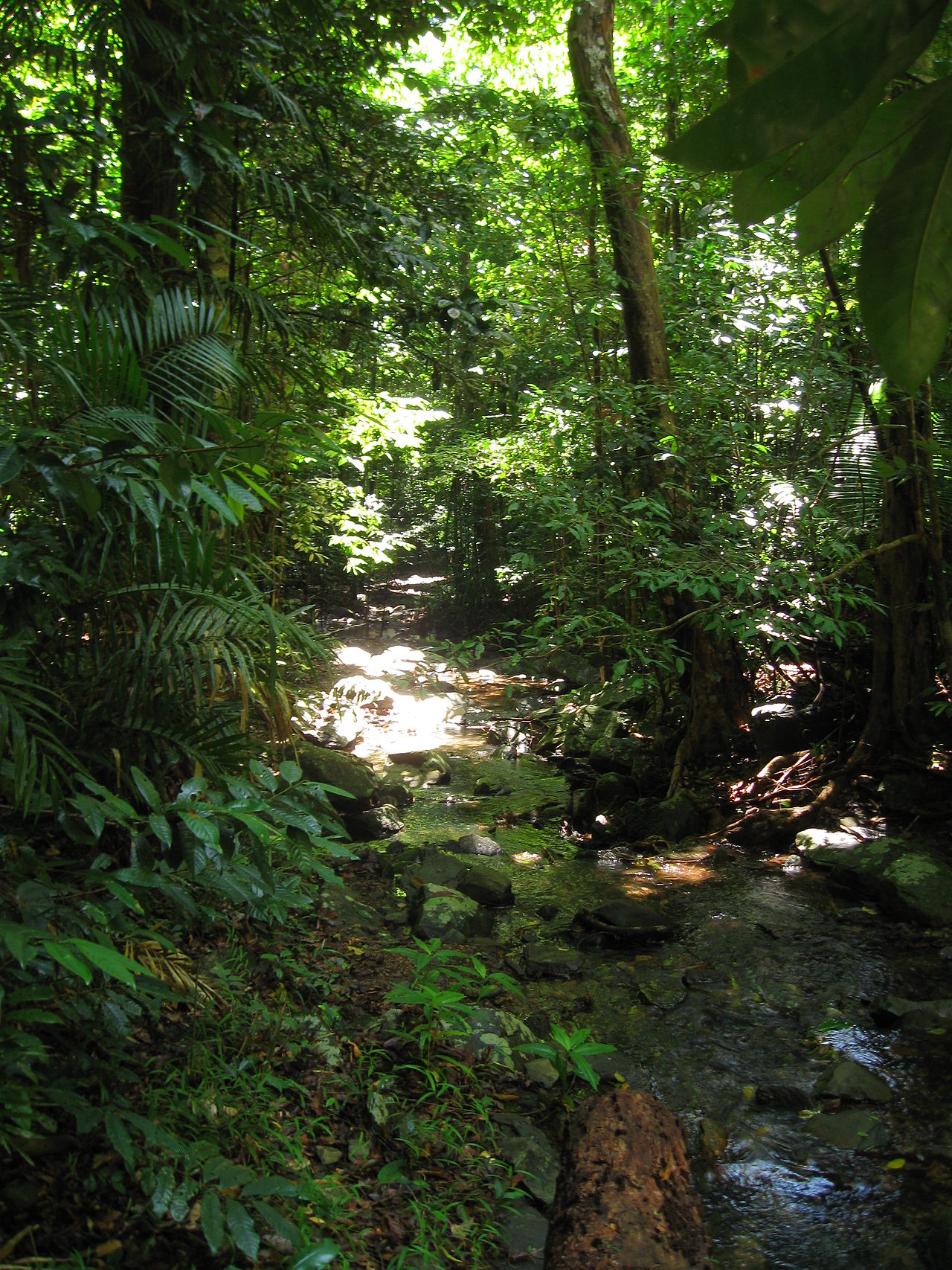
Tropical rainforests grow near the equator, where it is hot and wet all year round. The Amazon, the Congo Basin and the forests of Southeast Asia are the three big ones. There are no seasons in the way you know them — it is around 25 degrees every day, and it rains almost every afternoon.
Temperate rainforests are cooler and grow in a few narrow coastal strips: the Pacific north-west of North America, southern Chile, parts of New Zealand, Tasmania and Norway. They get their rain from the sea rather than from thunderstorms.
Temperate rainforests have fewer species but bigger trees. The tallest trees on Earth, the coast redwoods of California, grow in one, and the tallest of them is over 115 metres — taller than the Statue of Liberty.
The Four Layers
A rainforest is stacked, and each level is a different world.
The emergent layer is the giant trees poking out above everything else, up to 60 metres or more. It is windy, sunny and home to eagles, bats, butterflies and some monkeys.
The canopy just below is the roof of the forest, a dense mat of branches and leaves where around 70 to 90% of rainforest life is found. The understorey beneath it is dim and still, full of young trees, vines and insects. And the forest floor gets around 2% of the sunlight — dark, damp, and surprisingly open, because so little grows without light.
The Floor Is Almost Empty
Films show explorers hacking through impenetrable jungle. In a real mature rainforest you can usually walk quite easily, because the canopy blocks the light and almost nothing grows below.
The dense tangle happens at the edges, along rivers, and where trees have fallen and let light in. That is jungle rather than deep forest.
Rainforest soil is also poor, which surprises people. Almost all the nutrients are locked up in the living plants, not in the ground. When something dies it is broken down within weeks by fungi, termites and bacteria in the heat and damp, and the nutrients go straight back into the trees.
Grow a Rainforest in a Jar
Put a layer of small stones in a clear jar, then a layer of soil, then a small plant such as moss or a fern. Water it very lightly, put the lid on, and set it somewhere bright but out of direct sun.
Within a day the inside of the glass will fog up. Water evaporates from the soil and leaves, condenses on the glass and runs back down. The jar makes its own weather, and if you have sealed it well it may need no more watering for months.
One sealed bottle garden planted in England in 1960 was watered only once, in 1972, and was still alive over fifty years later. A rainforest does the same thing on a continental scale — around half of the rain that falls on the Amazon was released by the forest itself.
The Amazon
The Amazon covers about 5.5 million square kilometres across nine countries and is roughly the size of Australia. Around 60% is in Brazil.
It contains an estimated 390 billion trees of around 16,000 species, and about 10% of all known species on Earth. New ones are described constantly — in one recent survey period, a new plant or animal was named there on average every couple of days.
Around 400 to 500 indigenous groups live in the Amazon, and some have never had contact with the outside world. Brazil's government agency for indigenous affairs monitors dozens of uncontacted groups by aerial survey without approaching them.
The Congo and Southeast Asia
The Congo Basin in Central Africa is the second-largest rainforest, spanning six countries and around two million square kilometres. It is home to forest elephants, okapi, bonobos, and both eastern and western gorillas.
The rainforests of Borneo, Sumatra and New Guinea are the third great block, and among the oldest on Earth — Borneo's are thought to be around 130 million years old, roughly twice the age of the Amazon.
They are also the only home of the orangutan, whose name means person of the forest in Malay. Sumatra is the only place where tigers, rhinos, elephants and orangutans all live in the same forest.
Extraordinary Plants
The Rafflesia arnoldii of Sumatra and Borneo has the largest single flower in the world, up to a metre across and weighing 11 kilograms. It has no leaves, stem or roots, lives as a parasite inside a vine, and smells strongly of rotting meat to attract flies.
Strangler figs start life as a seed dropped by a bird high in another tree. They send roots down to the ground, gradually wrap around the host, and eventually kill it — leaving a hollow tube of fig where the original tree used to be.
Around a quarter of modern medicines come from rainforest plants, including quinine for malaria, and drugs derived from the rosy periwinkle of Madagascar that transformed the survival rate for childhood leukaemia. Fewer than 1% of rainforest plants have been tested for medical use.
Animals of the Canopy
Living in a rainforest means living in the trees, and animals have solved it in different ways.
Howler monkeys have a hollow bone in the throat that lets their call carry five kilometres — the loudest land animal in the Americas. Flying frogs, flying squirrels, flying snakes and flying lizards in Southeast Asia all glide between trees rather than climbing down.
Poison dart frogs are brightly coloured as a warning, and their toxins come from the insects they eat — raised in captivity on ordinary food, they are harmless. The three-toed sloth moves so slowly that green algae grows in its fur, which is excellent camouflage and also, for some species, a snack.
People of the Forest
Somewhere around 50 million people live in rainforests worldwide, and many more depend on them. They are not empty wilderness — they have been inhabited and shaped by humans for thousands of years.
Scientists studying Amazon soils have found large patches of unusually dark, fertile earth called terra preta, created deliberately by people mixing charcoal, pottery and organic waste into the ground centuries ago. Lidar surveys from aircraft have revealed roads, earthworks and settlement patterns under the canopy, suggesting the pre-1500 Amazon supported millions of people.
Rainforest peoples also hold detailed knowledge of thousands of plants and their uses that exists nowhere in any book. Much of it is being lost faster than the forest itself, as languages disappear and young people move to cities.
Why They Matter to You
Rainforests absorb carbon dioxide as they grow and store it in wood and soil. The Amazon alone holds an estimated 150 to 200 billion tonnes of carbon.
They also drive rainfall far beyond their borders. Moisture released by Amazon trees travels as flying rivers in the air and falls as rain on farmland in southern Brazil and Argentina. Congo forest moisture waters the Ethiopian highlands, which feed the Nile.
Cut down enough forest and the system starts to fail. Scientists warn of a tipping point at which the Amazon becomes too dry to sustain itself and shifts into savannah, and estimates of where that point lies range from around 20% to 25% of the forest lost. Roughly 17 to 20% has already gone.
Rainforests Are Loud
Anyone who visits a tropical rainforest is struck first by the noise rather than the sight. The canopy is dense enough that you often hear far more than you see.
Cicadas can reach over 100 decibels, about as loud as a chainsaw. Frogs call all night in choruses of dozens of species at once, each at a different pitch so they do not drown each other out. Howler monkeys start before dawn, and their roar carries several kilometres.
Scientists now use this. Recording microphones left in the canopy for months can identify species by sound alone, count how many are there, and detect chainsaws and gunshots — a technique called bioacoustic monitoring that is used to spot illegal logging in real time.
What Is Being Done
The main causes of loss are cattle ranching, soya and palm oil plantations, logging, mining and road building. Around 80% of Amazon deforestation is linked to cattle.
Deforestation rates go up and down with policy. Brazil cut its rate by around 80% between 2004 and 2012, saw it rise again, and cut it sharply once more from 2023. That shows the problem is not unstoppable — it responds to enforcement.
Things that help include buying certified sustainable timber, palm oil and paper; eating less beef; and supporting organisations that fund indigenous land rights, since forests managed by indigenous communities consistently lose less cover than land around them. To keep exploring, read about how rivers work and see the count of countries in South America, most of which share the Amazon.