
Tucked between Nigeria and Togo on the Gulf of Guinea, Benin is one of West Africa's most underrated treasures, a slim country that punches far above its size in history and culture. This is the land where Vodun (the religion the world misnamed "voodoo") was born, where a fearsome female army once defended a powerful kingdom, and where an entire town floats on a lagoon. From royal palaces to stilt villages, here are ten fascinating facts that reveal why Benin deserves a far bigger place on the map.
1. It Has Two Capitals Doing Two Different Jobs
Benin is one of those quietly confusing countries with a split capital arrangement. Porto-Novo is the official, constitutional capital and seat of the National Assembly, but it is actually the smaller and sleepier of the two cities. The real engine of the nation is Cotonou, the largest city and economic heart, home to the government's executive offices, the main port, the airport, and the bulk of business activity.
This means that while Porto-Novo holds the title, most diplomats, ministries, and embassies operate out of Cotonou. The arrangement is a legacy of colonial-era decisions and has stuck ever since. Visitors often arrive in Cotonou assuming it is the capital, only to learn the honor technically belongs to its quieter neighbor down the coast.
2. Benin Is the Birthplace of Vodun (Voodoo)
Long before Hollywood turned it into a horror trope, Vodun was, and still is, a sophisticated indigenous religion that originated among the Fon and Ewe peoples of present-day Benin. It is an official religion here, practiced openly by a large share of the population alongside Christianity and Islam, and it deeply influences daily life, healing, and community decisions.
Every January 10th, Benin celebrates National Vodun Day, a vibrant public holiday centered on the coastal town of Ouidah. Drummers, dancers, and devotees fill the streets in elaborate costumes, and ceremonies honor ancestral spirits and deities called orishas. Far from sinister, Vodun is a rich spiritual system that spread across the Atlantic with the slave trade, shaping religious traditions in Haiti, Brazil, and the American South.
3. The Powerful Kingdom of Dahomey Ruled Here
For roughly 250 years, much of modern Benin was the Kingdom of Dahomey, one of West Africa's most formidable and organized states. Centered on the city of Abomey, Dahomey grew wealthy and powerful, partly through its central role in the Atlantic slave trade. Its royal palaces in Abomey are now a UNESCO World Heritage Site, decorated with striking bas-relief sculptures that recorded the kingdom's victories and history.
Dahomey was famous for its military discipline and centralized monarchy. The country was even named "Dahomey" at independence in 1960 before changing its name to Benin in 1975. You can learn more in our country guide, which traces this remarkable lineage from kingdom to modern republic.
4. It Had a Real-Life Army of Women Warriors
One of Dahomey's most astonishing features was the Agojie, an elite all-female military regiment that European visitors nicknamed the "Dahomey Amazons." These women were trained, armed, and feared, forming a core part of the kingdom's army for generations. They served as royal bodyguards and frontline fighters, and accounts describe them as exceptionally disciplined and ferocious in battle.
The Agojie were so unusual that they captivated foreign observers and have inspired modern retellings, including major films. Their legacy challenges old assumptions about gender and warfare in pre-colonial Africa, and today they stand as a powerful symbol of Beninese heritage and women's strength. Few nations can claim such a distinctive and historically documented warrior tradition.
5. A Whole Town Floats on Water
On Lake Nokoué near Cotonou sits Ganvié, often called the "Venice of Africa." This extraordinary settlement of tens of thousands of people is built entirely on stilts above the water, with homes, shops, schools, and even a market all reachable only by canoe.
Ganvié was founded centuries ago by the Tofinu people, who fled to the lake to escape slave raiders from Dahomey, knowing their pursuers had a religious prohibition against entering the water. What began as a clever survival strategy became a permanent, thriving community. Today residents make their living largely through fishing, using ingenious underwater enclosures, and the village is one of Benin's most photographed and remarkable destinations.
6. French Is Official, But Dozens of Languages Thrive
As a former French colony, Benin uses French as its official language for government, education, and business. But step into any market or village and you will hear a vibrant chorus of indigenous tongues. Fon and Yoruba are widely spoken in the south, while languages like Bariba and Dendi are common in the north.
In total, Benin is home to dozens of local languages reflecting its many ethnic groups, including the Fon, Adja, Yoruba, and Bariba peoples. This multilingualism is everyday reality for many citizens, who often switch fluidly between French and one or more local languages. The country's linguistic richness mirrors its cultural diversity and is part of what makes Beninese identity so layered.
7. Cotton Is the Backbone of the Economy
Benin's economy is heavily agricultural, and one crop reigns supreme: cotton. Often called "white gold," cotton is the country's most important cash crop and a major export, supporting the livelihoods of a large portion of rural families. In recent years Benin has ranked among Africa's leading cotton producers.
Beyond cotton, the economy leans on subsistence farming of crops like maize, cassava, and yams, as well as the busy Port of Cotonou, a vital gateway for landlocked neighbors such as Niger and Burkina Faso. Re-export and transit trade with giant neighbor Nigeria also play a huge role. Despite challenges, Benin has pursued reforms to diversify and grow, including investment in tourism built around its rich heritage.
8. The Pendjari Region Shelters West Africa's Big Wildlife
In Benin's northwest lies Pendjari National Park, part of the larger transboundary W-Arly-Pendjari complex that spans into Burkina Faso and Niger. This protected wilderness is one of the last strongholds for big mammals in West Africa, including elephants, lions, hippos, buffalo, and antelope.
Pendjari is especially significant because it harbors one of the region's few remaining populations of the critically endangered West African lion and the rare West African cheetah. Conservation partnerships have invested heavily in protecting the area, making it a rising destination for safari travelers who want to experience African wildlife away from the crowds of East Africa. It is a reminder that Benin's natural heritage is as compelling as its cultural one.
9. The Cuisine Revolves Around Pâte and Fiery Sauces
Beninese food is hearty, communal, and full of bold flavor. A staple at countless meals is pâte (also called akassa), a smooth dough made from corn, cassava, or yam flour, rolled into balls and dipped into rich sauces. These sauces are where the magic happens, often featuring tomatoes, peanuts, okra, smoked fish, and plenty of chili.
The country's coastal location means fresh fish and seafood feature prominently in the south, while grilled meats and grain dishes are common in the north. Palm oil, ground peanuts, and locally grown vegetables form the backbone of the kitchen. Sharing a single dish from a communal bowl is a cherished social ritual, reflecting the warmth and togetherness at the center of Beninese daily life.
10. Its Flag Carries Pan-African Pride
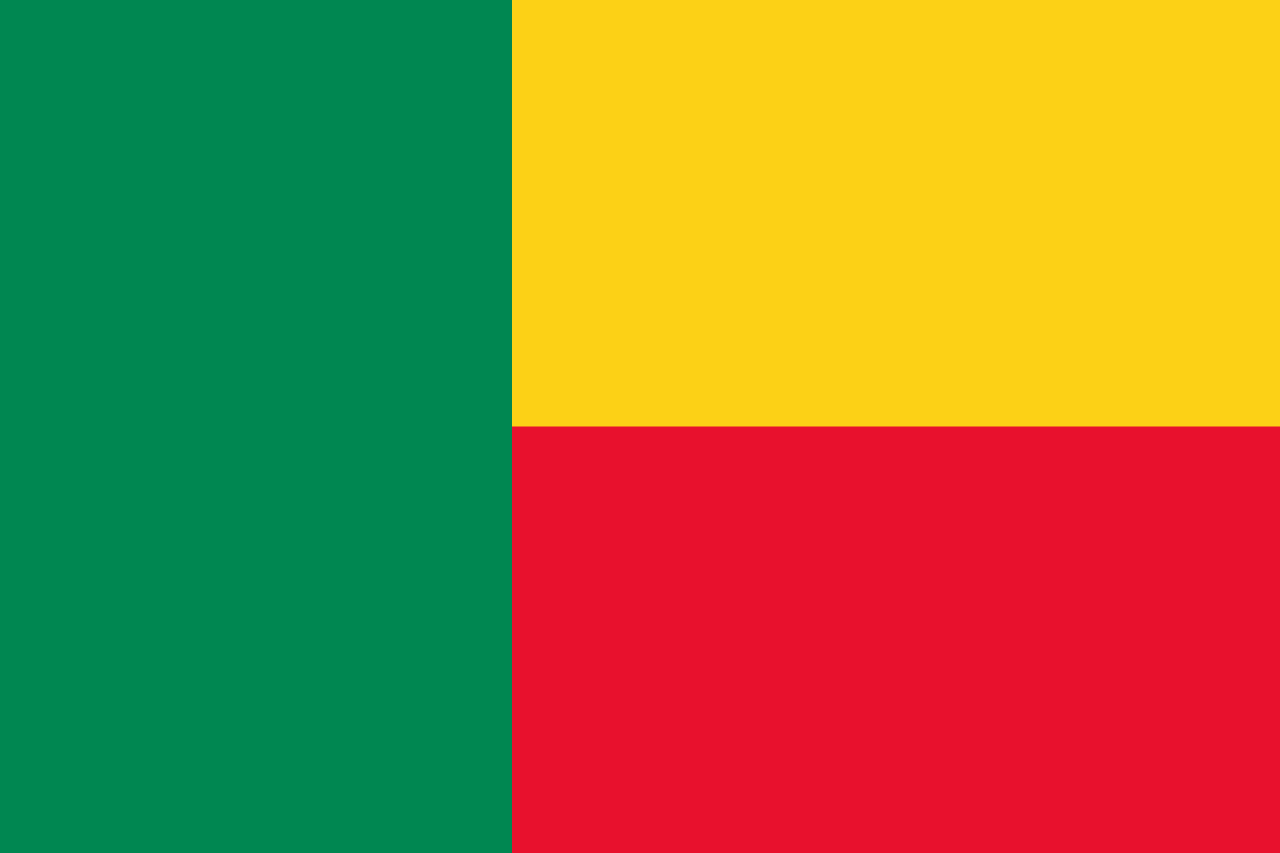
Benin's national flag is instantly recognizable, featuring a green vertical band on the left and two horizontal bands of yellow and red on the right. These are the classic Pan-African colors, shared with many newly independent African nations of the mid-20th century.
Each color carries meaning: green represents hope, renewal, and the country's lush palm groves; yellow symbolizes the savannas and the nation's wealth; and red honors the courage and sacrifice of ancestors. Adopted at independence in 1960, briefly replaced during the country's Marxist period, and then restored in 1990, the flag is a compact visual story of Benin's journey through independence, revolution, and democratic renewal.
Frequently Asked Questions
What is the capital of Benin?
Porto-Novo is the official constitutional capital and seat of the National Assembly. However, Cotonou is the largest city and serves as the economic capital and de facto seat of government, hosting most ministries, embassies, the main port, and the international airport.
What is Benin most famous for?
Benin is best known as the birthplace of the Vodun (voodoo) religion, the historic Kingdom of Dahomey with its all-female Agojie warriors, the UNESCO-listed royal palaces of Abomey, and the stilt village of Ganvié floating on Lake Nokoué.
Why is Benin called the cradle of voodoo?
Vodun originated among the Fon and Ewe peoples of this region and remains an official, openly practiced religion. The annual National Vodun Day on January 10th draws crowds to Ouidah, and the faith spread across the Atlantic during the slave trade, shaping traditions in Haiti, Brazil, and beyond.
Conclusion
Benin proves that geographic size has nothing to do with cultural depth. From floating villages and warrior queens to sacred Vodun ceremonies and roaming elephants, this slender West African nation offers a wealth of stories found nowhere else. These ten facts only begin to scratch the surface, and Benin rewards anyone curious enough to look closer.