
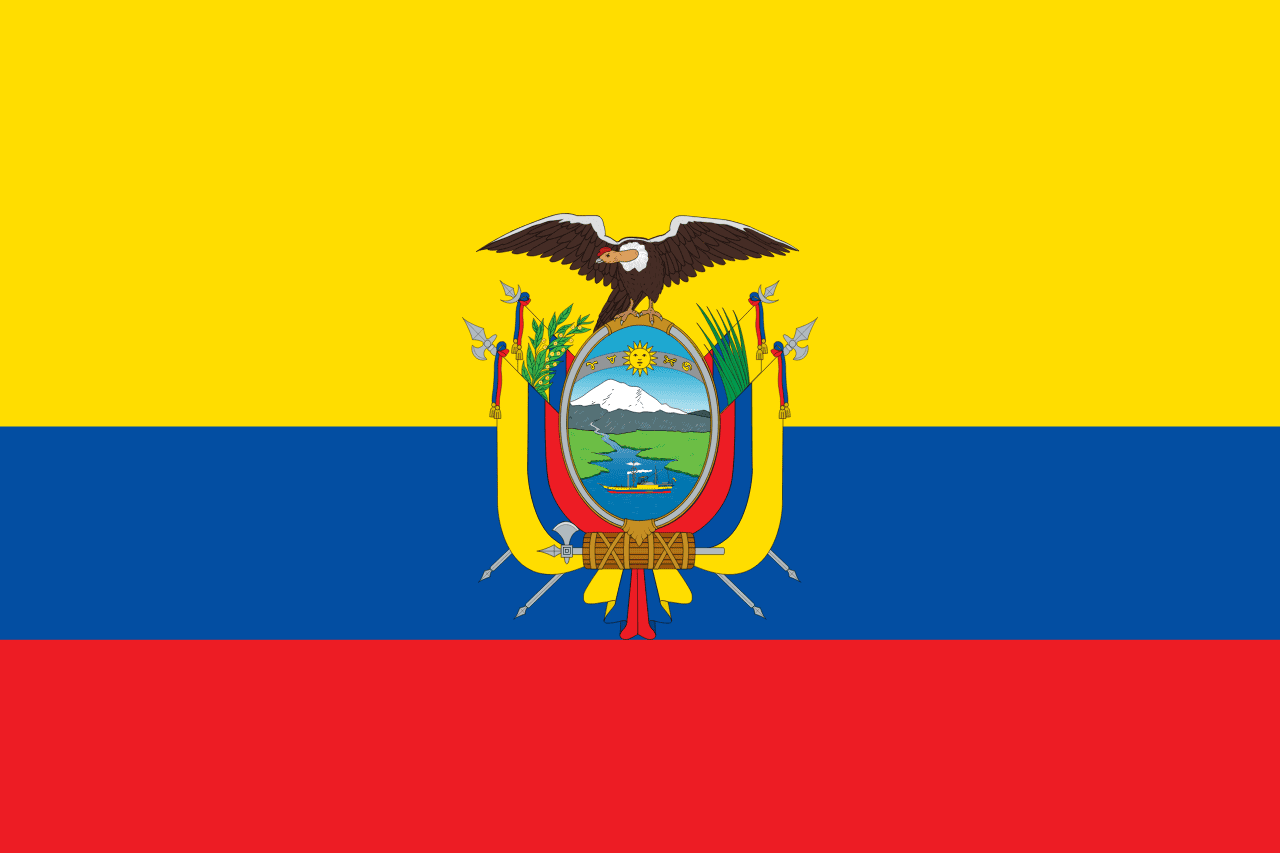
Straddling the line that gives it its name, Ecuador packs an astonishing amount of variety into one of South America's smallest mainland countries. In a single day you could stand with one foot in each hemisphere, hike a snow-capped volcano, and watch giant tortoises lumber across a black-sand beach. Here are ten facts that reveal why this Andean nation punches far above its size.
1. It's Named After the Equator That Slices Through It
Ecuador is the only country in the world named directly after a geographic line: the Equator, which cuts across the country just north of Quito. The Spanish word "ecuador" literally means "equator." Just outside the capital, the Mitad del Mundo (Middle of the World) monument marks the spot where you can supposedly straddle the northern and southern hemispheres at once. Amusingly, GPS later revealed the famous monument is a few hundred meters off the true line, but the nearby Intiñan museum lets visitors balance eggs and watch water drain in different directions as quirky equatorial demonstrations. Wherever you stand, the symbolism is powerful for a nation defined by its place on the planet.
2. Quito Is One of the Highest Capitals on Earth
Perched at roughly 2,850 meters (9,350 feet) in a long Andean valley, Quito is the second-highest official capital city in the world, just behind La Paz, Bolivia. Founded by the Spanish in 1534 on the ruins of an Incan city, Quito boasts one of the largest, best-preserved historic centers in the Americas. In 1978 it became one of the very first sites ever inscribed on the UNESCO World Heritage list. Its old town is a maze of whitewashed colonial mansions, gilded baroque churches, and cobbled plazas backed by the towering volcano Pichincha. Despite sitting almost on the Equator, the altitude keeps Quito comfortably spring-like all year round.
3. The Galápagos Islands Inspired a Scientific Revolution
About 1,000 kilometers off Ecuador's Pacific coast lie the Galápagos Islands, a volcanic archipelago that helped change how humanity understands life itself. When Charles Darwin visited in 1835 aboard HMS Beagle, the islands' unique finches, marine iguanas, and giant tortoises planted seeds for his theory of evolution by natural selection. Today the Galápagos remain a living laboratory, home to species found nowhere else on Earth, including the only penguin that lives north of the Equator. The islands were among the first natural sites named to the UNESCO World Heritage list and are protected by one of the planet's largest marine reserves. They are Ecuador's most famous natural treasure.
4. Four Worlds in One Compact Country
For its modest size, Ecuador offers a staggering range of landscapes, neatly divided into four regions. The Costa is the Pacific lowland of beaches and banana plantations; the Sierra is the spine of Andean volcanoes and highland cities; the Oriente is dense Amazon rainforest brimming with life; and the Galápagos floats far out at sea. Within this terrain stands Chimborazo, an inactive volcano whose summit, thanks to the Earth's equatorial bulge, is the farthest point from the planet's center, making it arguably the closest spot to the sun and stars. Few countries let you go from jungle to glacier to ocean so quickly.
5. A Proudly Multicultural Population
Home to roughly 18 million people, Ecuador is a richly mixed society. The majority are mestizo, of combined Indigenous and European heritage, but the country also has sizable Indigenous, Afro-Ecuadorian, and European-descended communities. More than a dozen distinct Indigenous nationalities live within its borders, from the Kichwa of the highlands to the Shuar and Waorani of the Amazon. This diversity is woven into everyday life, from the bright woven textiles of Otavalo, home to one of South America's most famous Indigenous markets, to the marimba rhythms of the Afro-Ecuadorian coast. To dive deeper into the nation's makeup, explore our full country guide.
6. Spanish Shares the Stage With Indigenous Tongues
Spanish is Ecuador's dominant language, but it is far from the only one. The 2008 constitution recognizes Kichwa (the local form of Quechua) and Shuar as official languages for "intercultural relations," and around a dozen other Indigenous languages are spoken across the Amazon and highlands. Kichwa words have seeped into everyday Ecuadorian Spanish, and bilingual education programs work to keep ancestral languages alive. This linguistic layering reflects the deep roots of the Inca and pre-Inca peoples who shaped the region long before Spanish ever arrived, and it gives Ecuador a cultural texture that goes well beyond what a single national language could express.
7. The Story of the Panama Hat Starts Here
One of Ecuador's most famous exports carries the wrong country's name. The lightweight straw hat known worldwide as the "Panama hat" is actually woven in Ecuador, primarily in the towns of Montecristi and Cuenca. The misnomer stuck in the 1800s when the hats were shipped through Panama and worn by canal workers and travelers, including a famously photographed U.S. president. The finest examples, called montecristi superfino, are so tightly hand-woven from toquilla palm fiber that they can hold water and take months to complete. The traditional weaving technique was added to UNESCO's list of Intangible Cultural Heritage, recognizing a craft that remains a point of national pride.
8. The Economy Runs on U.S. Dollars, Oil, and Bananas
In 2000, after a severe financial crisis, Ecuador took the dramatic step of abandoning its currency, the sucre, and adopting the U.S. dollar as legal tender. The country has used the greenback ever since, minting only its own small "centavo" coins. The economy leans heavily on oil from the Amazon basin, but agriculture is equally iconic: Ecuador is consistently one of the world's largest exporters of bananas, and it is also a leading source of shrimp, cut flowers (especially roses), and prized cacao. Its arriba cacao is celebrated by chocolatiers for its fine aroma, making Ecuador a quiet powerhouse in the world of fine chocolate.
9. A Cuisine Built on Ceviche, Plantains, and Guinea Pig
Ecuadorian food mirrors the country's geography. On the coast, tangy shrimp and fish ceviche rules, often served with crunchy corn nuts and fried plantain chips. In the highlands, hearty comfort food dominates: locro de papa, a creamy potato-cheese soup topped with avocado, and llapingachos, stuffed potato patties. The most surprising delicacy to outsiders is cuy, roasted guinea pig, an Andean tradition dating back thousands of years and reserved for special occasions. Wash it down with colada morada, a spiced purple fruit drink enjoyed during the Day of the Dead. Few cuisines so directly reflect the altitude, ocean, and ancestry of the people who created them.
10. The Country That Gave Nature Legal Rights
In 2008 Ecuador made history by becoming the first nation on Earth to enshrine the rights of nature, or Pachamama (Mother Earth), directly into its constitution. The provision gives ecosystems the legal right to exist, persist, and regenerate, and allows citizens to sue on nature's behalf. This pioneering idea reflects deep Indigenous Andean philosophies about living in balance with the natural world, expressed in the concept of sumak kawsay, or "good living." For a country whose territory ranges from the Amazon to the Galápagos, protecting biodiversity is both a moral stance and a practical necessity, and Ecuador's bold legal experiment has since inspired similar movements around the globe.
Frequently Asked Questions
What is the capital of Ecuador?
The capital is Quito, located high in the Andes at about 2,850 meters above sea level. It is the second-highest capital city in the world and home to a spectacularly preserved colonial old town that became one of the first UNESCO World Heritage Sites in 1978.
What is Ecuador most famous for?
Ecuador is best known for the Galápagos Islands, the wildlife haven that inspired Darwin's theory of evolution. It is also famous for the Equator that runs through it, its towering Andean volcanoes, Panama hats, fine cacao, and being the first country to grant legal rights to nature.
Why is the Panama hat actually from Ecuador?
Despite its name, the Panama hat is woven in Ecuador, mainly in Montecristi and Cuenca. The hats earned their misleading name in the 1800s when they were shipped through Panama and worn by workers building the canal, so buyers assumed that was their origin.
Conclusion
From the equatorial monument outside Quito to the tortoises of the Galápagos, Ecuador proves that geographic size has little to do with natural and cultural richness. It is a place where ancient Andean wisdom meets cutting-edge environmental law, where four wildly different worlds sit within a day's travel of one another. To keep exploring this remarkable nation, take a look at the meaning behind its flag and discover how its colors tell the story of the land.