
Namibia is a land of staggering emptiness and quiet drama, where towering orange dunes spill into a fog-shrouded ocean and the night sky burns with more stars than almost anywhere on Earth. With roughly 3.2 million people scattered across a country twice the size of Germany, it is one of the least crowded nations on the planet. These ten facts reveal why this corner of Southern Africa is far stranger and more spectacular than most travelers ever imagine.
1. It Has the World's Oldest Desert
The Namib Desert, which gives the country its name, is widely considered the oldest desert on Earth, having endured arid or semi-arid conditions for at least 55 million years. Stretching along the entire Atlantic coastline, it is home to the colossal dunes of Sossusvlei, some rising more than 300 meters and glowing a deep rust-red at sunrise. The name "Namib" comes from the Nama language and roughly means "vast place" or "place where there is nothing." Yet this seemingly lifeless landscape teems with specially adapted creatures, from fog-drinking beetles to the bizarre Welwitschia plant, which can live for over a thousand years. To learn more about the country's full geography, see our country guide.
2. Windhoek Sits High in the Central Highlands
Namibia's capital and largest city, Windhoek, perches at around 1,700 meters above sea level in the central highlands, giving it a pleasantly mild climate despite its desert surroundings. Home to roughly 430,000 people, it serves as the political, economic, and cultural heart of the nation. Its architecture is an unusual blend of German colonial buildings, Lutheran churches like the iconic Christuskirche, and modern African design. The city's name derives from "Windhoek," a reference to either a windy corner or the "Wynhoek" of an early leader. Despite being a capital, it retains a small-town calm, ringed by hills and acacia-dotted savanna.
3. It Was Once a German Colony
From 1884 to 1915, the territory was known as German South West Africa, the only substantial overseas colony Germany ever established in Africa. This era left deep and painful marks: between 1904 and 1908, colonial forces carried out the genocide of the Herero and Nama peoples, an event now recognized as one of the first genocides of the 20th century. The German legacy survives in place names, architecture, bakeries serving Brötchen, and a small German-speaking community. After World War I, the territory fell under South African control, and Namibia did not achieve full independence until 1990, making it one of Africa's youngest sovereign nations.
4. English Is the Official Language, But Few Speak It at Home
In a bold post-independence decision, Namibia chose English as its sole official language in 1990, despite it being the first language of only a tiny fraction of the population. The choice was deliberately neutral, avoiding favoritism among the country's many ethnic groups and distancing the new nation from the languages of colonial rule. In practice, Oshiwambo dialects are the most widely spoken mother tongues, while Afrikaans serves as a common lingua franca, and German, Khoekhoegowab (Nama/Damara), Otjiherero, and others flourish. This linguistic patchwork makes Namibia one of the most multilingual societies in the world.
5. It Is the Second Least Densely Populated Country on Earth
With only about three people per square kilometer, Namibia ranks as one of the most sparsely populated countries in the world, second only to Mongolia. You can drive for hours across gravel roads and gravel plains without passing another vehicle. This emptiness is partly due to the harsh desert and arid terrain covering much of the land. The population is concentrated in the wetter northern regions and around Windhoek. For visitors, the result is an overwhelming sense of space and solitude, with horizons that seem to stretch forever and a sky undimmed by light pollution.
6. The Skeleton Coast Is a Graveyard of Ships
Namibia's northern Atlantic shoreline bears the chilling name the Skeleton Coast, earned from the countless shipwrecks and whale bones that litter its sands. Dense coastal fog, treacherous currents, and hidden reefs have doomed vessels for centuries, and the rusting hulks of stranded ships still dot the beaches. The San people once called it "The Land God Made in Anger," while Portuguese sailors named it "The Gates of Hell." Despite the menace, it is hauntingly beautiful, where dunes meet crashing surf and seal colonies number in the hundreds of thousands. The desert lions and elephants that roam here have adapted remarkably to the unforgiving environment.
7. Conservation Is Written Into the Constitution
Namibia made history as one of the first countries in the world to enshrine environmental protection in its constitution. Its pioneering community conservancy program gives rural residents direct rights to manage and benefit from wildlife, turning local people into stewards rather than poachers. The results have been extraordinary: populations of black rhino, cheetah, and desert-adapted elephant have rebounded, and Namibia hosts the largest free-roaming black rhino population on Earth. Roughly 17 percent of the country is protected, including the vast Etosha National Park, whose salt pan is so large it is visible from space and draws enormous herds to its waterholes.
8. Etosha's Salt Pan Shimmers Like a Ghostly Sea
At the heart of Etosha National Park lies the Etosha Pan, a flat, blindingly white salt depression covering around 4,800 square kilometers. For most of the year it is bone dry, cracking under the sun and creating shimmering mirages on the horizon. But after heavy rains, the pan can briefly flood, attracting thousands of flamingos and pelicans to breed. The name "Etosha" means "Great White Place" in the Oshindonga language. Surrounding the pan, perennial springs and waterholes become magnets for elephants, lions, giraffes, zebras, and the endemic black-faced impala, making it one of Africa's premier wildlife-viewing destinations.
9. Biltong, Game Meat, and German Cake Share the Table
Namibian cuisine is a flavorful collision of indigenous, Afrikaner, and German influences. Dried, spiced meat called biltong is a beloved national snack, while game such as kudu, oryx, springbok, and even zorn-spiced ostrich frequently appear on menus. A traditional Oshiwambo dish, oshifima, is a stiff millet porridge eaten with stews and wild spinach. Thanks to the colonial past, you can also find German classics like sauerkraut, sausages, and apfelstrudel in Windhoek and Swakopmund. Along the coast, fresh oysters and seafood thrive in the cold, nutrient-rich Atlantic waters, making the country an unexpected delight for adventurous eaters.
10. Its Flag Was Born From Independence in 1990
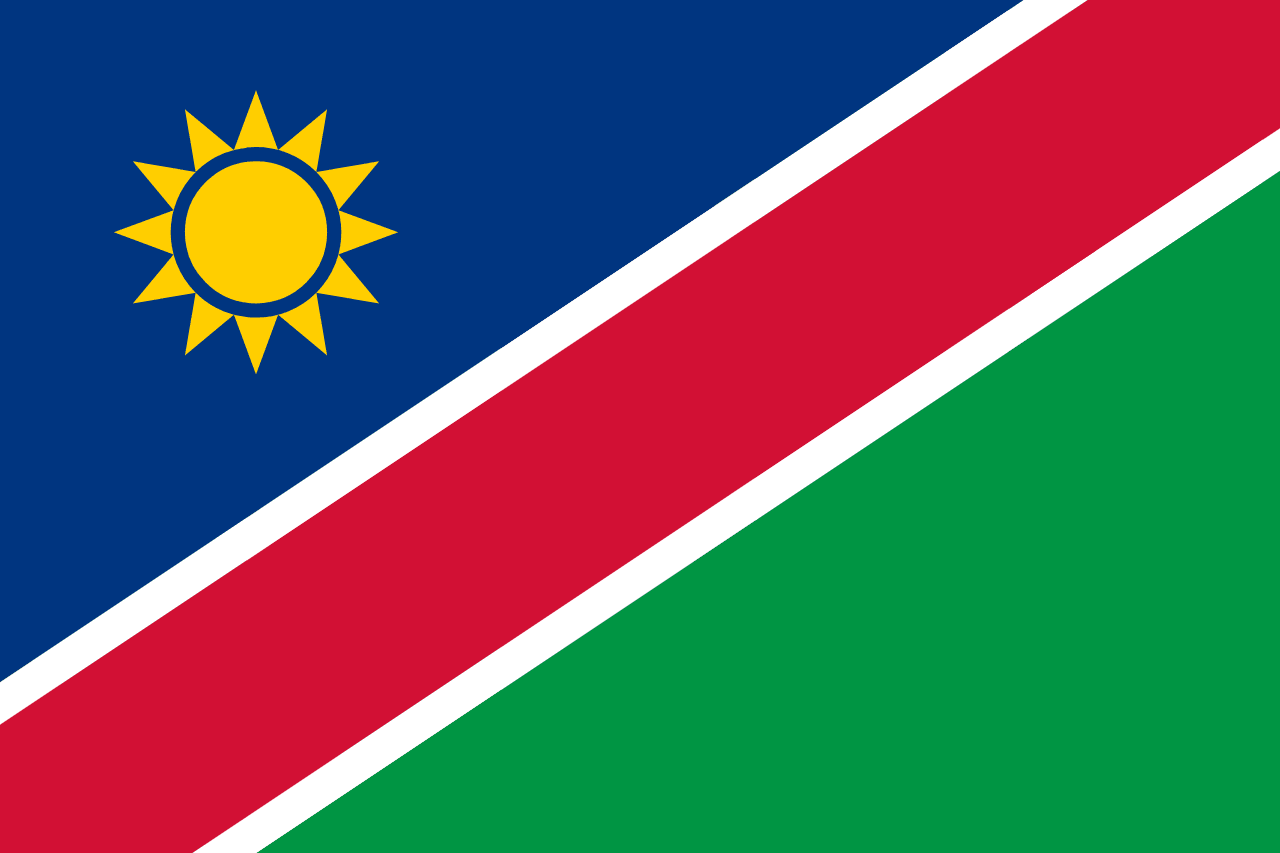
Namibia's striking national flag, adopted at independence on March 21, 1990, features a diagonal red band edged in white, with a blue triangle bearing a golden sun and a green triangle. The colors carry deep meaning: red for the people and their determination, blue for the sky and the Atlantic Ocean, green for vegetation and agriculture, white for peace and unity, and the golden sun for life and energy. The design beat out hundreds of submissions in a national competition. You can explore the full symbolism in our piece on the flag of Namibia and what each element represents.
Frequently Asked Questions
What is the capital of Namibia?
The capital of Namibia is Windhoek, located in the central highlands at about 1,700 meters above sea level. It is the country's largest city and its political, commercial, and cultural center, home to roughly 430,000 people.
What is Namibia famous for?
Namibia is famous for the towering red dunes of the Namib Desert and Sossusvlei, the shipwreck-strewn Skeleton Coast, abundant desert-adapted wildlife in Etosha National Park, and pioneering community-based conservation. It is also one of the least densely populated countries on Earth.
Why are there so few people in Namibia?
Much of Namibia is covered by harsh desert and arid plains that cannot support large populations or intensive farming. With only about three people per square kilometer, water scarcity and rugged terrain have kept settlement concentrated in the wetter north and around Windhoek.
Conclusion
From the oldest desert on the planet to a constitution that protects its wildlife, Namibia is a country of superlatives wrapped in silence and space. Its blend of German heritage, indigenous cultures, and breathtaking landscapes makes it one of Africa's most rewarding destinations to explore. These ten facts are only a starting point, and the more you discover, the more this vast, sun-drenched land reveals its quiet magic.