
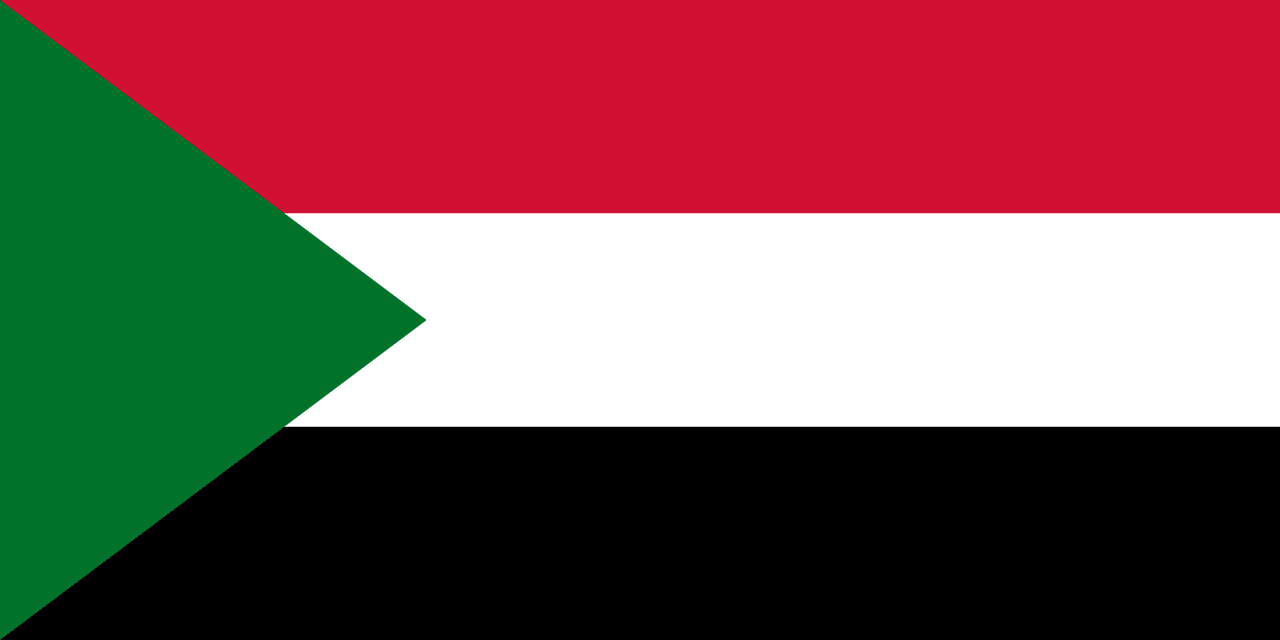
Sudan is a vast, sun-baked land where two great rivers meet, ancient pyramids outnumber those of Egypt, and the Sahara gives way to the lush banks of the Nile. Once Africa's largest country, it remains a place of staggering historical depth and cultural complexity. These ten facts reveal a nation far richer and more surprising than headlines suggest.
1. The Blue and White Nile Marry in Its Capital
Khartoum, Sudan's capital, sits at one of the most geographically dramatic locations on Earth: the confluence of the Blue Nile and the White Nile. The Blue Nile arrives carrying silt-laden waters from the Ethiopian Highlands, while the slower White Nile flows up from the lakes of East Africa. Where they meet, the two streams briefly run side by side in distinct colors before merging into the single Nile that flows north through Egypt to the Mediterranean. Sudanese poetically call this meeting point "al-Mogran," the confluence. The greater Khartoum area is actually a tri-city, joining Khartoum, Khartoum North (Bahri), and Omdurman across the converging waters.
2. Sudan Has More Pyramids Than Egypt
It surprises many travelers to learn that Sudan contains roughly twice as many pyramids as its famous northern neighbor. The pyramids of Meroe, built by the kings and queens of the Kingdom of Kush, number in the hundreds, clustered in the desert near the Nile. They are steeper and narrower than Egypt's pyramids, rising sharply from sandy plains often empty of tourists. These were royal tombs for the Nubian rulers who governed a powerful civilization for over a thousand years. To learn more about the country's geography and heritage, see our country guide.
3. The Kingdom of Kush Once Ruled Egypt
Long before colonial mapmakers drew Sudan's borders, the Nubian Kingdom of Kush flourished along the Nile. At the height of its power in the 8th century BCE, Kushite kings conquered Egypt and ruled it as the 25th Dynasty, the so-called "Black Pharaohs." Their capital later moved to Meroe, which became a celebrated center of ironworking and trade, exchanging goods with the Roman world and beyond. Kushite civilization developed its own script, Meroitic, which remains only partially deciphered today. This deep antiquity makes the region one of the cradles of African civilization, predating most of the world's recorded history.
4. It Was Africa's Largest Country Until 2011
For decades Sudan held the title of the largest country in Africa by area. That changed in July 2011, when South Sudan voted overwhelmingly for independence following a long and devastating civil war. The split reshaped the map: Sudan lost about a quarter of its territory and the majority of its oil reserves, while Algeria became Africa's new largest nation. Today Sudan still ranks among the continent's biggest countries, stretching from the Sahara in the north to savanna grasslands in the south, and bordering seven nations plus the Red Sea.
5. A Crossroads of Arab and African Identity
Sudan sits at the meeting point of the Arab and African worlds, and its people reflect that blend. The population of roughly 45 to 48 million spans hundreds of ethnic groups speaking dozens of languages. Arabic is the most widely spoken tongue and, alongside English, holds official status. Many Sudanese also speak Nubian languages, Beja, Fur, and other indigenous tongues. This diversity is a defining feature of national life, woven into music, dress, and dialect. The country's identity has long been shaped by the tension and exchange between its Arabized northern heartland and its African periphery.
6. The Nubian Desert Is Among the Driest on Earth
Northern Sudan is dominated by the Nubian Desert, an eastern wing of the Sahara that ranks among the most arid landscapes on the planet. Some parts may go years without measurable rainfall, and the terrain is a sweep of sand seas, rocky plateaus, and dramatic wind-carved formations. Yet life persists along the thin green ribbon of the Nile, where date palms and irrigated farms cling to the riverbanks. This stark contrast, between lifeless desert and fertile river valley, has shaped Sudanese settlement patterns for thousands of years, concentrating communities along the water.
7. Tea and Coffee Are Social Rituals
Hospitality runs deep in Sudanese culture, and few customs express it better than the serving of tea and coffee. Sweet, spiced tea (shai) is offered constantly throughout the day, often brewed with cardamom or cinnamon. Sudanese coffee, known as jabana, is prepared in a distinctive clay pot, roasted fresh, ground with spices like ginger and cloves, and poured through a sieve into small cups. Street-corner tea ladies, who set up charcoal stoves and low stools on city pavements, are a beloved fixture of daily life and an informal social institution where people gather to talk.
8. Ful Medames Fuels the Nation
The unofficial national dish of Sudan is ful medames, a hearty stew of slow-cooked fava beans mashed with oil, often topped with cheese, egg, onions, and a drizzle of sesame. Eaten communally from a shared bowl and scooped up with bread, it is the classic Sudanese breakfast and a source of national pride. Other staples include kisra, a thin fermented sorghum flatbread, and asida, a soft porridge served with rich stews. Sudanese cuisine reflects the country's agriculture, leaning heavily on sorghum, millet, peanuts, and sesame, of which Sudan is one of the world's leading producers.
9. Gum Arabic and the Sahel's Acacia Trees
Sudan is the world's dominant producer of gum arabic, a natural resin tapped from acacia trees that grow across its central belt. This unassuming substance is a hidden ingredient in countless products worldwide, used as a stabilizer and emulsifier in soft drinks, candies, medicines, and printing inks. The "gum belt" supports the livelihoods of millions of rural Sudanese who harvest the resin by hand during the dry season. Because the trees thrive in semi-arid conditions, gum arabic cultivation also helps hold back desertification, making it both an economic lifeline and an environmental safeguard.
10. The Red Sea Coast Hides World-Class Reefs
Sudan's eastern edge meets the Red Sea, a coastline far less developed than those of its neighbors but treasured by serious divers. The reefs here are pristine, vivid with coral and patrolled by sharks, manta rays, and turtles. The famed undersea explorer Jacques Cousteau conducted experiments here in the 1960s, building the underwater habitat Conshelf II near Port Sudan to test whether humans could live beneath the sea. Today Port Sudan remains the country's main seaport and gateway to trade. The combination of empty reefs and historic exploration makes this stretch of coast a quiet legend among underwater adventurers.
Frequently Asked Questions
What is the capital of Sudan?
The capital of Sudan is Khartoum, located at the meeting point of the Blue Nile and White Nile. Together with Omdurman and Khartoum North, it forms a large metropolitan area that serves as the country's political and economic center.
What is Sudan famous for?
Sudan is famous for having more ancient pyramids than Egypt, thanks to the Nubian Kingdom of Kush and the royal tombs at Meroe. It is also known as the meeting place of the Blue and White Nile, as the world's leading source of gum arabic, and for warm traditions of hospitality. You can also explore the symbolism of its national flag.
Why does Sudan have so many pyramids?
The pyramids were built as royal tombs by the kings and queens of Kush, a Nubian civilization that thrived along the Nile for over a thousand years. Because Kushite rulers built pyramids over many generations, especially around their capital at Meroe, Sudan ended up with hundreds of them, far more than Egypt.
Conclusion
Sudan is a country of remarkable contrasts, where desert meets river, ancient kingdoms left towering monuments, and a mosaic of peoples carries forward traditions thousands of years old. From the steep pyramids of Meroe to the bustling tea stalls of Khartoum, it rewards anyone curious enough to look beyond the surface. These ten facts are only an invitation to keep exploring one of Africa's most historically rich and underappreciated nations.