
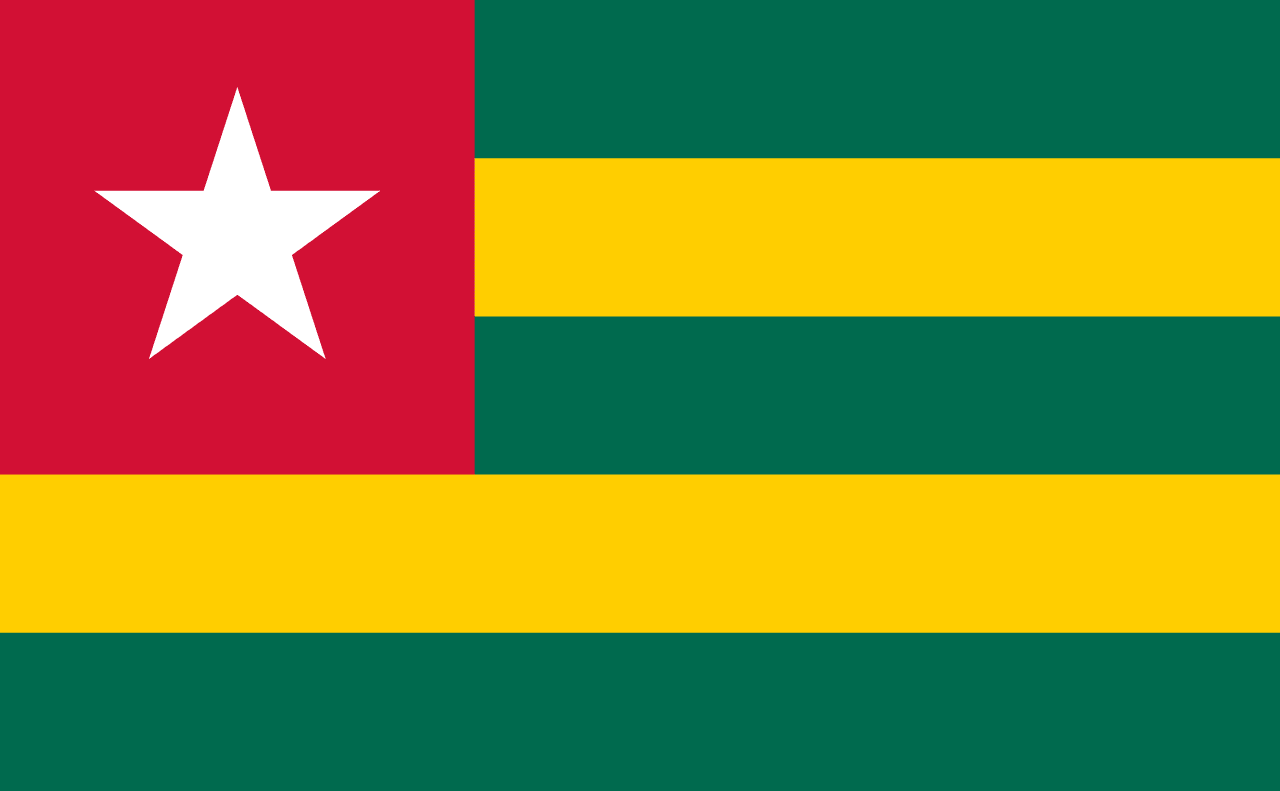
Squeezed into a sliver of West African coastline barely 70 kilometres wide at the sea, Togo is one of Africa's narrowest nations and one of its most overlooked. Yet within this skinny ribbon of land you'll find voodoo markets stocked with monkey skulls, a former German colonial capital wrapped around a palm-fringed lagoon, and rolling mountains where coffee and cocoa grow. Here are ten genuinely fascinating facts about Togo.
1. It's a Long, Skinny Sliver of a Country
Togo stretches roughly 600 kilometres from north to south but is only about 110 kilometres across at its widest, narrowing to a slender 56-kilometre Atlantic coastline in the south. This unusual ribbon shape is a relic of the colonial scramble for Africa, when European powers carved up the continent with rulers rather than respect for geography or ethnic boundaries. The result is a nation that packs an astonishing range of landscapes into a tight vertical strip: coastal lagoons and palm beaches in the south, a forested central plateau, the Atakora mountain range running diagonally through the middle, and dry savanna in the far north. Few countries let you travel through so many climate zones in a single day's drive.
2. Lomé Is a Capital Right on the Border
The capital, Lomé, sits in the extreme southwest corner of the country, practically touching the frontier with Ghana. Its position is so close to the border that you can stroll from Togolese streets to Ghanaian ones in minutes. Lomé grew up around a deep-water port and is now one of West Africa's busiest harbours, serving as a vital gateway for landlocked neighbours like Burkina Faso, Niger, and Mali. The city is famous for its sprawling Grand Marché, its breezy palm-lined boulevards, and a relaxed coastal atmosphere. Lomé also hosts the headquarters of several regional institutions, punching well above the weight you'd expect from a city in such a small nation. You can read more in our country guide.
3. Around 9 Million People in a Tiny Space
Togo is home to roughly 9 to 10 million people, and despite its modest size it is densely populated by regional standards. The population is youthful, with a median age well under 20, meaning the country is overwhelmingly made up of children and young adults. Most Togolese live in the southern half of the country, drawn to the fertile coastal plain, the capital, and the trading towns strung along the main north-south highway. Rural life still dominates much of the interior, where farming families grow the maize, yams, and cassava that feed the nation. This dense, young, and largely agricultural population gives Togo a vibrant, energetic character.
4. French Is Official, but Ewe and Kabye Rule Daily Life
French is Togo's official language, a legacy of the period when France administered the territory after World War I. But on the streets and in the markets, indigenous languages carry the day. Ewe dominates in the south, while Kabye (also spelled Kabiye) is widely spoken in the north, and both have been promoted as national languages. Across the country you'll hear dozens of other tongues reflecting Togo's many ethnic groups. A coastal pidgin and a smattering of English near the Ghana border add to the mix. This linguistic layering means many Togolese are comfortably multilingual, switching effortlessly between a local mother tongue, a regional lingua franca, and French.
5. It Was Once Germany's "Model Colony"
Before it was French, Togo was German. From 1884 to 1914 the territory was the colony of Togoland, and German administrators trumpeted it as their Musterkolonie, or "model colony," because it was one of the few that turned a profit without subsidies. The Germans built railways, roads, and the port infrastructure that still underpins Lomé's economy today. After Germany's defeat in World War I, the colony was split between Britain and France, with the British portion eventually joining Ghana and the French portion becoming modern Togo. This tangled colonial inheritance explains why Togo's flag, place names, and institutions carry traces of three different European powers.
6. The Birthplace of Voodoo
Togo, along with neighbouring Benin, lies at the heart of the historic homeland of Vodun, the religion known in the West as voodoo. Far from the Hollywood caricature of pins and zombies, Vodun is a sophisticated spiritual tradition centred on ancestor veneration, nature spirits, and a supreme creator deity. A large share of Togolese practise traditional African religions, often alongside Christianity or Islam. The most striking expression of this is the Akodessewa Fetish Market in Lomé, billed as the largest voodoo market in the world, where healers sell dried animal parts, skulls, herbs, and talismans believed to cure ailments and ward off misfortune. It is one of the most extraordinary markets anywhere on Earth.
7. Phosphates, Coffee, and Cocoa Drive the Economy
Togo's economy rests on agriculture and mining. The country is a significant producer of phosphate, used to make fertiliser, and these deposits have long been a key export earner. The fertile southern and central regions yield coffee, cocoa, and cotton for export, while subsistence farming of yams, maize, sorghum, and cassava feeds the population. The port of Lomé is another economic engine, generating revenue by handling cargo bound for the landlocked Sahel. In recent years Togo has worked to position itself as a regional logistics and financial hub. Even so, it remains one of the world's lower-income nations, with most people depending on farming and informal trade.
8. Mount Agou and the Cascading Kpalimé Hills
The highest point in Togo is Mount Agou, rising to about 986 metres in the lush southwestern highlands near the town of Kpalimé. This green, misty region is the country's most scenic, dotted with waterfalls, coffee and cocoa plantations, butterfly-filled forests, and hillside villages famous for their woodcarvers and batik artists. To the north, the Atakora mountains continue into the Fazao-Malfakassa and Kéran national parks, which shelter antelopes, buffalo, and elephants. While Togo's wildlife populations have been thinned by hunting and habitat loss, these protected areas remain important refuges and a draw for the small but growing number of nature-minded travellers.
9. A Football-Mad Nation Led by a Legend
Like much of West Africa, Togo is passionate about football. The national team, nicknamed the Sparrowhawks (Les Éperviers), reached the FIFA World Cup for the first and only time in 2006 in Germany. The country's greatest sporting icon is Emmanuel Adebayor, the towering striker who starred for clubs including Arsenal, Manchester City, Real Madrid, and Tottenham, and who was named African Footballer of the Year in 2008. Adebayor became a national hero and one of the most recognisable Togolese figures on the world stage. Football pitches, both formal and improvised, are everywhere, and matches involving the Sparrowhawks bring the whole country to a standstill.
10. Fufu, Fish, and Fiery Sauces
Togolese cuisine is hearty, communal, and built around starchy staples paired with rich sauces. A national favourite is pâte (also called akume), a smooth dough made from maize or cassava flour, eaten by hand and dipped into spicy stews. Fufu, pounded from yam or plantain, is another beloved staple. Coastal life means fresh fish and seafood feature heavily, often grilled or simmered in tomato and chilli sauces, while groundnut (peanut) sauces add a creamy depth to many dishes. Palm wine and locally brewed millet beer accompany social gatherings. Meals are typically shared, reflecting the deep communal spirit that runs through Togolese culture.
Frequently Asked Questions
What is the capital of Togo?
The capital is Lomé, located in the far southwest of the country right on the Atlantic coast and almost touching the border with Ghana. It is Togo's largest city, its main port, and the centre of government, trade, and cultural life.
What is Togo famous for?
Togo is best known as a heartland of the Vodun (voodoo) religion, home to Lomé's famous Akodessewa Fetish Market. It is also recognised for its phosphate mining, its long thin shape, its colonial history under Germany then France, and football star Emmanuel Adebayor. You can also explore the symbolism of its national flag.
Why is Togo so narrow?
Togo's slender shape is a direct result of colonial border-drawing. European powers carved up West Africa with little regard for geography or local communities, and Togo ended up as a narrow strip stretching from the coast deep into the interior, just 56 kilometres wide where it meets the sea.
Conclusion
Togo may be small and frequently overlooked, but it rewards anyone willing to look closer. From the bustling port of Lomé to the misty heights of Mount Agou, from the world's largest voodoo market to the roar of the Sparrowhawks, this narrow West African nation packs remarkable diversity into a tiny footprint. These ten facts only begin to capture a country whose history, landscapes, and culture run far deeper than its modest size suggests.