
Imagine a country so low-lying that its highest natural point is barely the height of a basketball hoop, so small you could drive across its capital atoll in minutes, and so remote that for years it had no regular flights at all. That is Tuvalu, a scattering of nine coral specks in the central Pacific that ranks among the tiniest and most fascinating nations on Earth. Here are ten facts that reveal why this little ocean republic captures the imagination far beyond its size.
1. It Is the Fourth Smallest Country on Earth
Tuvalu covers just about 26 square kilometers of land, making it the fourth smallest sovereign nation in the world, ahead of only Vatican City, Monaco, and Nauru. Its nine islands are spread across roughly 700 kilometers of open ocean, yet the total dry land would fit comfortably inside a mid-sized city. The name Tuvalu means "eight standing together" in the local language, a reference to the eight traditionally inhabited islands (the ninth, Niulakita, was historically uninhabited). Despite this minuscule footprint, the country controls a vast exclusive economic zone of around 750,000 square kilometers of sea, a striking ratio of water to land that defines almost everything about Tuvaluan life. To learn more, see our country guide.
2. Its Highest Point Is Only About 4.5 Meters
Tuvalu is famously one of the flattest countries on the planet. There are no mountains, no hills, and no rivers; the islands are coral atolls and reef islets sitting just above sea level. The highest natural elevation is only around 4.5 meters, and most of the land sits well below that. This makes Tuvalu acutely vulnerable to rising seas, king tides, and storm surges, and the nation has become a global symbol in climate discussions. During especially high tides, seawater can bubble up through the porous coral ground in the middle of the islands, flooding gardens and roads from below rather than from the shoreline.
3. The Capital Sits on a Thin, Curving Atoll
The capital, Funafuti, is not a single city but a coral atoll made up of many islets ringing a large turquoise lagoon. The main islet, Fongafale, is where most government buildings, the hospital, and the international airport are located, and in places it is only a few hundred meters wide, with the ocean on one side and the lagoon on the other. The airport runway doubles as the island's biggest open space; when no planes are scheduled, children play football and families gather there in the cool of the evening. Roughly half of Tuvalu's entire population lives on this one slender strip of land.
4. Fewer Than 12,000 People Call It Home
With a population of around 11,000, Tuvalu is among the least populated countries in the world. The society is tightly knit and overwhelmingly Polynesian, with extended family and island community (the kaupule and falekaupule, or traditional assembly) playing central roles in daily decisions. Land is held communally and passed down through families, and consensus-based meetings still guide much of village life. Because the population is so small, many Tuvaluans know one another or are related, and a large diaspora lives in New Zealand, Fiji, and Australia, sending support back home and keeping cultural ties alive across the Pacific.
5. The Language Belongs to the Polynesian Family
The Tuvaluan language is a Polynesian tongue closely related to Samoan, and it remains the everyday language of homes, churches, and island gatherings. English is also an official language and is used in government and education, a legacy of the British colonial era. Tuvaluan is rich in terms tied to the sea, fishing, navigation, and weather, reflecting a culture shaped entirely by the ocean. Distinct dialects exist between the northern and southern islands, and on the island of Nui, the local speech shows strong Gilbertese (Kiribati) influence, a reminder of the historic ties and movements between island groups.
6. It Was Once Joined to Kiribati as the Ellice Islands
For much of the colonial period, Tuvalu was known as the Ellice Islands and was administered together with the Gilbert Islands (today's Kiribati) as a single British colony. The two groups, however, were culturally distinct, the Ellice being Polynesian and the Gilberts Micronesian. In 1974 the Ellice Islanders voted overwhelmingly in a referendum to separate, and in 1978 Tuvalu became a fully independent nation within the Commonwealth. This peaceful, democratic split is relatively rare in colonial history and is a point of quiet pride. Tuvalu retains the British monarch as head of state, represented locally by a governor-general.
7. Its Internet Domain Earns Real Money
In one of the most surprising twists of the digital age, Tuvalu was assigned the internet country-code domain ".tv." Because those two letters are instantly associated with television and video, the domain has become commercially valuable, leased to media companies, streamers, and broadcasters around the world. The licensing revenue has at times made up a significant share of government income, helping fund schools, scholarships, and infrastructure. For a country with almost no land-based exports, this clever monetization of a quirk of internet administration has been a genuine lifeline and a frequently cited example of small-nation ingenuity.
8. The Cuisine Revolves Around Sea and Coconut
Tuvaluan food is built around what the ocean and the coral land can provide: fresh fish, shellfish, coconut in every form, breadfruit, bananas, and the starchy swamp taro known as pulaka, grown in carefully dug pits. Coconut cream enriches many dishes, and fish is eaten grilled, raw, or simmered. A traditional treat is fekei, a sweet pudding made from grated root crops and coconut. Imported rice and tinned foods have become common because little can be farmed on the thin, salty soil. Communal feasting tied to church events and celebrations remains a cornerstone of social life, with food shared generously across the community.
9. Music, Dance, and the Fatele Define Celebrations
At the heart of Tuvaluan culture is the fatele, a high-energy traditional dance performed at festivals, weddings, and important events. Singers and a chorus build up rhythm by striking a wooden box or mat while dancers move in synchronized rows, the tempo accelerating until it reaches a joyful climax. The songs often celebrate community achievements, history, or friendly rivalry between islands. Christianity, brought by missionaries in the 19th century, blends with these older traditions; the church and its choirs are central to community life. Handicrafts such as woven fans, mats, and shell jewelry showcase skilled artistry passed down through generations of islanders.
10. It Has a Conservation Area and a National Flag Full of Stars
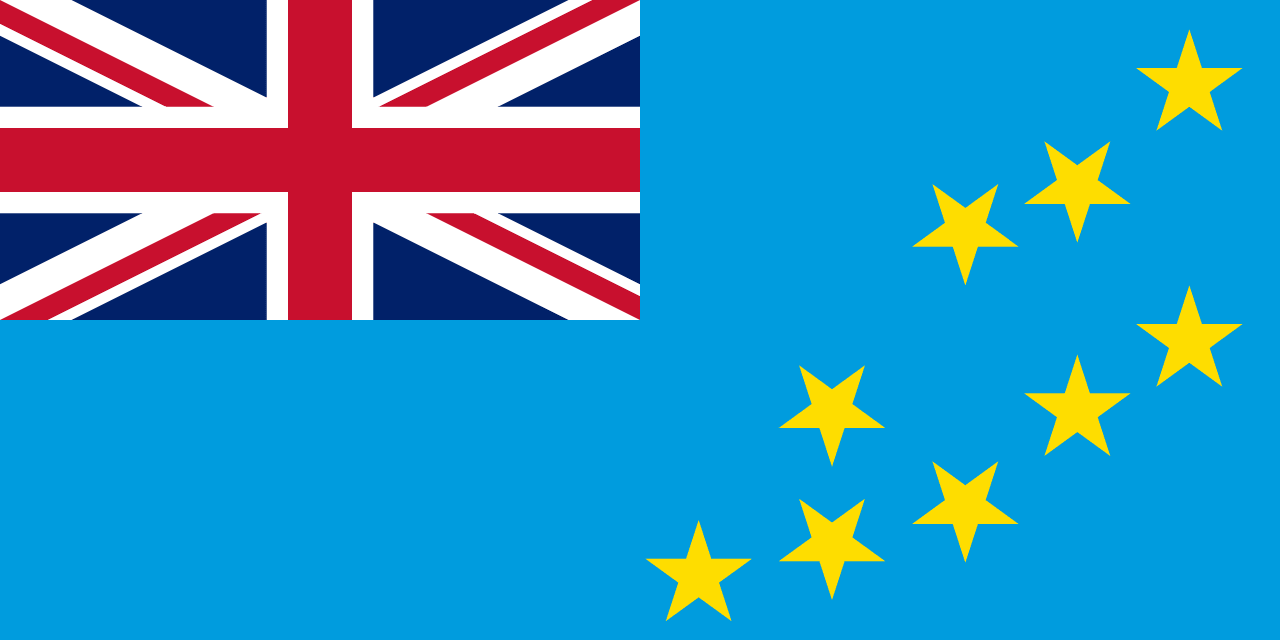
The Funafuti Conservation Area protects a stretch of lagoon, reef, and uninhabited islets, sheltering sea turtles, seabirds, and vibrant coral teeming with tropical fish. It is a haven for nesting green turtles and a popular spot for snorkeling among the country's few visitors. Tuvalu's flag is itself a small geography lesson: on a light blue field sit nine yellow stars arranged to mirror the actual layout of the islands in the ocean. Few national flags double as a literal map of the country, making Tuvalu's banner one of the most distinctive and meaningful in the world.
Frequently Asked Questions
What is the capital of Tuvalu?
The capital of Tuvalu is Funafuti, a coral atoll rather than a conventional city. Most government offices, the main hospital, and the international airport sit on the narrow main islet of Fongafale, which wraps around a large lagoon and is home to roughly half the country's population.
What is Tuvalu famous for?
Tuvalu is famous for being one of the world's smallest and lowest-lying nations, for its leading role in global climate-change conversations, and for its valuable ".tv" internet domain. It is also known for pristine lagoons, Polynesian culture, and a flag whose nine stars map out its islands.
Can you really not find a mountain anywhere in Tuvalu?
Correct. Tuvalu has no mountains or hills at all. The entire country is made of flat coral atolls and reef islets, with the highest natural point only about 4.5 meters above sea level, which is why the ocean is visible from almost everywhere on the islands.
Conclusion
Tuvalu proves that significance has nothing to do with size. From its star-spangled flag and clever internet domain to its Polynesian dances, taro pits, and the ever-present horizon of the Pacific, this tiny atoll nation offers a wealth of stories. Vulnerable yet resilient, remote yet globally connected, Tuvalu is a reminder of how much wonder can be packed into a few square kilometers of coral and sea.
