
Tucked between the towering giants of Brazil and Argentina, Uruguay is the kind of country that quietly outperforms expectations. It is South America's second-smallest nation, yet it consistently ranks among the continent's most stable, progressive, and surprising places. From a coastline obsessed with grilled beef to a president who once gave away most of his salary, here are ten facts that reveal why Uruguay punches far above its weight.
1. It Is South America's Second-Smallest Country
At roughly 176,000 square kilometers, Uruguay is the second-smallest sovereign nation in South America, surpassing only Suriname. Wedged between Brazil to the north and Argentina across the Río de la Plata to the west, it can feel like a footnote on the map. Yet its modest size is part of its charm. The terrain is famously gentle: rolling grassy plains known as the cuchillas dominate the interior, with no mountain rising much above 500 meters. This rich, well-watered pastureland is ideal for cattle ranching, which has shaped the country's economy and identity for centuries. To learn more, explore our full country guide.
2. Nearly Half the Population Lives in One City
Uruguay is home to around 3.4 million people, and an astonishing share of them, roughly 1.3 million in the greater metropolitan area, live in the capital, Montevideo. This makes Uruguay one of the most centralized countries in the world by population. Montevideo sits on the northern bank of the Río de la Plata and functions as the political, cultural, and economic heart of the nation. Its long waterfront promenade, the Rambla, stretches for more than 22 kilometers and is a beloved gathering place where locals stroll, jog, and sip mate at sunset.
3. Uruguayans Are the World's Biggest Mate Drinkers
If there is one image that captures everyday Uruguayan life, it is a person walking down the street with a thermos tucked under one arm and a gourd of mate in the other hand. This caffeine-rich herbal infusion, made from dried yerba mate leaves and sipped through a metal straw called a bombilla, is a national obsession. Uruguay consumes more yerba mate per capita than any other country on Earth, well over the neighboring giants of Argentina and Paraguay. Sharing mate from the same gourd is a daily ritual of friendship and hospitality, and the thermos-under-the-arm pose is practically a national emblem.
4. It Was a Pioneer in Progressive Social Reform
Uruguay has long been one of the most socially progressive nations in Latin America, a reputation rooted in the early 20th century under President José Batlle y Ordóñez. He championed the eight-hour workday, free public education, and a strong separation of church and state, decades ahead of many wealthier countries. That tradition continues today: Uruguay legalized same-sex marriage and abortion in the early 2010s, and in 2013 it became the first country in the world to fully legalize and regulate the production and sale of cannabis. These reforms earned it a global reputation as a laboratory for bold, pragmatic policy.
5. José "Pepe" Mujica Was Called the World's Humblest President
From 2010 to 2015, Uruguay was led by José Mujica, a former guerrilla fighter who became one of the most admired figures in modern politics. Rather than living in the presidential palace, Mujica stayed on his modest flower farm outside Montevideo, drove an old Volkswagen Beetle, and donated around 90 percent of his salary to charity and social programs. His unpretentious lifestyle and philosophical speeches about consumerism and happiness made him an international icon. He embodied a distinctly Uruguayan blend of egalitarian values and quiet self-confidence that resonates far beyond the country's borders.
6. Beef and the Asado Are National Treasures
Uruguay has one of the highest per-capita beef consumption rates on the planet, and food culture revolves around the asado, a slow barbecue cooked over wood embers. The parrilla, or grill, is a fixture in homes and restaurants alike, and weekend asados are a cherished social institution. Beyond grilled meat, Uruguayans love the chivito, a hearty steak sandwich piled with ham, cheese, egg, lettuce, and tomato that is widely considered the national dish. Wash it down with a glass of Tannat, the robust red wine grape that has become Uruguay's signature export to the world's wine lists.
7. It Hosted and Won the First-Ever World Cup
For a small nation, Uruguay has an outsized football legacy. In 1930 it hosted the very first FIFA World Cup, building the Estadio Centenario in Montevideo for the occasion, and went on to win the tournament on home soil. Two decades later came the Maracanazo of 1950, when Uruguay stunned host Brazil in front of a colossal crowd at the Maracanã to claim a second world title. With just a few million people, the country has produced football heroes for generations. The four stars on the national team's crest proudly commemorate those triumphs.
8. Punta del Este Is South America's Glamorous Riviera
Along the Atlantic coast lies Punta del Este, a glittering resort town often compared to Monaco or Saint-Tropez. Its peninsula bristles with high-rise apartments, marinas, and beaches that draw the wealthy from across the region every summer. The town's most photographed landmark is La Mano, a giant sculpture of fingers emerging from the sand at Playa Brava. Nearby, the bohemian village of José Ignacio and the windswept fishing town of Cabo Polonio offer a quieter, off-grid alternative, where sea lions outnumber streetlights and electricity is scarce by design.
9. It Runs on Almost Entirely Renewable Electricity
Uruguay has quietly become a global leader in clean energy. Through heavy investment in wind, solar, hydroelectric, and biomass power, the country now generates the vast majority of its electricity, often well over 90 percent in a given year, from renewable sources. This rapid transformation happened in barely a decade, without large fossil fuel subsidies, and is frequently cited as a model for other nations. The windmills dotting its open plains have become as much a part of the modern landscape as the cattle that graze beneath them, a fitting symbol of a country that blends tradition with forward thinking.
10. Its Sky-Blue Flag Tells the Story of Independence
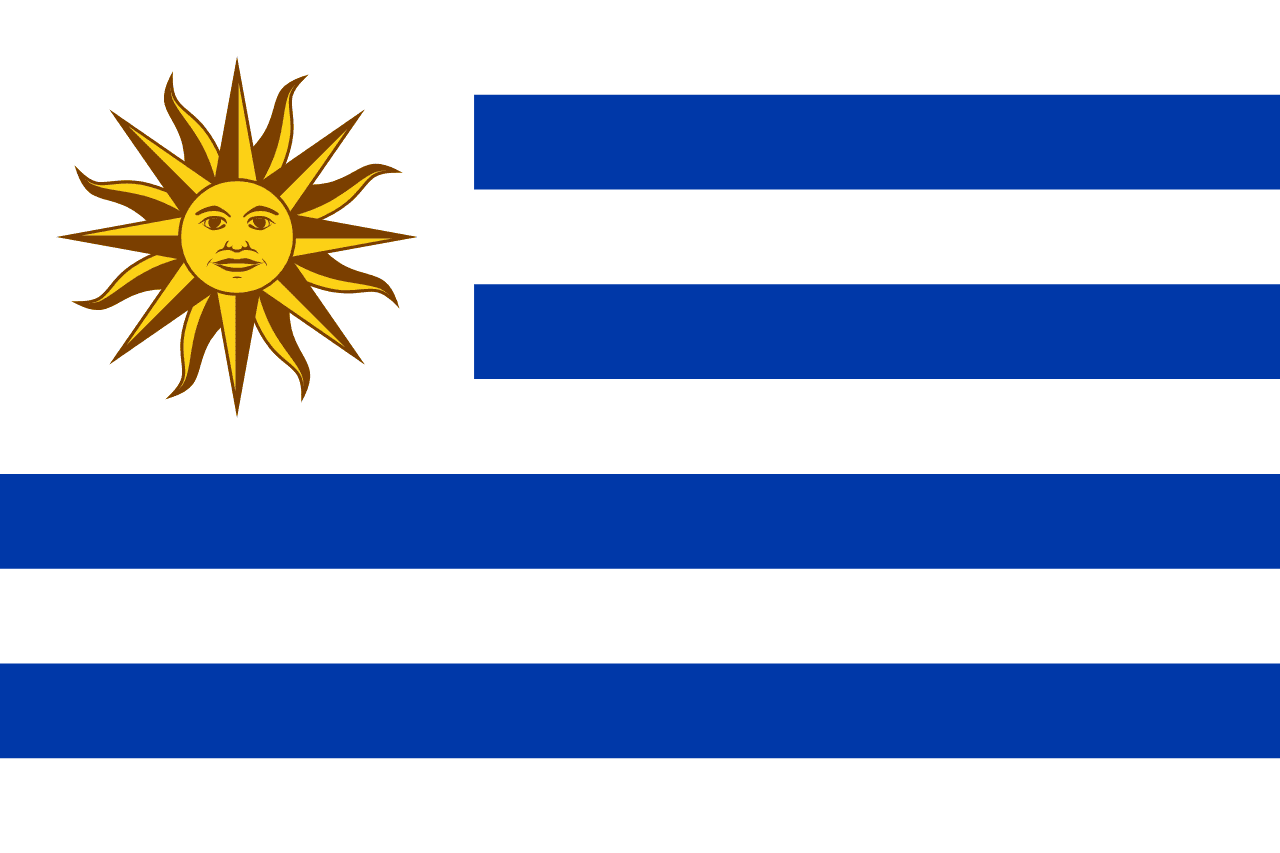
Uruguay's flag features nine horizontal stripes alternating white and sky blue, with a golden Sun of May in the upper corner. The nine stripes represent the country's original departments at independence, while the radiant sun is a symbol shared with Argentina, recalling the shared struggle against Spanish colonial rule in the early 1800s. The country's official name, the Oriental Republic of Uruguay, refers to its position on the eastern bank of the Uruguay River. You can dive deeper into the symbolism in our article on the Uruguayan flag.
Frequently Asked Questions
What is the capital of Uruguay?
The capital of Uruguay is Montevideo, located on the northern shore of the Río de la Plata. It is by far the largest city in the country, home to roughly a third to a half of the entire national population, and serves as the seat of government as well as the cultural and economic center.
What is Uruguay famous for?
Uruguay is famous for its passion for football, including winning the first World Cup in 1930, its beef-centric asado culture, the near-universal habit of drinking mate, glamorous beach resorts like Punta del Este, and its reputation as one of South America's most stable, progressive, and clean-energy-focused nations.
Why is Uruguay considered so progressive?
Uruguay has a long history of social reform dating back to the early 1900s, including early adoption of the eight-hour workday and secular public education. In recent years it legalized same-sex marriage and abortion and, in 2013, became the first country in the world to fully legalize and regulate recreational cannabis.
Conclusion
Uruguay proves that small countries can have enormous personalities. Whether it is leading the world on renewable energy and social policy, sharing a gourd of mate with a stranger, or roaring through a World Cup against far larger rivals, this quiet South American nation rewards anyone willing to look closer. These ten facts are only an invitation, and the best way to understand Uruguay is to keep exploring its grasslands, coastlines, and remarkable history.