
Uzbekistan sits squarely at the crossroads of the ancient Silk Road, a land of turquoise-domed mosques, sun-baked deserts, and snow-capped mountains where caravans once carried silk, spices, and ideas between China and Europe. With around 37.7 million people, it is the most populous country in Central Asia and one of the few in the world built around cities older than almost any others still standing. Here are ten facts that capture why this remarkable nation deserves a place on every traveler's map.
1. One of Only Two Doubly Landlocked Countries on Earth
Uzbekistan holds a rare geographic distinction: it is one of just two doubly landlocked countries in the world, meaning every one of its neighbors is also landlocked. To reach an ocean from Uzbekistan, you would have to cross at least two international borders. The only other country with this trait is tiny Liechtenstein in Europe. Uzbekistan shares frontiers with five nations: Kazakhstan, Kyrgyzstan, Tajikistan, Turkmenistan, and Afghanistan. This deeply interior position shaped its destiny, turning it into a hub of overland trade rather than maritime commerce, and helping its desert oases flourish as caravan towns.
2. Samarkand and Bukhara Are Living Open-Air Museums
Few countries pack as much architectural splendor into so little space. Samarkand, once the dazzling capital of conqueror Timur (Tamerlane), is home to the Registan, a plaza framed by three towering madrasahs covered in intricate blue tilework that ranks among the most beautiful sights in the Islamic world. A short journey away, Bukhara preserves a medieval core of more than 140 protected monuments, ancient bathhouses, and trading domes. Both cities are UNESCO World Heritage Sites, alongside Khiva's walled inner town of Itchan Kala. Walking their streets feels like stepping directly into the pages of a Silk Road epic.
3. The Aral Sea Disaster Is One of History's Worst Environmental Tragedies
Once the world's fourth-largest lake, the Aral Sea on Uzbekistan's northwestern border has shrunk to a fraction of its former size. Soviet-era irrigation diverted the rivers that fed it to grow cotton, and within a few decades the water all but vanished. Rusting fishing boats now sit stranded on a dry, salty seabed nicknamed the Aralkum Desert, where toxic dust storms blow across the region.
The collapse devastated local fishing towns like Moynaq, which once thrived on the shore and now lie miles from any water. Today the area stands as a sobering reminder of how human decisions can reshape an entire landscape.
4. Tashkent Has One of the Most Beautiful Subway Systems in the World
The capital, Tashkent, is Central Asia's largest city and home to roughly two and a half million people. After a devastating earthquake leveled much of it in 1966, the city was rebuilt on a grand scale. Its crowning achievement is the Tashkent Metro, opened in 1977 and the first subway in Central Asia. Each station was designed as a unique work of art, with marble columns, sparkling chandeliers, mosaics, and themes ranging from cosmonauts to poetry. For decades photography was banned because the stations doubled as nuclear shelters, but today visitors are free to admire these subterranean palaces.
5. The Uzbek Language Switched Alphabets Multiple Times
Uzbek, a Turkic language closely related to Uyghur, is the country's official tongue and is spoken by the vast majority of the population. Its written form has undergone a remarkable journey. For centuries Uzbek was written in the Arabic script, but in the 1920s Soviet authorities switched it to Latin, then to Cyrillic in 1940. After independence in 1991, the country began transitioning back to a Latin-based alphabet. Russian remains widely understood and is common in business and government. This linguistic layering reflects Uzbekistan's position at the meeting point of empires and cultures.
6. Plov Is the National Dish and a Source of Deep Pride
No food defines Uzbekistan like plov (also called osh), a rich rice dish cooked with carrots, onions, chunks of lamb or beef, and sometimes raisins, chickpeas, or quince in a heavy cauldron called a kazan. Each region has its own version, and master cooks known as oshpaz can prepare plov for hundreds of guests at weddings and celebrations.
The dish is so central to national identity that UNESCO added Uzbek plov to its list of intangible cultural heritage. In Tashkent, a famous "Plov Center" cooks enormous batches daily, and locals often gather to eat it for lunch. Bread, called non, is equally sacred and is never placed upside down.
7. It Was the Beating Heart of the Silk Road
For more than a thousand years, the territory of modern Uzbekistan was the central artery of the Silk Road, the trade network linking East Asia to the Mediterranean. Merchants, scholars, and pilgrims passed through its oasis cities, exchanging not just goods but mathematics, astronomy, and religion. The medieval city of Bukhara was a renowned center of Islamic learning. The great scholar Al-Khwarizmi, whose name gave us the word "algorithm," and the polymath physician Ibn Sina (Avicenna) both came from this region, leaving a legacy that shaped science across the world.
8. Uzbekistan Is One of the World's Top Cotton Producers
Cotton, often called "white gold," has dominated Uzbekistan's economy for generations and the country remains among the largest cotton producers and exporters globally. The crop was the centerpiece of Soviet agricultural planning, which is precisely what drained the Aral Sea. Beyond cotton, Uzbekistan is rich in natural gas, gold, and other minerals, holding some of the largest gold reserves on the planet. In recent years the government has worked to modernize the economy, diversify away from raw cotton exports, and develop tourism around its extraordinary historic cities. You can learn more in our country guide.
9. The Flag's Crescent and Stars Carry Layered Meaning
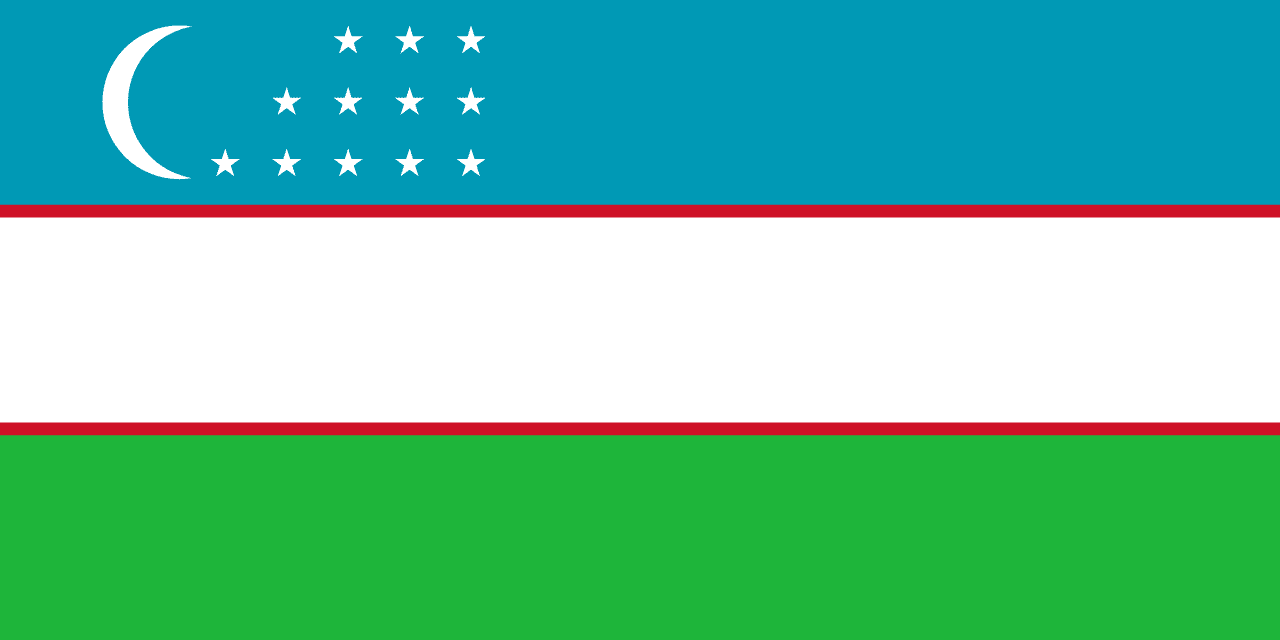
Adopted shortly after independence in 1991, the Uzbek flag features horizontal bands of blue, white, and green separated by thin red stripes, with a white crescent moon and twelve stars in the upper corner. The blue recalls the sky and water and echoes the banners of Timur, the white symbolizes peace and purity, and the green represents nature and fertility. The crescent signals the rebirth of an independent nation, while the twelve stars are linked to the months of the calendar and the signs of the zodiac. Explore the full design and symbolism in our guide to the flag of Uzbekistan.
10. Boasting Mountains, Deserts, and a Surprising Wildlife Mix
Despite being famous for the vast Kyzylkum Desert that covers much of its center, Uzbekistan is far from a flat wasteland. The eastern fringes rise into the foothills of the Tian Shan and Pamir-Alay mountain ranges, where ski resorts like Chimgan attract winter visitors near Tashkent. The country's varied terrain supports wildlife including gazelles, the elusive snow leopard in the high peaks, wild boar, and numerous bird species. Conservation programs now protect the rare Bukhara deer and the saiga antelope, while nature reserves work to preserve fragile habitats threatened by farming and the lingering effects of the Aral Sea's collapse.
Frequently Asked Questions
What is the capital of Uzbekistan?
The capital is Tashkent, the largest city in all of Central Asia with roughly 2.5 million residents. It serves as the nation's political, economic, and cultural center and is famous for its ornate, art-filled metro stations.
What is Uzbekistan most famous for?
Uzbekistan is best known for its spectacular Silk Road cities, especially Samarkand, Bukhara, and Khiva, with their blue-tiled mosques and madrasahs. It is also celebrated for plov, its cotton industry, and its role as a historic center of trade and learning.
Why is Uzbekistan called doubly landlocked?
A country is doubly landlocked when it is surrounded only by other landlocked countries, so you must cross at least two borders to reach the sea. Uzbekistan and Liechtenstein are the only two such nations in the world.
Conclusion
From the shimmering domes of Samarkand to the haunting silence of the dried-up Aral seabed, Uzbekistan is a country of dramatic contrasts and deep history. It rewards the curious traveler with ancient cities, hearty cuisine, and warm hospitality rooted in centuries of cultural exchange. These ten facts only begin to reveal a nation that was once the center of the known world and is now rediscovering its place on the global stage.