
Introduction
Tunisia 🇹🇳 and Libya 🇱🇾 share a long Mediterranean coastline and a desert interior, yet the two North African neighbors are far from mirror images. One is a compact country with a dense, coast-hugging population; the other is one of Africa's largest territories, most of it empty desert. This comparison sets them side by side across size, population, capitals, climate, and the features that define each.
Whether you are studying for a geography class, mapping out a trip, or just curious how the two stack up, the figures and tables below lay out the essentials.
Size & Geography
| Feature | Tunisia 🇹🇳 | Libya 🇱🇾 |
|---|---|---|
| Area | 163,610 km² | 1,759,540 km² |
| Continent | Africa | Africa |
| Region | North Africa | North Africa |
| Land Borders | Algeria, Libya | Tunisia, Algeria, Niger, Chad, Sudan, Egypt |
| Landscape | mountains in the north, hot central plain, Sahara in the south | mostly barren, flat to undulating plains and desert |
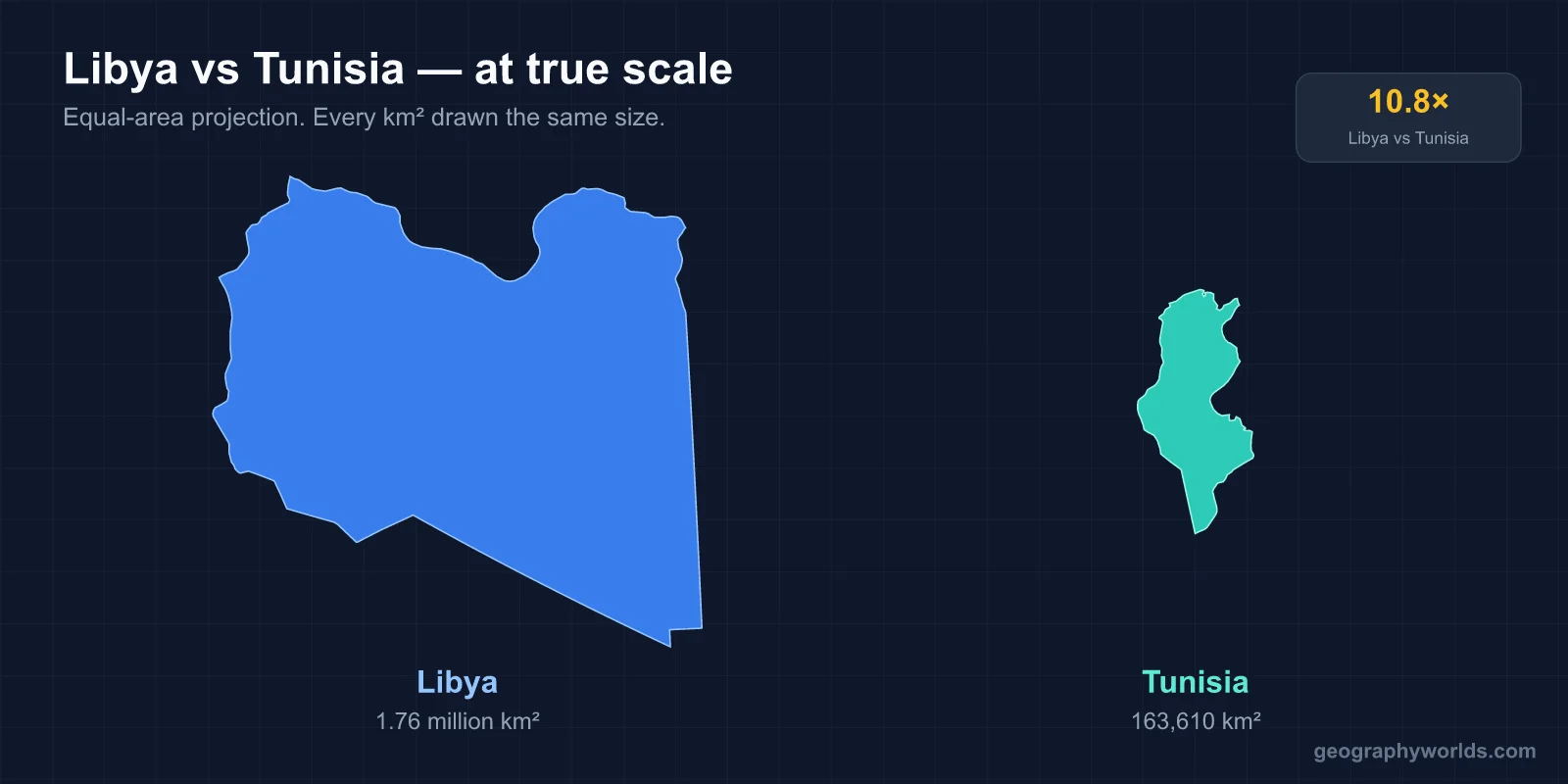
The size gap is the headline difference. At 1,759,540 km², Libya is roughly 10.8 times the area of Tunisia's 163,610 km² and stretches deep into the Sahara, which is why it shares land borders with six countries against Tunisia's two. Tunisia packs more variety into less space, grading from northern mountains to a hot central plain before the desert takes over, while Libya is overwhelmingly barren plains and dunes.
Population & Demographics
| Metric | Tunisia 🇹🇳 | Libya 🇱🇾 |
|---|---|---|
| Population | 12.4 million | 7.5 million |
| Population Density | 75.9 per km² | 4.3 per km² |
Here the larger country is the emptier one. Despite covering more than ten times the land, Libya is home to just 7.5 million people, while smaller Tunisia holds around 12.4 million, about 1.6 times as many. The density figures tell the same story from the other side: Tunisia averages 75.9 people per km² against Libya's 4.3, a gap of roughly 71.6. Most Libyans cluster along the Mediterranean coast, leaving the desert interior all but unpopulated.
Capital Cities
Both capitals sit on the Mediterranean in the heart of North Africa. Tunis, Tunisia's capital, anchors the country's north near the ancient site of Carthage; Tripoli serves the same role for Libya further east along the coast.
Language, Currency & Culture
| Aspect | Tunisia 🇹🇳 | Libya 🇱🇾 |
|---|---|---|
| Languages | Arabic (official), French widely used | Arabic (official) |
| Currency | Tunisian Dinar (TND) | Libyan Dinar (LYD) |
Arabic is the official language in both countries, a shared thread across the Maghreb. The clearest contrast is Tunisia's widespread use of French alongside Arabic, a legacy of its time under French rule, whereas Libya leans almost entirely on Arabic. Each country also runs its own dinar, the Tunisian Dinar (TND) and the Libyan Dinar (LYD).
Climate & Natural Features
| Aspect | Tunisia 🇹🇳 | Libya 🇱🇾 |
|---|---|---|
| Climate | Mediterranean in the north, desert in the south | Mediterranean along coast; dry desert interior |
| Key Features | Atlas Mountains, Sahara Desert, Mediterranean coast | Sahara Desert, Mediterranean coast, Tibesti Mountains |
| Economy | agriculture (olives), tourism, textiles, phosphates | oil and natural gas |
Both countries follow the familiar Maghreb pattern of a mild Mediterranean strip giving way to arid desert inland, though Tunisia's wetter north supports a more diverse landscape that includes the eastern reaches of the Atlas Mountains. Libya's terrain runs from the coast to the Sahara and the Tibesti Mountains along its southern edge. The economic split is just as sharp: Tunisia spreads its income across olive farming, tourism, textiles, and phosphates, while Libya leans heavily on its oil and natural gas.
What Makes Each Country Unique
Tunisia draws visitors with the ruins of ancient Carthage, Mediterranean beaches, and a string of Star Wars filming locations. The fictional planet Tatooine took its name from the southern Tunisian town of Tataouine, near where several desert scenes were shot.
Libya is defined by vast Saharan landscapes and some of the best-preserved Greek and Roman ruins anywhere, most famously at Leptis Magna. It also holds the largest proven oil reserves in Africa and the ninth-largest in the world.
Key Differences at a Glance
- Area: Tunisia (163,610 km²) vs Libya (1,759,540 km²) — Libya is 10.8x larger
- Population: Tunisia (12.4 million) vs Libya (7.5 million) — Tunisia is 1.6x more populous
- Capitals: Tunis vs Tripoli
- Currency: Tunisian Dinar (TND) vs Libyan Dinar (LYD)
- Continents: Africa vs Africa
- Density: Tunisia is more densely populated (difference of ~71.6 people per km²)
- Languages: Arabic (official) vs Arabic (official)
Verdict
Tunisia and Libya make a study in opposites despite their shared coast and language. Libya wins on sheer scale, about 10.8 times the land area, yet Tunisia carries the larger population at roughly 1.6 times Libya's, a neat reminder that territory and people rarely scale together.
Tunisia's appeal lies in its variety, a Mediterranean north backed by the Atlas Mountains and an economy spread across olives, tourism, and phosphates. Libya is the desert giant, its coastal climate fronting a vast dry interior and an economy built almost entirely on oil and natural gas.
Set against each other, the two neighbors show how differently the same corner of North Africa can be shaped. Whether you are traveling, studying, or simply curious, holding them side by side sharpens the picture of the wider Maghreb.
Test Your Knowledge!
Think you know your countries? Try our interactive geography quiz!
Play Geography Games →