
Introduction
Algeria 🇩🇿 and Libya 🇱🇾 are two giants of North Africa, neighbors along a shared desert frontier and both dominated by the Sahara. Yet one is the largest country on the continent while the other is among its most thinly peopled. This comparison weighs them up across area, population, capitals, climate, and the features that set each apart.
Whether you are studying geography, planning travel across the Maghreb, or simply curious how the two compare, the figures below lay out the essentials.
Size & Geography
| Feature | Algeria 🇩🇿 | Libya 🇱🇾 |
|---|---|---|
| Area | 2,381,741 km² | 1,759,540 km² |
| Continent | Africa | Africa |
| Region | North Africa | North Africa |
| Land Borders | Morocco, Tunisia, Libya, Niger, Mali, Mauritania, Western Sahara | Tunisia, Algeria, Niger, Chad, Sudan, Egypt |
| Landscape | mostly Sahara Desert in the south, Tell Atlas in the north | mostly barren, flat to undulating plains and desert |
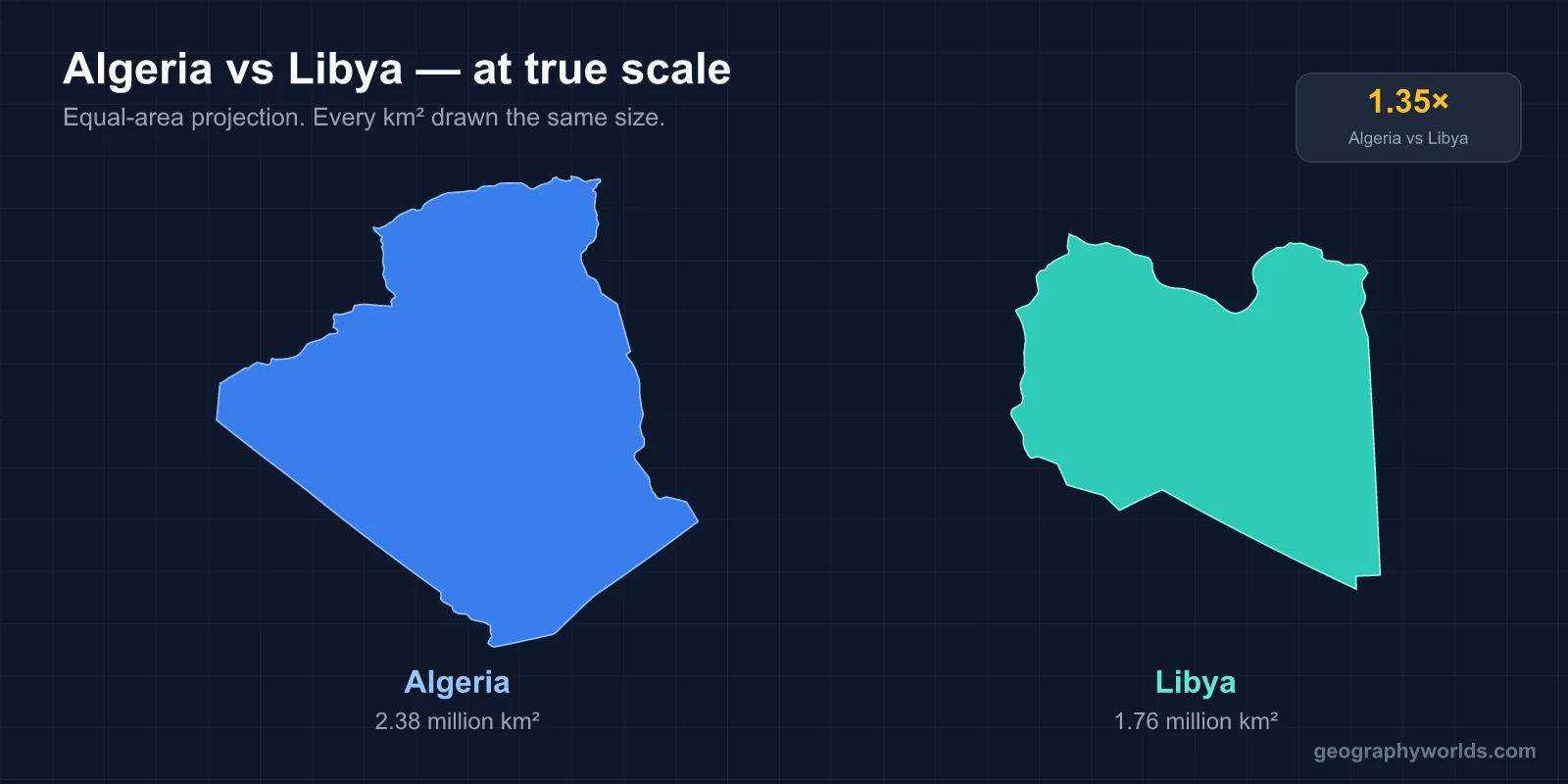
Both are enormous by any measure, but Algeria edges ahead at 2,381,741 km², roughly 1.4 times the area of Libya's 1,759,540 km². Algeria's land tilts from the Sahara across its vast southern interior up to the Tell Atlas ranges that shelter its northern coast, and it touches a remarkable seven neighbors. Libya is flatter and more uniformly desert, mostly barren plains rolling between a Mediterranean shore and a Saharan interior, bordered by six countries of its own.
Population & Demographics
| Metric | Algeria 🇩🇿 | Libya 🇱🇾 |
|---|---|---|
| Population | 48.0 million | 7.5 million |
| Population Density | 20.2 per km² | 4.3 per km² |
The population contrast is sharper still. Algeria is home to 48.0 million people against Libya's 7.5 million, about 6.4 times as many, even though it is only modestly larger in area. That translates into a density of 20.2 people per km² in Algeria versus just 4.3 in Libya, a difference of roughly 15.9 people per km². In both countries, of course, the great majority cluster along the northern coast, leaving the desert interior almost empty.
Capital Cities
Algeria is run from Algiers, its largest city and chief Mediterranean port, while Libya's capital is Tripoli, likewise a coastal city facing the sea. Both capitals sit in North Africa and both hug the shoreline, a reminder that life in these Saharan nations is drawn toward the water rather than the sands.
Language, Currency & Culture
| Aspect | Algeria 🇩🇿 | Libya 🇱🇾 |
|---|---|---|
| Languages | Arabic (official), Berber (national), French widely used | Arabic (official) |
| Currency | Algerian Dinar (DZD) | Libyan Dinar (LYD) |
Arabic is the official language in both countries, but the linguistic mix is broader in Algeria, where Berber holds national status and French remains widely used as a legacy of the colonial era. Libya's language landscape is more uniformly Arabic. Each country issues its own dinar, the Algerian Dinar (DZD) and the Libyan Dinar (LYD), reflecting the separate paths the two have taken through their distinct histories.
Climate & Natural Features
| Aspect | Algeria 🇩🇿 | Libya 🇱🇾 |
|---|---|---|
| Climate | arid to semi-arid; mild, wet winters along coast | Mediterranean along coast; dry desert interior |
| Key Features | Sahara Desert, Atlas Mountains, Mediterranean coast | Sahara Desert, Mediterranean coast, Tibesti Mountains |
| Economy | oil and gas, agriculture, mining | oil and natural gas |
The two share the same basic pattern of a habitable coast and an arid interior, but with a slight difference in emphasis. Algeria is arid to semi-arid overall, softened by mild, wet winters along the coast, and combines the Sahara Desert, the Atlas Mountains, and a long Mediterranean shoreline. Libya leans more clearly Mediterranean on the coast before drying into desert inland, and its standout features are the Sahara, the Mediterranean coast, and the Tibesti Mountains in the far south. Both economies run on hydrocarbons, though Algeria also draws on agriculture and mining alongside its oil and gas, while Libya is more singularly dependent on oil and natural gas.
What Makes Each Country Unique
Algeria is internationally renowned for being the largest country in Africa, Saharan landscapes, and Roman ruins at Timgad and Djémila. Algeria is the largest country in Africa by area — roughly 80% of its territory is covered by the Sahara Desert.
Libya is best known for vast Saharan desert landscapes, ancient Greek and Roman ruins at Leptis Magna. Libya has the largest proven oil reserves in Africa and the ninth-largest in the world.
Key Differences at a Glance
- Area: Algeria (2,381,741 km²) vs Libya (1,759,540 km²) — Algeria is 1.4x larger
- Population: Algeria (48.0 million) vs Libya (7.5 million) — Algeria is 6.4x more populous
- Capitals: Algiers vs Tripoli
- Currency: Algerian Dinar (DZD) vs Libyan Dinar (LYD)
- Continents: Africa vs Africa
- Density: Algeria is more densely populated (difference of ~15.9 people per km²)
- Languages: Arabic (official) vs Arabic (official)
Verdict
Algeria and Libya are Saharan neighbors that look alike on a map yet differ greatly in the lives they support. Algeria is the larger country at 1.4 times the area, and it leads decisively in population at 6.4 times Libya's total, giving it a noticeably higher density even though both nations are mostly empty desert.
Algeria pairs an arid to semi-arid climate with the Atlas Mountains, the Sahara, and a long Mediterranean coast, and spreads its economy across oil and gas, agriculture, and mining. Libya is more Mediterranean on the coast and more desert inland, marked by the Sahara, its shoreline, and the Tibesti Mountains, with an economy resting almost entirely on oil and natural gas. Same desert, two different balances.
Set side by side, they show how shared geography can still produce very different countries. Whether you are planning a visit, studying world geography, or simply curious, the comparison brings North Africa into sharper focus.
Test Your Knowledge!
Think you know your countries? Try our interactive geography quiz!
Play Geography Games →