
The 5 main types of caves are: solution caves (dissolved limestone, most common), lava tubes (formed by flowing lava), sea caves (carved by waves), ice caves (formed in glaciers), and tectonic caves (created by rock movement). Caves are classified by the process that formed them.
Caves form through various geological processes. The five main types — solution, lava, sea, ice, and tectonic — each result from different forces acting on different rock types.
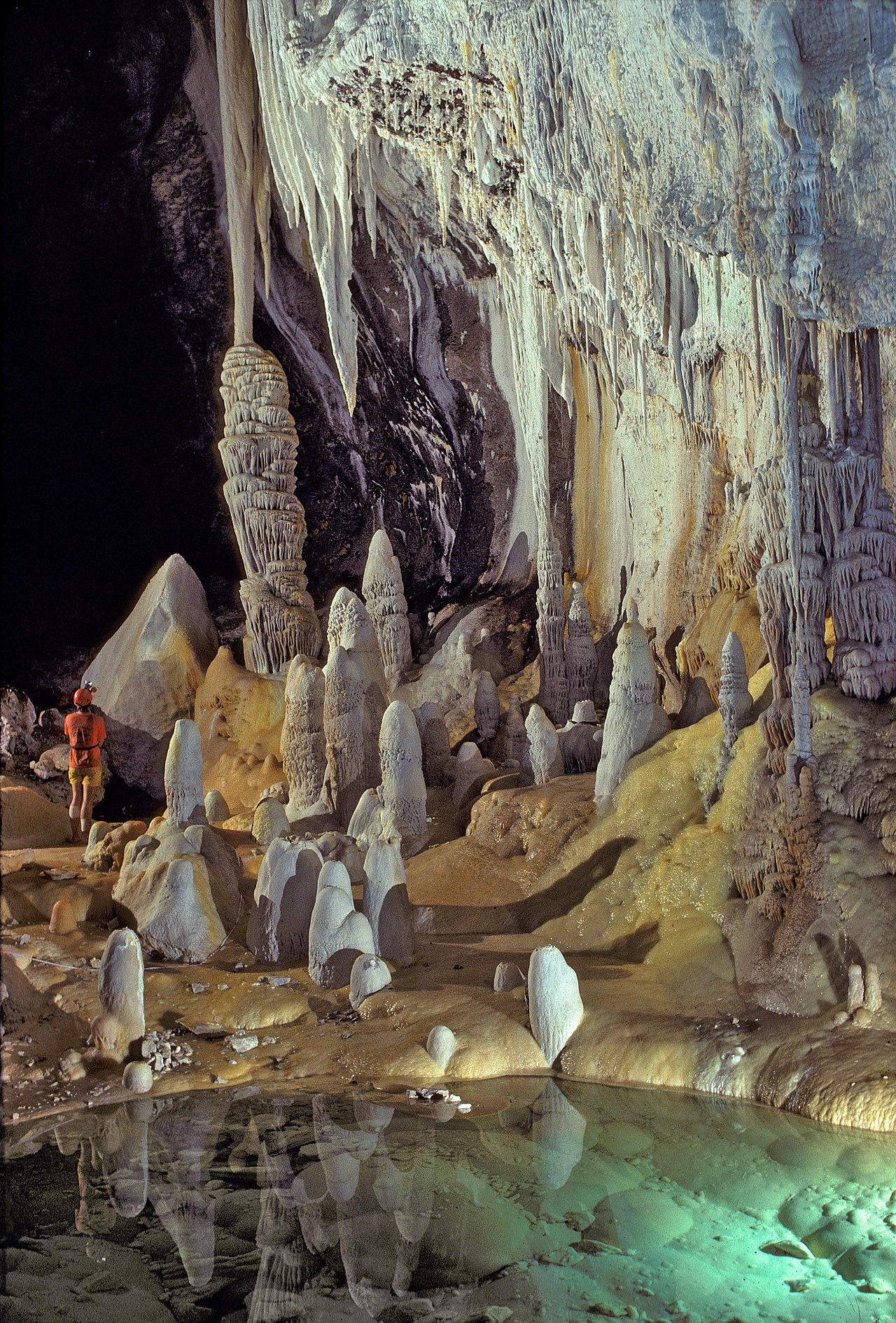
Solution Caves (Limestone Caves)
Solution caves form when slightly acidic water dissolves soluble rock — usually limestone, dolomite, or gypsum. They are by far the most common and largest cave type, containing formations like stalactites (hanging from ceiling), stalagmites (growing from floor), columns, flowstones, and underground rivers. The process takes thousands to millions of years.
How it forms: Rainwater absorbs CO₂ from the atmosphere and soil, forming weak carbonic acid. This acid dissolves limestone along cracks and bedding planes, gradually enlarging them into passages and chambers.
Examples: Mammoth Cave (Kentucky, world's longest at 676 km), Carlsbad Caverns (New Mexico), Škocjan Caves (Slovenia), Phong Nha (Vietnam)
Lava Tubes
Lava tubes form during volcanic eruptions when the outer surface of a lava flow cools and hardens while molten lava continues to flow through the interior. When the eruption ends, the lava drains out, leaving a hollow tube. They can be tens of kilometers long and large enough to walk through.
How it forms: During a volcanic eruption, basaltic lava flows downhill. The surface cools and solidifies while lava continues flowing inside. When the eruption stops, the remaining lava drains out, leaving a tube.
Examples: Kazumura Cave (Hawaii, 65 km — world's longest lava tube), Thurston Lava Tube (Hawaii), Jeju lava tubes (South Korea), Undara (Australia)
Sea Caves
Sea caves are carved into coastal cliffs by the relentless pounding of waves. Wave action, combined with the abrasive force of sand and pebbles, exploits weaknesses in rock (faults, joints, softer layers) to create caves. Sea caves can extend tens of meters into the cliff and may have spectacular blowhole openings.
How it forms: Wave energy attacks weaknesses in coastal rock — faults, joints, or softer strata. Hydraulic pressure, abrasion by sediment, and chemical dissolution gradually enlarge the opening into a cave.
Examples: Blue Grotto (Capri, Italy), Fingal's Cave (Scotland), Painted Cave (California), Sea Lion Caves (Oregon)
Ice Caves (Glacier Caves)
Ice caves form within glaciers or ice sheets when meltwater carves tunnels through the ice, or when geothermal heat melts passages from below. They are stunningly beautiful, with translucent blue ice walls and ceilings, but are inherently unstable and can collapse without warning.
How it forms: Meltwater on the glacier surface enters crevasses and melts tunnels through the ice. Geothermal heat from below can also create passages. Caves change shape constantly as ice moves and melts.
Examples: Mendenhall Glacier ice caves (Alaska), Vatnajökull ice caves (Iceland), Eisriesenwelt (Austria — cave with permanent ice inside rock)
Tectonic Caves
Tectonic caves form when rocks shift, crack, or collapse due to tectonic forces — faulting, folding, or gravity. They include talus caves (spaces between fallen boulders), fracture caves (opened by faulting), and erosion residual caves (remnants of larger features). They are generally smaller and less spectacular than solution caves.
How it forms: Tectonic forces create fractures, faults, or voids in rock. Gravity causes rock blocks to shift apart or collapse, creating cave-like spaces between or beneath them.
Examples: Talus caves in mountain scree fields, fracture caves along fault lines, boulder caves
Key Facts
- The world's longest cave is Mammoth Cave in Kentucky at over 676 km of surveyed passages.
- The deepest cave is Veryovkina Cave in Georgia (country) at 2,212 meters deep.
- About 17% of Earth's land surface is karst terrain (limestone landscapes with caves).
- Cave ecosystems support unique species found nowhere else — some cave animals have lost their eyes entirely.
Fun Facts
- Cave paintings at Lascaux (France) and Altamira (Spain) are over 17,000 years old.
- A cave in Vietnam (Son Doong) is large enough to contain a 40-story building.
- Caves on Mars may one day provide shelter for human colonists.
Summary
The five types of caves — solution, lava, sea, ice, and tectonic — represent different geological processes at work. Caves are windows into Earth's interior, hosting unique ecosystems and preserving records of past climates and human history.
Test Your Geography Knowledge!
Think you know your geographic features? Try our interactive quizzes!
Play Geography Games →