

The 6 main types of waterfalls are: plunge (water falls vertically, losing contact with rock), horsetail (water maintains some contact with rock), cascade (water descends a series of rock steps), punchbowl (narrow falls into a wide pool), block/sheet (wide curtain of water), and tiered (distinct drops separated by pools). Waterfalls are classified by the manner of water descent.
Waterfalls are classified by how water descends. From free-falling plunge waterfalls to gently sloping cascades, each type results from different geological and hydrological conditions.
Plunge Waterfalls
Plunge waterfalls drop vertically through the air, losing contact with the rock face behind them. A cavity or overhang behind the falling water often creates a space you can walk behind. They are the most dramatic type and include some of the world's tallest waterfalls.
How it forms: Water flows over a cliff edge with resistant rock on top and softer rock beneath. The softer rock erodes faster, creating an overhang. The stream falls freely through the air.
Examples: Angel Falls (Venezuela, world's tallest at 979 m), Yosemite Falls (California), Kaieteur Falls (Guyana)
Horsetail Waterfalls
Horsetail waterfalls descend vertically but maintain some contact with the rock face, spreading out like a horse's tail. The water flows over and along the rock surface rather than falling completely free. They are often found on smooth, steep rock faces.
How it forms: Water descends a steep but not overhanging rock face. The angle of the rock keeps water in contact with the surface as it falls, creating a fanning pattern.
Examples: Yosemite's Horsetail Fall (famous for "Firefall" effect), Reichenbach Falls (Switzerland)
Cascade Waterfalls
Cascades are waterfalls where water descends over a series of natural rock steps or ledges, rather than making one single drop. Each step breaks the fall and the water tumbles from level to level. Cascades are common in mountain streams with bedded or layered rock.
How it forms: Alternating layers of hard and soft rock create natural steps. The river erodes softer layers faster, leaving ledges of harder rock over which water cascades.
Examples: Iguazu Falls (Argentina/Brazil), Dunn's River Falls (Jamaica), Rhine Falls (Switzerland)
Punchbowl Waterfalls
Punchbowl waterfalls have a narrow stream that falls into a wide, deep plunge pool. The pool is much wider than the waterfall itself, often carved out by the force of falling water over time. They are scenic and often popular swimming spots.
How it forms: A narrow waterfall erodes a wide, deep pool at its base through hydraulic action and abrasion. The pool widens over time as the turbulent water erodes the surrounding rock.
Examples: Punchbowl Falls (Oregon), Wailua Falls (Hawaii), McWay Falls (California)
Block (Sheet) Waterfalls
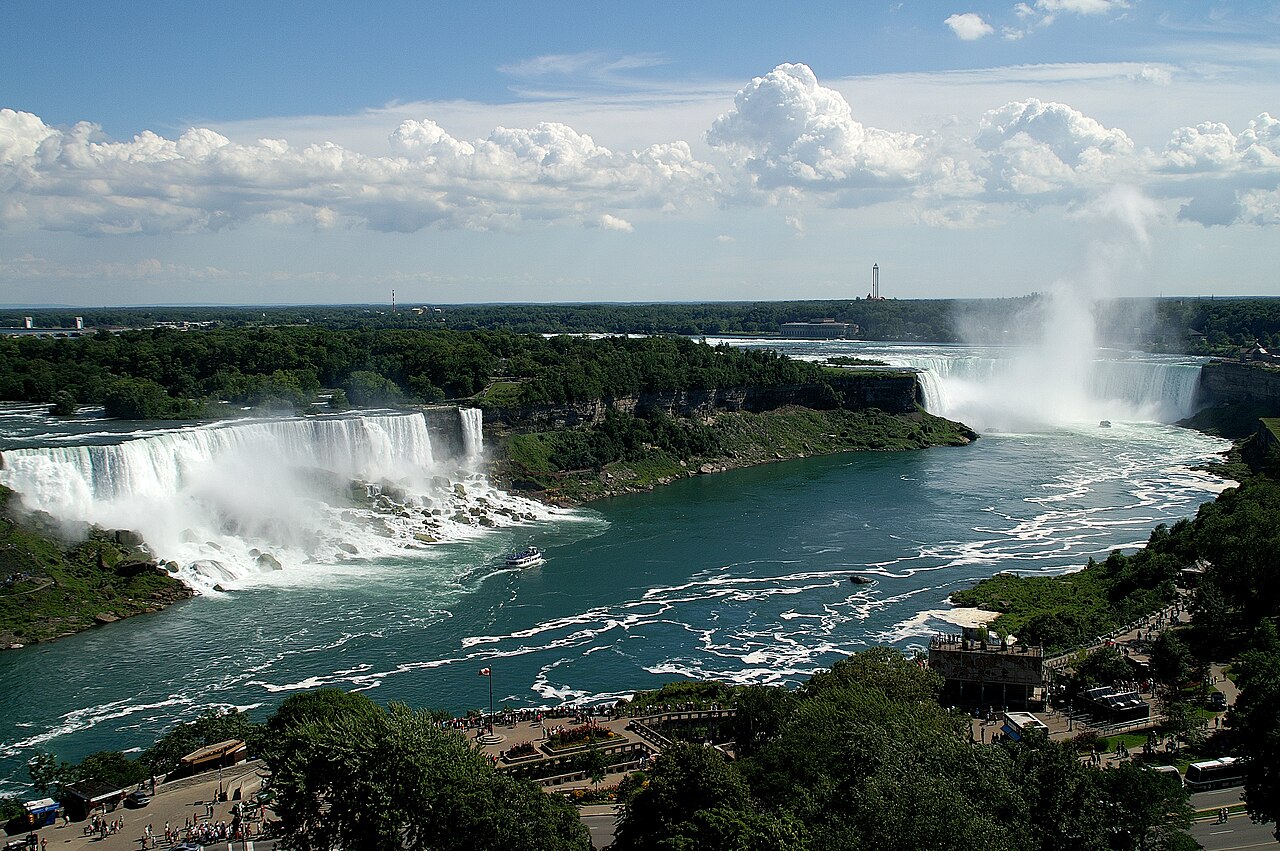
Block waterfalls are wide curtains of water descending over a broad rock ledge, often wider than they are tall. They are among the most powerful waterfall types by water volume. The famous Niagara Falls is the classic example of a block waterfall.
How it forms: A river flows over a wide, uniform rock ledge with resistant caprock. The entire width of the river drops simultaneously, creating a massive curtain of water.
Examples: Niagara Falls (USA/Canada), Victoria Falls (Zambia/Zimbabwe), Iguazu Falls (sections)
Tiered (Multi-Step) Waterfalls
Tiered waterfalls consist of a series of distinct drops separated by pools or flat areas, creating a staircase effect. Each tier may be a different type — plunge, cascade, or horsetail — making tiered waterfalls among the most visually complex and impressive.
How it forms: Multiple resistant rock layers at different heights create separate drop points. Water flows through pools between tiers. Each tier may erode at a different rate.
Examples: Sutherland Falls (New Zealand, 3 tiers), Tugela Falls (South Africa, 5 tiers), Plitvice Lakes waterfalls (Croatia)
Key Facts
- Angel Falls in Venezuela is the world's tallest waterfall at 979 meters (3,212 feet).
- Niagara Falls is the most powerful waterfall in North America by water volume.
- Victoria Falls is the largest curtain of falling water in the world (1,708 m wide, 108 m tall).
- Waterfalls naturally migrate upstream as erosion undercuts the rock lip.
Fun Facts
- Niagara Falls has been turned off twice — in 1848 (ice jam) and 1969 (US Army Corps of Engineers diverted the river for study).
- Angel Falls is so tall that much of the water evaporates or turns to mist before reaching the base.
- Iceland has more waterfalls per square kilometer than any other country.
Summary
The six types of waterfalls — plunge, horsetail, cascade, punchbowl, block, and tiered — each offer unique visual spectacles. Understanding waterfall types reveals the geological forces and erosion processes that create these natural wonders.
Test Your Geography Knowledge!
Think you know your geographic features? Try our interactive quizzes!
Play Geography Games →