
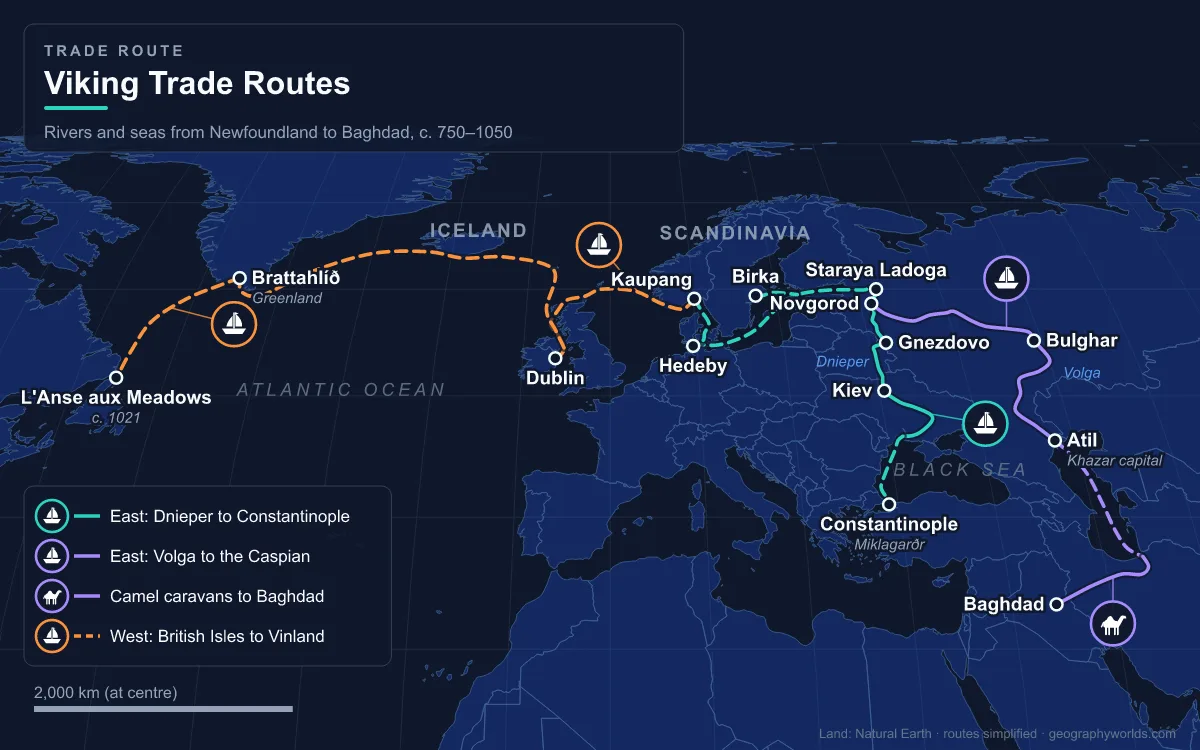
Viking trade routes were the sea lanes, rivers and portages that Scandinavian merchants used from the late 8th to the 11th century, running from home markets such as Hedeby, Birka and Kaupang east along the Dnieper to Constantinople and down the Volga to the Caspian Sea, with goods carried on by camel to Baghdad, and west to Dublin, Iceland, Greenland and, around 1021, Newfoundland. Their peak came in the 10th and early 11th centuries. Furs, honey, wax, amber, swords and enslaved people went south and east; Islamic silver dirhams, silk, wine, glass and spices came back. Followed stop by stop, the routes show how Norse traders tied northern Europe to the Byzantine and Abbasid economies.
Hedeby, Kaupang and Birka: The Scandinavian Home Markets
Hedeby and the Schlei portage
Hedeby (Old Norse Heiðabýr, "heath settlement") stood at the head of the Schlei, a narrow inlet of the Baltic at the base of the Jutland peninsula, in what is now Schleswig-Holstein in Germany. Its value was geographic. A portage of less than 15 km linked the Schlei to the Treene River, which flows into the Eider and on to the North Sea, so cargo could be dragged overland instead of sailing around the whole of Jutland. The Eider just to the south marked Denmark's border from 811 to 1864, putting Hedeby between the Frankish Empire and the Danish kingdom.
Hedeby became the second-largest Nordic town of the Viking Age after Uppåkra in southern Sweden, and at about 24 hectares it covered more ground than Birka, Dublin, Ribe or Gnezdovo. Around 965 the traveller Ibrahim ibn Yaqub described it as a very large city at the very end of the world's ocean. It was destroyed in 1066 and abandoned, and the town of Schleswig grew up across the water instead. Hedeby and the Danevirke earthworks were added to UNESCO's World Heritage List in 2018. Kaupang in Vestfold, Norway's first known market town, founded around 800 and abandoned in the mid-10th century, played a similar role further north; its name comes from the Old Norse for "buy" and "harbour".
Birka on Lake Mälaren and the Gotland silver hoards
Birka, on the island of Björkö in Lake Mälaren about 30 km west of modern Stockholm, was founded around 750 and lasted about two centuries before it was abandoned around 975. Only 500 to 1,000 people lived there, but it was the Baltic link in the eastern trade, handling furs from the Sami, the Finns and north-western Russia in exchange for goods from Europe and western Asia. The missionary Ansgar founded Sweden's first known Christian congregation there in 831, and Birka with neighbouring Hovgården has been a World Heritage Site since 1993.
Out in the Baltic, the island of Gotland shows what the eastern trade brought home. On 16 July 1999 archaeologists found the Spillings Hoard, the world’s largest Viking silver treasure, under the floorboards of what was probably a storehouse on a farm north-west of Slite. Its two silver caches weighed 67 kg (148 lb) before conservation and held 14,295 coins, most of them Islamic dirhams. The silver was hidden some time after 870–871, and a third cache nearby held more than 20 kg of bronze scrap.

Staraya Ladoga, Novgorod and Gnezdovo: Into the Russian River System
Ships bound east crossed the Baltic into the Gulf of Finland, followed the Neva into Lake Ladoga and turned up the Volkhov River. About 10 km upstream stood Ladoga, which the Norse called Aldeigjuborg and which is now Staraya Ladoga. Tree-ring dating puts its founding in 753, and the oldest dirhams found in European Russia came from there, the earliest dated to 786/787. Until about 950 it was one of the most important trading ports in eastern Europe.
Further up the Volkhov lay Novgorod, which the Norse called Hólmgarðr, where the Dnieper and Volga routes divided. Boats bound for the Dnieper crossed Lake Ilmen, went up the Lovat and were hauled over portages to the Western Dvina and then the Dnieper basin. On the upper Dnieper near Smolensk, the 10th-century trading station at Gnezdovo grew into one of the largest Viking Age sites in Europe, with about 3,000 burial mounds in eight clusters, roughly 1,300 of which have been excavated since 1874.
The Dnieper Rapids, Kiev and Miklagarðr
The Byzantine emperor Constantine VII Porphyrogenitus, writing in the mid-10th century, described how Slavic tribes dependent on Kiev hollowed out boats called monoxyla, each able to carry 30 to 40 people, and brought them to Kiev to sell to the Rus'. Fleets gathered there from Novgorod, Smolensk, Lyubech, Chernihiv and Vyshhorod and set off downriver in June. Below modern Dnipro they had to haul their boats around seven rapids where the river fell about 50 m in 66 km, watching for Pecheneg nomads, especially at the narrow Ford of Vrar. The rapids have been underwater since the DniproHES dam was completed in 1932. After a halt at St George's Island, the boats were rigged with sails in the Dnieper estuary and hugged the western Black Sea coast past the Danube delta to Constantinople, which the Norse called Miklagarðr, "the great city".
The Primary Chronicle records a first Rus'–Byzantine treaty in 907, after Oleg's raid on Constantinople, followed by a fuller one in 911. As preserved in the chronicle, the 907 text lists fifteen Rus' signatories, thirteen of them with Old Norse names. It settled Rus' merchants in the quarter of Saint Mamas and let them enter the city only through one gate, unarmed, no more than 50 at a time, with food supplied by the imperial authorities for up to six months. From Constantinople came wine, spices, jewellery, glass, fine fabrics, icons and books; the north sent timber, fur, honey, wax and amber. A runestone raised around 1050 in the Sjonhem cemetery on Gotland remembers a man named Hróðfúss, treacherously killed abroad by the Blakumen; most historians read the name as Vlachs, though some argue for Cumans.
Bulghar and Atil on the Volga, with Baghdad Beyond
From the Novgorod region a second route crossed a portage of about 3 km to the headwaters of the Volga and followed the river south through Finnic and Permian lands to Volga Bulgaria, whose cities Bulgar and Suvar lay east of present-day Moscow. Further down was Atil, the Khazar capital on the Caspian shore. Around 885–886 the Persian geographer Ibn Khordadbeh described Rus' merchants carrying beaver hides, black fox pelts and swords south, paying a tithe to the Byzantine emperor and another to the Khazar ruler, crossing the Caspian and sometimes taking their goods by camel to Baghdad.
The most vivid account is by Ahmad ibn Fadlan, secretary to an embassy sent by the Abbasid caliph al-Muqtadir. The party left Baghdad on 21 June 921 and reached the Volga Bulgar capital on 12 May 922. There Ibn Fadlan watched Rus' traders at work and described a ship burial in detail. Furs, honey and enslaved people were the main northern cargoes on this route, and the Islamic silver paid for them is what fills the hoards of Gotland and the Swedish mainland. The Volga route lost its importance in the 11th century.
Dublin's Slave Market on the Liffey
The western routes ran through the British Isles. Norse ships over-wintered in Ireland from 840–841, and the settlement at Dublin, founded in 841, opened a slave market that came to sell captives from Ireland, Wales and Scotland and from as far away as Muslim Spain. In 870 Vikings, most likely led by Olaf the White and Ivar the Boneless took Dumbarton Rock, capital of the Kingdom of Strathclyde, and the next year carried most of its people to Dublin to be sold. Irish captives were taken to Iceland, where Gaels formed about 40 percent of the founding population. By the 11th century Dublin was the largest slave market in western Europe, and Islamic dirhams have been found there as well as at Birka. The trade declined after William the Conqueror tightened control of the English and Welsh coasts around 1080.
Greenland and L'Anse aux Meadows at the Western Edge
The furthest stops were in the North Atlantic. The Norse settlements in western Greenland peaked at 2,000 to 3,000 people and paid for imported timber by exporting walrus ivory, walrus hide, polar bear skins and narwhal tusks to Europe. That trade weakened as African elephant ivory competed with walrus tusks and as the Little Ice Age made both farming and the voyage to Europe harder. Falling ivory prices may also have pushed Norse hunters to overkill the walrus herds they depended on.

At L'Anse aux Meadows, on the northern tip of Newfoundland, archaeologists found eight sod buildings and over 800 Norse objects, along with evidence of iron production. A 2021 study of tree rings pinned Norse woodcutting there to 1021. The camp could house 30 to 160 people and had no stables, farms or cemetery, so it was probably an overwintering base rather than a colony; the historian Eleanor Barraclough has suggested it was a temporary boat-repair station. Butternuts found in the remains do not grow north of New Brunswick, which shows the Norse sailed further south. The site has been a UNESCO World Heritage Site since 1978.
The eastern river lanes are covered in more depth in our guide to the Dnieper River, and the German merchant league that took over much of the Baltic trade after the Viking Age is the subject of our Hanseatic League guide.