
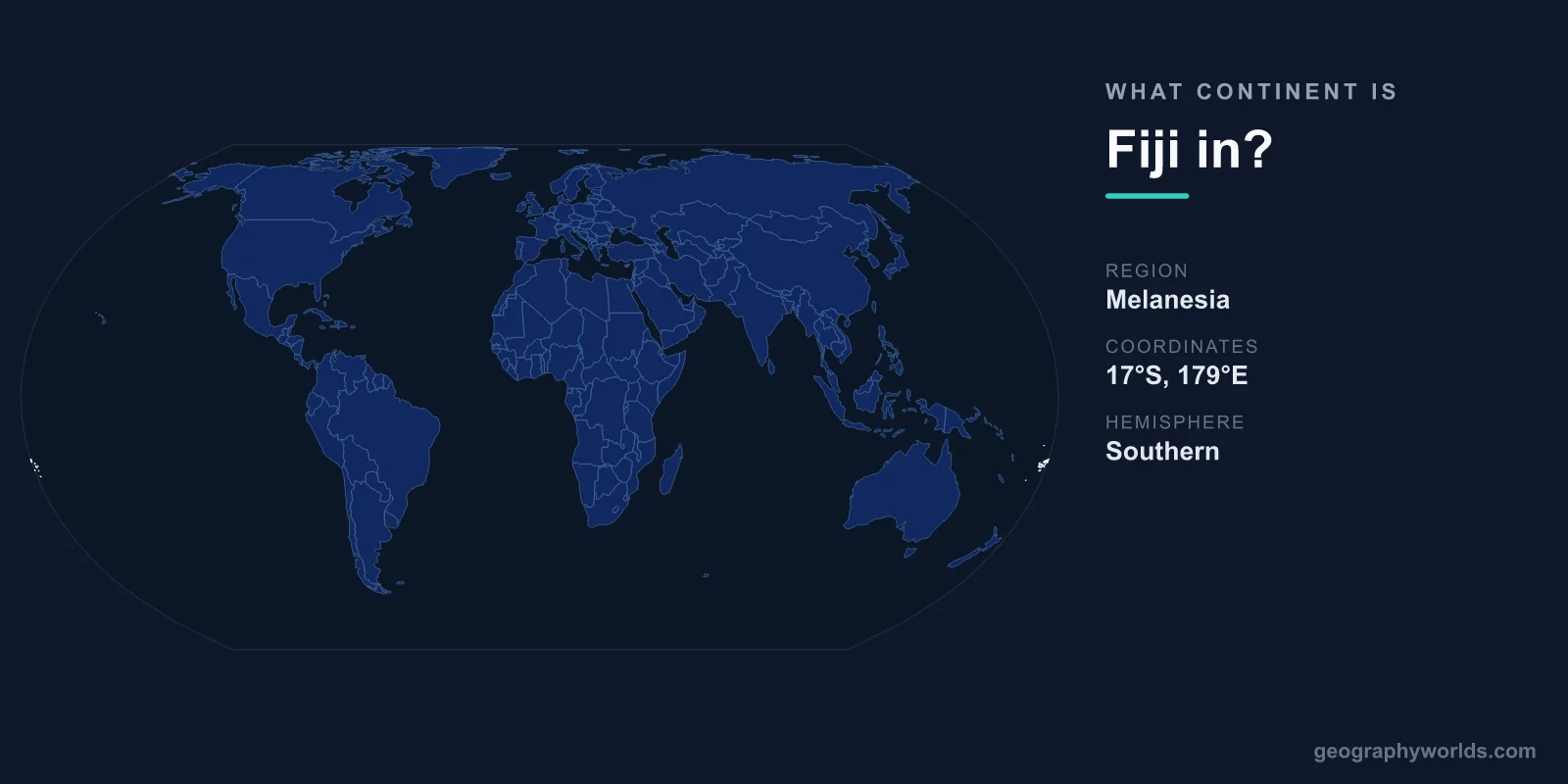
Fiji is located on the continent of Oceania, specifically within the Melanesia subregion of the South Pacific Ocean. Although it is sometimes loosely grouped with "Australia and the Pacific," the correct continental answer is Oceania. Fiji is an archipelago of more than 330 islands scattered across the warm tropical waters roughly 2,000 km north of New Zealand and about 3,000 km east of Australia.
Why Fiji Belongs to Oceania
Oceania is the continental region that encompasses Australia, New Zealand, Papua New Guinea, and the thousands of islands of the central and southern Pacific. Unlike Africa or Asia, which are single landmasses, Oceania is defined more by its watery expanse than by continuous land. The United Nations geoscheme places Fiji firmly within Oceania and, more precisely, in Melanesia — the cluster of islands that also includes Papua New Guinea, the Solomon Islands, Vanuatu, and New Caledonia.
The name Melanesia comes from Greek words meaning "islands of the black-skinned people," a reference to the Indigenous Melanesian populations who settled the region thousands of years ago. Fiji sits at the eastern edge of Melanesia, where it borders the cultural zone of Polynesia, giving the country a distinctive blend of influences. You can learn more in our fiji country guide.
Where Exactly Is Fiji?
Fiji lies in the heart of the South Pacific, almost equidistant between Australia and South America. Its position can be summarised as follows:
- Continent: Oceania
- Subregion: Melanesia
- Capital: Suva (on the island of Viti Levu)
- Total land area: about 18,274 km²
- Coastline: roughly 1,129 km
The country is centred near 18 degrees south latitude and the 180-degree meridian. This places it just below the equator in the tropics, which is why Fiji enjoys warm temperatures year-round. Its nearest neighbours are all fellow Oceanian nations: Vanuatu to the west, Tonga to the east, Tuvalu to the north, and the much larger landmass of New Zealand far to the south.
An Archipelago of Volcanic Islands and Coral Atolls
Fiji is made up of around 332 islands, of which only about 110 are permanently inhabited. Two of them dominate the country: Viti Levu and Vanua Levu, which together account for roughly 87% of the total land area and are home to the vast majority of Fiji's people. Viti Levu hosts both the capital, Suva, and Nadi, the gateway city where most international visitors arrive.
The larger islands are volcanic in origin, with rugged, mountainous interiors cloaked in rainforest. Fiji's highest peak, Tomanivi, rises to 1,324 metres on Viti Levu. By contrast, many of the smaller outlying islands are low-lying coral atolls and reef formations that barely break the surface of the sea. The surrounding waters host some of the planet's most spectacular reefs, including the Great Astrolabe Reef, one of the largest barrier reefs in the world.
Straddling the International Date Line
One of Fiji's most remarkable geographic quirks is that the 180-degree meridian — closely tied to the International Date Line — passes directly through the archipelago. This means Fiji is among the very first inhabited places on Earth to greet each new day, and famously it was one of the first nations to welcome the dawn of the year 2000. To keep the country on a single calendar day, the date line is bent so that all of Fiji shares the same time zone rather than being split between two days.
A Regional Hub for the South Pacific
Despite its modest land area, Fiji is one of the most developed and connected nations in Oceania. Nadi International Airport serves as a key stopover for air routes linking North America, Australia, and New Zealand, making the country a natural crossroads of the South Pacific. Fiji is also a founding member of the Pacific Islands Forum, the leading political and economic organisation of the region, and its capital Suva hosts numerous regional institutions and diplomatic missions.
Culturally, Fiji reflects its Oceanian setting through traditions such as the ceremonial drinking of kava, a mildly sedative beverage made from the root of a pepper plant, which plays a central role in social and ceremonial life across the islands.
Frequently Asked Questions
Is Fiji in Asia or Oceania?
Fiji is in Oceania, not Asia. While it lies in the broader Asia-Pacific economic zone, geographically and continentally it belongs to Oceania, in the Melanesian subregion of the South Pacific.
Is Fiji part of Polynesia or Melanesia?
Fiji is officially classified as part of Melanesia. However, it sits on the cultural boundary with Polynesia, so Fijian society blends Melanesian and Polynesian influences in language, customs, and appearance.
Is Fiji a country or a territory?
Fiji is a fully independent sovereign country. It gained independence from the United Kingdom in 1970 and is a member of the United Nations and the Pacific Islands Forum.
How far is Fiji from Australia and New Zealand?
Fiji lies roughly 3,000 km east of Australia and about 2,000 km north of New Zealand, placing it in the open waters of the central South Pacific between the two.