
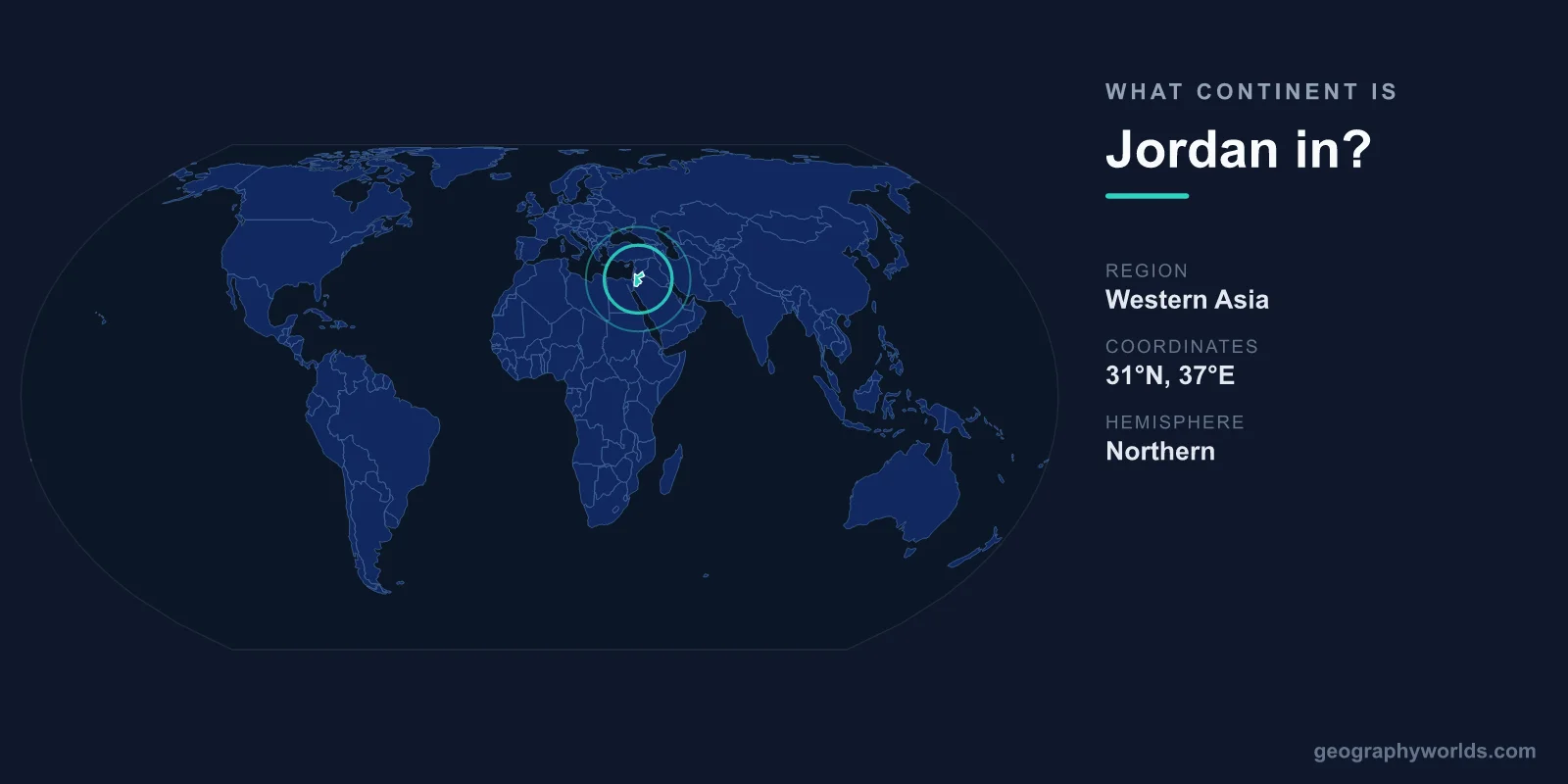
Jordan is located in Asia, specifically in the Western Asia subregion that the world more commonly calls the Middle East. It sits in the northern half of the Arabian Peninsula's western edge, wedged between the Levant and the great Arabian desert, and is recognised by the United Nations as part of Western Asia.
Why Jordan Belongs to Asia
Continents are defined by the large continuous landmasses of the Earth, and Jordan rests firmly on the Asian plate alongside its neighbours. There is sometimes confusion because Jordan shares deep historical, cultural, and linguistic ties with the Arab world that stretches across both Asia and North Africa. But geographically there is no ambiguity: every one of Jordan's land borders is shared with another Asian country.
The country lies at the meeting point of three of Asia's great cultural zones, the Mediterranean Levant to the west, the Arabian heartland to the south, and Mesopotamia to the east. This crossroads position explains why Jordan has been crossed by traders, pilgrims, and armies for thousands of years, from the Nabataeans who built Petra to the caravan routes that linked Damascus with Mecca.
Where Exactly Is Jordan?
Jordan occupies roughly 89,342 square kilometres, making it a relatively small country, comparable in size to Portugal or the US state of Indiana. Its capital, Amman, sits in the western highlands where most of the population lives. Key location facts include:
- Continent: Asia
- Region: Western Asia (the Middle East / Levant)
- Capital: Amman
- Area: approximately 89,342 km²
- Coastline: just 26 km on the Gulf of Aqaba (Red Sea)
The country lies east of the Jordan River and the Dead Sea, both of which form part of the Great Rift Valley, an immense geological fracture that runs from East Africa up through the Middle East. This valley gives Jordan one of the most extreme elevation ranges of any small country, dropping to the lowest dry land on Earth.
Jordan's Neighbours and Borders
Jordan is bordered by four countries and one territory, and all of them are in Asia, which reinforces its Asian identity:
- Saudi Arabia to the south and southeast, along Jordan's longest border
- Iraq to the northeast
- Syria to the north
- Israel and the Palestinian West Bank to the west
Although Jordan is often described as nearly landlocked, it does possess a short but vital 26-kilometre coastline at the Gulf of Aqaba, an arm of the Red Sea. This sliver of shoreline gives the port city of Aqaba enormous strategic and economic importance, serving as Jordan's only sea gateway for imports, exports, and tourism.
The Landscape: Desert, Highlands, and the Dead Sea
Around three-quarters of Jordan is arid desert, especially in the vast Eastern Desert that merges into Saudi Arabia. The western highlands, by contrast, catch more rainfall and support agriculture and the bulk of the population. This division shapes everyday life: cities cluster in the cooler, greener west while the east remains sparsely settled.
Jordan's terrain swings dramatically. Its highest point, Jabal Umm ad Dami, rises to about 1,854 metres in the south near Wadi Rum, the towering sandstone desert valley so otherworldly that filmmakers have used it to depict the planet Mars in productions such as The Martian and Dune. At the opposite extreme lies the Dead Sea shore at roughly 430 metres below sea level, the lowest exposed land surface anywhere on the planet. The hypersaline Dead Sea, shared with Israel and the West Bank, is so dense with minerals that swimmers float effortlessly, though it is shrinking by about a metre each year as water is diverted from the Jordan River.
A Crossroads of History and Culture
Jordan's Asian location placed it at the heart of some of humanity's oldest stories. Petra, the rose-red city carved into sandstone cliffs by the Nabataeans more than two thousand years ago, is one of the New Seven Wonders of the World and was "lost" to Western knowledge until a Swiss traveller reached it in 1812. The country is also a founding member of the Arab League and maintains close ties with both its Levantine and Gulf Arab neighbours. To explore more about the nation's people, economy, and attractions, see our jordan country guide.
Frequently Asked Questions
Is Jordan in Asia or the Middle East?
Both descriptions are correct. "Asia" is the continent, while "Middle East" is a geopolitical and cultural region that lies within Western Asia. Jordan belongs to Asia and is a core Middle Eastern country.
Is Jordan in Africa?
No. Although Jordan is an Arab country and shares cultural links with North African nations like Egypt, it is located entirely in Asia. The Red Sea separates the Arabian landmass from the African continent.
Is Jordan part of the Arabian Peninsula?
Jordan sits on the northwestern edge of the Arabian Peninsula and the southern Levant. It is sometimes grouped with the peninsula for cultural reasons, but geographically it forms a bridge between the peninsula and the Mediterranean lands to the north.
Does Jordan have a coastline?
Yes, but only a very short one. Jordan's single stretch of coast runs about 26 kilometres along the Gulf of Aqaba on the Red Sea, anchored by the resort and port city of Aqaba.