
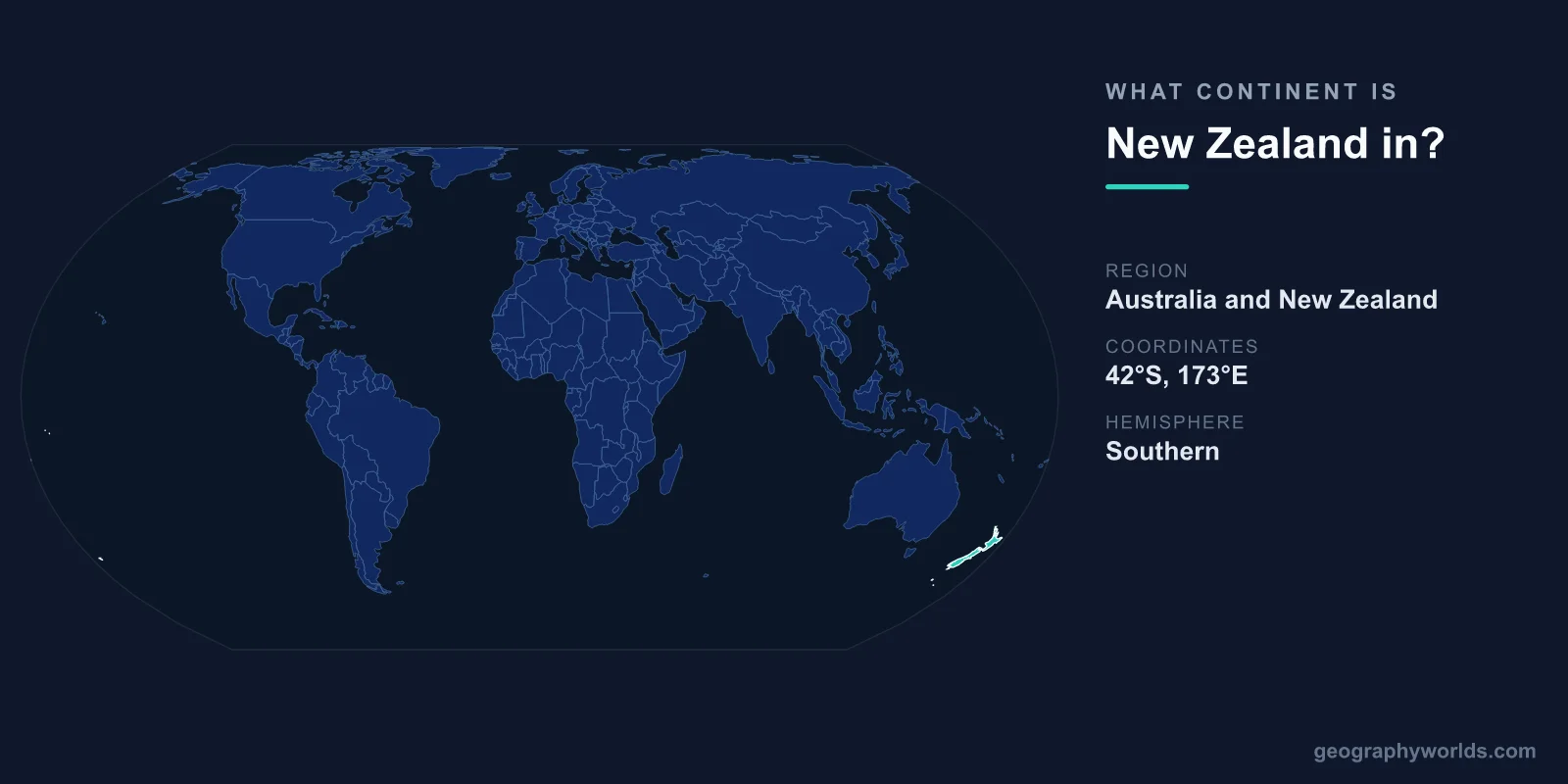
New Zealand is located in Oceania, the geographic region that encompasses the islands of the southwestern and central Pacific Ocean. It is not part of any traditional landmass continent such as Asia or Australia. Instead, it sits roughly 2,000 km southeast of Australia across the Tasman Sea, making it one of the most remote inhabited nations on Earth.
Why Oceania, Not a Traditional Continent
Most people learn a list of seven continents in school, but New Zealand fits none of the classic landmass-based names. It is too far offshore to belong to Australia and far too distant from Asia. The widely used solution is the region Oceania, a grouping that covers Australia, New Zealand, and the thousands of Pacific islands spread across Melanesia, Micronesia, and Polynesia.
The United Nations and most geographers place New Zealand firmly in Oceania. Within that broad region, you will also see New Zealand described as part of Australasia (alongside Australia) and, culturally, as part of Polynesia, since its indigenous Maori people share Polynesian roots. These labels overlap rather than contradict each other: Oceania is the continental-scale region, while Australasia and Polynesia are sub-regions within it.
It helps to remember that the word "continent" is used in two different senses. In everyday geography, a continent is a large, conventionally agreed division of land such as Africa or Europe, and by that standard New Zealand simply belongs to the Oceania region. In geology, a continent is defined by the nature of the crust beneath it, and by that stricter definition New Zealand has a far more interesting story to tell.
Zealandia: New Zealand's Hidden Continent
There is a fascinating geological twist. Many scientists argue that New Zealand is actually the visible tip of a separate, mostly submerged continent called Zealandia (or Te Riu-a-Maui). This continental mass covers roughly 4.9 million km², making it about two-thirds the size of Australia, yet only around 7% of it rises above sea level. The rest lies beneath the Pacific.
The two main islands of New Zealand, along with New Caledonia and a scattering of smaller islands, are the high points of this drowned landmass. Geologists point to Zealandia's thick, distinctly continental crust, which differs from the thinner oceanic crust of the surrounding seafloor, as evidence that it qualifies as a continent in its own right. Researchers formally argued the case in 2017, and Zealandia is now widely studied as a candidate for Earth's eighth continent. So while New Zealand is conventionally grouped into Oceania, it may also be the emergent crown of the planet's most hidden continent.
Zealandia broke away from the supercontinent Gondwana between roughly 85 and 60 million years ago, drifting east as the Tasman Sea opened up. Over the following tens of millions of years it stretched, thinned, and largely sank, leaving only its tallest ridges and volcanoes above the waves. That long, slow submergence is the single biggest reason New Zealand looks and feels so different from its nearest neighbours.
Where Exactly Is New Zealand?
New Zealand lies in the southwestern Pacific Ocean, deep in the Southern Hemisphere. The country is made up of two large islands, the North Island and the South Island, plus more than 600 smaller islands. Its nearest large neighbour is Australia, about 2,000 km to the northwest, while New Caledonia and Fiji lie roughly 1,500 to 1,800 km to the north. Every one of these neighbours is also part of Oceania, underscoring just how clustered the region's nations are amid a vast expanse of open ocean.
Because it sits so far south and east, New Zealand is one of the last places on Earth to see the sun set each day and among the first major landmasses west of the International Date Line to greet the new day. This isolation in the open Pacific has shaped everything from its weather, driven by the Roaring Forties westerly winds, to its history of late human settlement.
Key Facts
- Region: Oceania (Australasia / Polynesia)
- Capital: Wellington
- Largest city: Auckland
- Total area: approximately 268,021 km²
- Coastline: around 15,134 km
- Highest point: Aoraki / Mount Cook, 3,724 m
- Distance from Australia: roughly 2,000 km across the Tasman Sea
A Landscape Shaped by Tectonic Forces
New Zealand straddles the boundary between the Australian and Pacific tectonic plates, and that collision defines its dramatic terrain. The South Island is dominated by the Southern Alps, a chain of jagged peaks where glaciers descend almost to sea level. The North Island, by contrast, features active volcanoes, bubbling geothermal fields, and steaming hot springs, especially around Rotorua and the central Volcanic Plateau.
This restless geology also makes the country prone to earthquakes. The same plate boundary that builds soaring mountains and fuels geysers keeps the land in constant slow motion, gradually reshaping the islands over geological time. The Alpine Fault, which runs almost the length of the South Island, is one of the most active faults on the planet. To learn more about the nation's regions, climate, and travel highlights, see our New Zealand country guide.
Isolation and Unique Wildlife
Because New Zealand has been isolated from other landmasses for roughly 80 million years, it evolved an extraordinary range of plants and animals found nowhere else. With few native land mammals, birds filled ecological roles elsewhere occupied by mammals. The flightless kiwi, the reptilian tuatara (a living relic of an ancient lineage), and the giant weta insects are among the species that make the country a natural laboratory of evolution.
That same isolation left native species vulnerable. When humans arrived they brought rats, stoats, and other predators that devastated ground-dwelling birds, driving the giant moa to extinction and pushing the kiwi toward it. Today New Zealand runs some of the world's most ambitious conservation programmes, including predator-free island sanctuaries, to protect this irreplaceable wildlife.
Human arrival came late as well. The Maori navigated here from eastern Polynesia around 1300 AD and named the land Aotearoa, often translated as "Land of the Long White Cloud." European contact followed centuries later, and today New Zealand blends Maori and British heritage into a distinct Pacific identity.
How New Zealand Compares to Its Neighbours
It is easy to lump New Zealand and Australia together, but they are geographically and geologically distinct. Australia sits on its own ancient, stable continental plate and is largely flat, dry, and interior-focused, whereas New Zealand rides a turbulent plate boundary and is mountainous, wet, and almost entirely coastal. The 2,000 km Tasman Sea between them is wider than many people assume, and the two countries have separate governments, currencies, and ecosystems despite their close cultural ties.
Compared with the tropical islands of Polynesia and Melanesia to the north, New Zealand is far larger, more temperate, and more mountainous. While Fiji and the Cook Islands enjoy year-round warmth, New Zealand's spread across more than 13 degrees of latitude gives it everything from subtropical beaches in the far north to glaciers and snowfields in the south.
Frequently Asked Questions
Is New Zealand part of Australia?
No. New Zealand is a separate, fully independent country. It shares the broad region of Oceania and the sub-region of Australasia with Australia, but the two are distinct nations divided by the roughly 2,000 km-wide Tasman Sea.
Is New Zealand in Asia?
No. New Zealand is not in Asia. It lies far to the southeast of the Asian continent, in the southwestern Pacific Ocean, and is classified as part of Oceania.
What continent does New Zealand belong to?
In the standard model, New Zealand belongs to Oceania. Geologically, however, it may sit atop Zealandia, a largely submerged continent that some scientists recognise as Earth's eighth continent.
Is New Zealand in Polynesia?
Culturally and geographically, yes. New Zealand forms the southwestern corner of the Polynesian Triangle, and its indigenous Maori people descend from Polynesian voyagers, even though the country is most often described simply as part of Oceania.