
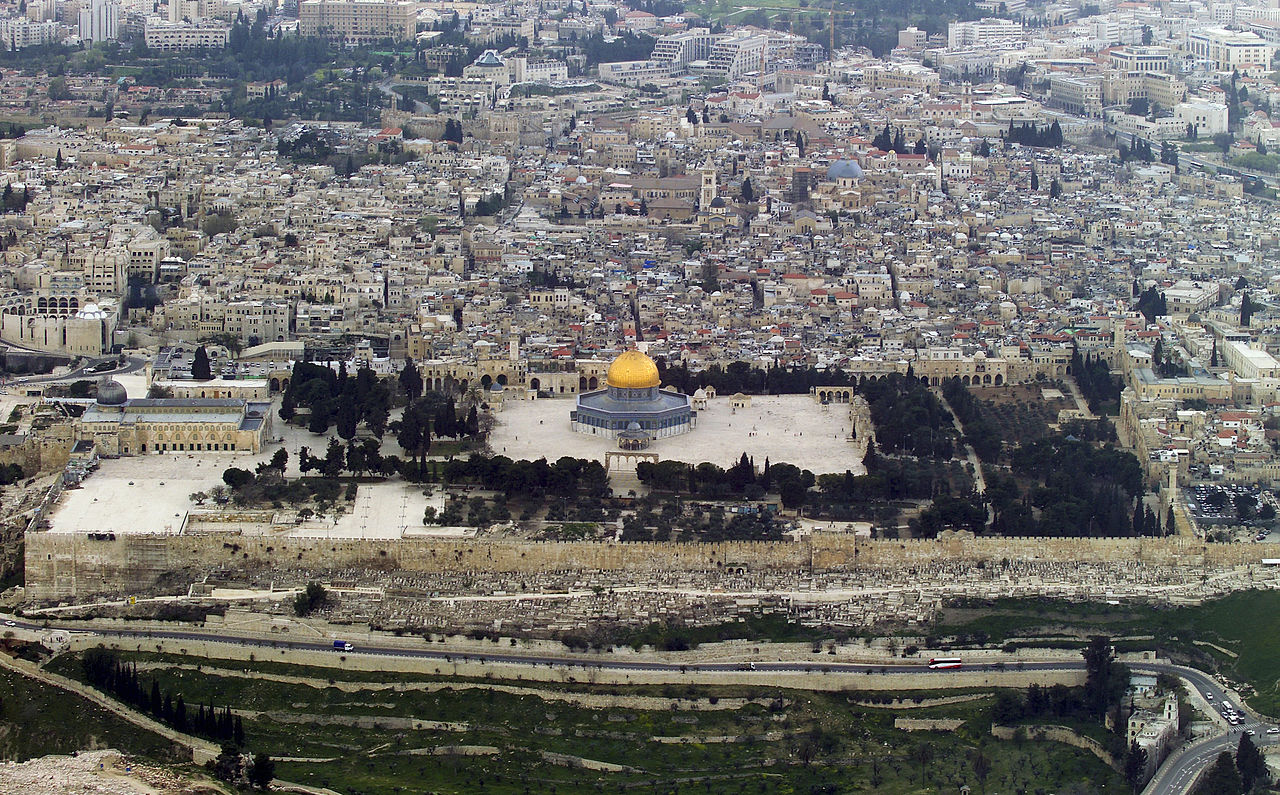
Few cities are as small in physical scale and as enormous in political and religious weight as Jerusalem. The Old City, the ancient walled core where most of the sacred sites are concentrated, covers less than one square kilometre. Within those walls sit the Temple Mount/Haram al-Sharif, the holiest site in Judaism and third holiest in Islam; the Western Wall, the most sacred surviving Jewish prayer site; the Church of the Holy Sepulchre, traditionally identified as the location of Christ's crucifixion and resurrection; the Via Dolorosa, the route believed to be Jesus's path to the cross; and dense residential quarters that have housed Armenian, Christian, Jewish, and Muslim communities for centuries. Across modern Greater Jerusalem, just under one million people live in a city whose political status is among the most contested questions in international law.
The Physical Setting
Jerusalem sits in the Judean Mountains at an elevation of around 750 metres, on a watershed between the Mediterranean and the Dead Sea. The land rises sharply from the coastal plain to the west and falls dramatically eastward into the Judean Desert and the Jordan Valley. The Old City is built on two parallel ridges — the western and the eastern — separated by the Tyropoeon Valley (now largely filled in). The eastern ridge contains the Temple Mount platform and overlooks the Kidron Valley and the Mount of Olives beyond. The western ridge contains the Christian and Armenian Quarters and the citadel known as the Tower of David. The city's elevation gives it cooler summers and occasional snow in winter, conditions unusual in the surrounding region. The natural water supply has always been a constraint; the historic Pool of Siloam and Hezekiah's Tunnel, an 8th-century BCE aqueduct cut through bedrock, were among the earliest serious water-engineering works in the region.
Three Religions, Stacked
The same square kilometre contains the holiest sites of three world religions for reasons that go back to specific events and traditions. For Judaism, Jerusalem is the city of David, the location of the First and Second Temples (destroyed in 586 BCE and 70 CE respectively), and the place where the Western Wall — the surviving retaining wall of the Second Temple platform — remains the closest accessible point to the site of the Holy of Holies. For Christianity, Jerusalem is the city of Jesus's last week, with the Church of the Holy Sepulchre containing the locations identified by 4th-century pilgrim tradition as Golgotha (the crucifixion site) and the empty tomb. For Islam, Jerusalem is the third holiest city after Mecca and Medina, the destination of Muhammad's Night Journey (Isra and Mi'raj), and the site of the Al-Aqsa Mosque and the Dome of the Rock — the latter built around the rock from which Muhammad is said to have ascended to heaven and which is also traditionally identified by Jews as the location where Abraham nearly sacrificed Isaac.
The same hilltop — the Temple Mount to Jews and Haram al-Sharif to Muslims — contains the Western Wall on its outer face and the Dome of the Rock and Al-Aqsa on its surface. The arrangement is geographically unique and politically extraordinarily charged.
The 1947 Partition and What Came of It
The UN Partition Plan for Palestine of 1947 designated Jerusalem as a "corpus separatum" — a separate body under international administration, neither part of the proposed Jewish state nor the proposed Arab state. The plan was never implemented. The 1947-49 Arab-Israeli War ended with Jerusalem divided: West Jerusalem under Israeli control, East Jerusalem (including the Old City) under Jordanian control, and a barbed-wire no-man's land between them. From 1949 to 1967 Jewish residents could not access the Western Wall, which lay in Jordanian territory; Jordanian sovereignty was recognised by only Britain and Pakistan; and the city was effectively cut in half along what became known as the Green Line.
In the 1967 Six-Day War Israel captured East Jerusalem and the West Bank from Jordan. Israel formally annexed East Jerusalem along with surrounding territories in a 1980 Basic Law that declared "Jerusalem, complete and united, is the capital of Israel." The annexation is recognised by essentially no other country. The UN Security Council unanimously rejected it in Resolution 478 (1980) and reaffirmed its position multiple times since. East Jerusalem residents who are Palestinian were given permanent residency status in Israel but not citizenship, an unusual category that allows them to live and work in Israel but not vote in national elections.
The Embassy Question
Until 2017, essentially every country with diplomatic relations with Israel maintained its embassy in Tel Aviv rather than Jerusalem, in line with the international position that Jerusalem's final status should be negotiated and not unilaterally settled. The United States moved its embassy to Jerusalem in May 2018, following the Trump administration's December 2017 recognition of Jerusalem as Israel's capital. Guatemala, Honduras, Kosovo, Paraguay, and a handful of other countries have followed in varying ways. The European Union, the United Kingdom, Russia, China, and most other major economies have not moved their embassies. The embassy question is a precise diplomatic proxy for the broader question of whether other states accept Israel's claim to all of Jerusalem.
The Status of the Holy Sites
The administration of the holy sites is governed by a complex set of arrangements collectively known as the "status quo." The Temple Mount/Haram al-Sharif is managed by the Jordanian-administered Islamic Waqf (religious endowment), an arrangement that survives from the Jordanian period and was preserved by Israel after 1967 in exchange for Jordan's acceptance of Israeli sovereignty over the area. Jews and other non-Muslims may visit the platform during restricted hours but are formally prohibited from praying there — a rule that is enforced inconsistently and has been the subject of repeated political flashpoints. The Church of the Holy Sepulchre is shared among six Christian denominations (Greek Orthodox, Armenian, Latin Catholic, Coptic, Ethiopian, and Syriac) under a 19th-century arrangement codified by the Ottoman government, with disputes occasionally still settled by the keys to the church being held by a Muslim family — the Joudeh family — to prevent fights among the Christian custodians. The Western Wall is administered by an Israeli rabbinical authority.
Modern Geography of the Divided City
Today's Jerusalem is administratively unified under Israeli rule but functionally and demographically divided. Roughly 60 percent of residents are Jewish Israelis, concentrated in West Jerusalem and in settlements built in East Jerusalem since 1967 (Ramat Eshkol, French Hill, Pisgat Ze'ev, Gilo, Har Homa). Roughly 38 percent are Palestinians, concentrated in the eastern neighbourhoods (Silwan, Sheikh Jarrah, Shu'afat, Beit Hanina, the Old City's Muslim and Christian Quarters). The remaining 2 percent are Christian Israelis and a handful of others. Public services — water, sewage, road maintenance, schools — are markedly unequal between the western and eastern districts, with the eastern Palestinian neighbourhoods consistently underserved relative to their population share of municipal taxation.
The Israeli West Bank barrier, built since 2002 to separate Israel from the West Bank, cuts through the eastern outskirts of Jerusalem, separating some Palestinian Jerusalem residents from the rest of the city while excluding other Palestinian areas (Kafr Aqab, Shu'afat refugee camp) on the Jerusalem side of the wall.
The Old City and Its Quarters
The walled Old City is conventionally divided into four "quarters," a designation that became firmly fixed during the British Mandate period but reflects much older communal patterns. The Christian Quarter, in the northwest, contains the Church of the Holy Sepulchre and is the heart of Christian pilgrimage. The Armenian Quarter, in the southwest, is the smallest, home to one of the world's oldest Armenian diaspora communities and the St James Monastery. The Jewish Quarter, in the south, was largely destroyed during the 1948 war and the subsequent Jordanian occupation and has been rebuilt since 1967 with controversial archaeological excavations. The Muslim Quarter, occupying the entire northeast and the largest by area, contains the entrances to the Haram al-Sharif and is the most densely populated. The four-quarter division masks a substantially more complex map of religious and ethnic enclaves that have shifted over centuries.
Future Prospects
Every serious peace plan since 1993 has assumed Jerusalem would be divided in some way between Israeli and Palestinian sovereignty, with East Jerusalem becoming the capital of a Palestinian state and West Jerusalem the capital of Israel, with special arrangements for the Old City and the holy sites. No such plan has been implemented. The 2000 Camp David talks, the 2001 Taba talks, the 2008 Olmert proposal, and various unofficial back-channel proposals (notably the 2003 Geneva Initiative) have all included variants of a Jerusalem division, and all have failed at the implementation stage. The status quo continues by default. The city remains, in international law, an unresolved question and, in daily life, a place where roughly a million people share a small mountainous patch of the eastern Mediterranean under conditions that are not war but are not peace either.