
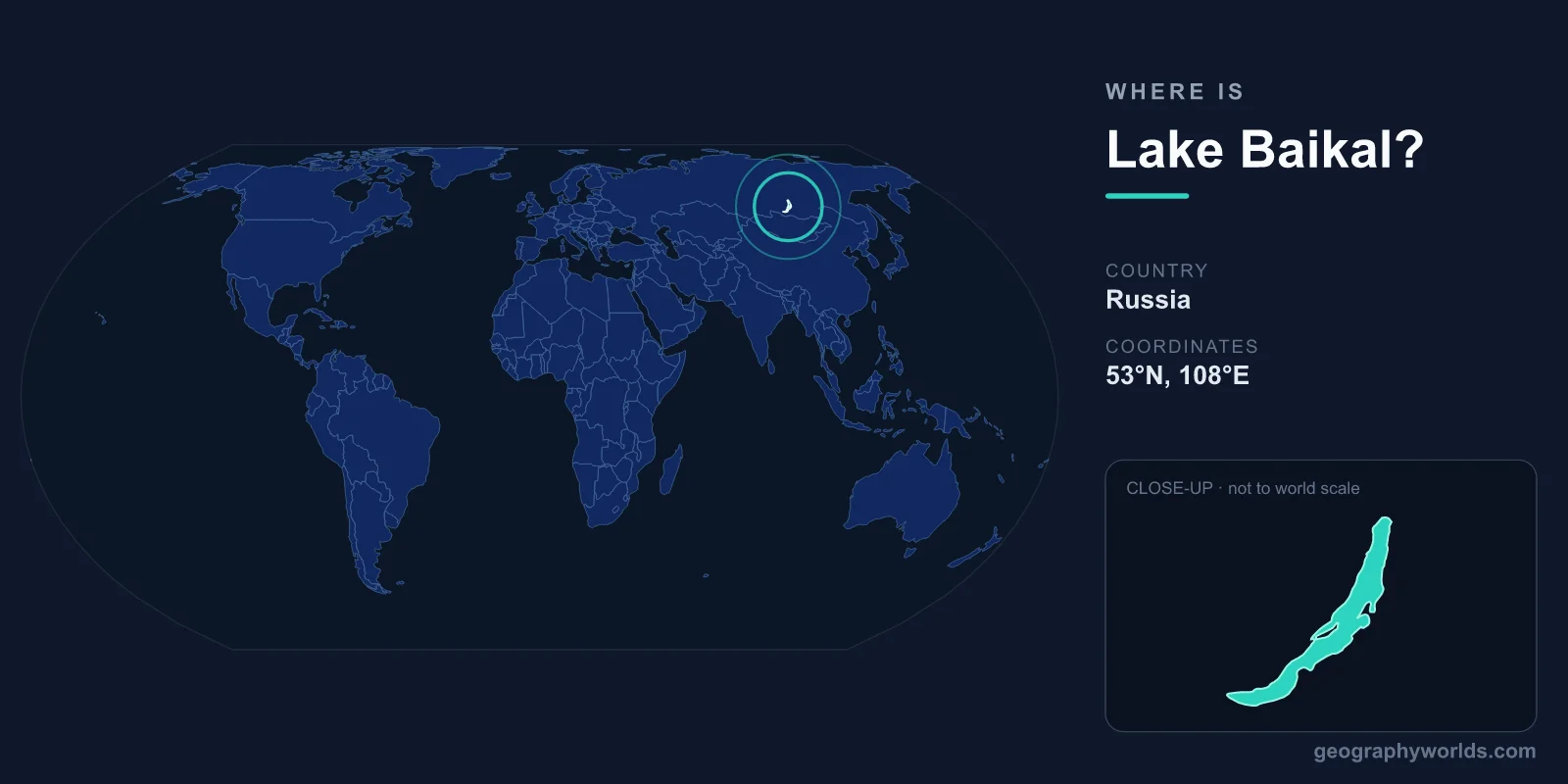
Lake Baikal is located in southeastern Siberia, Russia, centered at approximately 53°N latitude and 108°E longitude. It sits in a rift valley between mountain ranges, roughly 70 kilometers north of the Mongolian border. At 1,642 meters deep, it is the deepest lake on Earth, and at roughly 25 million years old, it is also the oldest.
Introduction
The lake stretches 636 kilometers from southwest to northeast, holding approximately 23,615 cubic kilometers of water — roughly 20 percent of the world's unfrozen surface freshwater. If empty, all the world's major rivers combined would take over a year to fill it.
Exact Location & Coordinates
- Center Coordinates: 53°N, 108°E
- Region: Southeastern Siberia, Russia
- Nearest Major City: Irkutsk (~70 km west)
- Distance to Mongolia: ~70 km north of the border
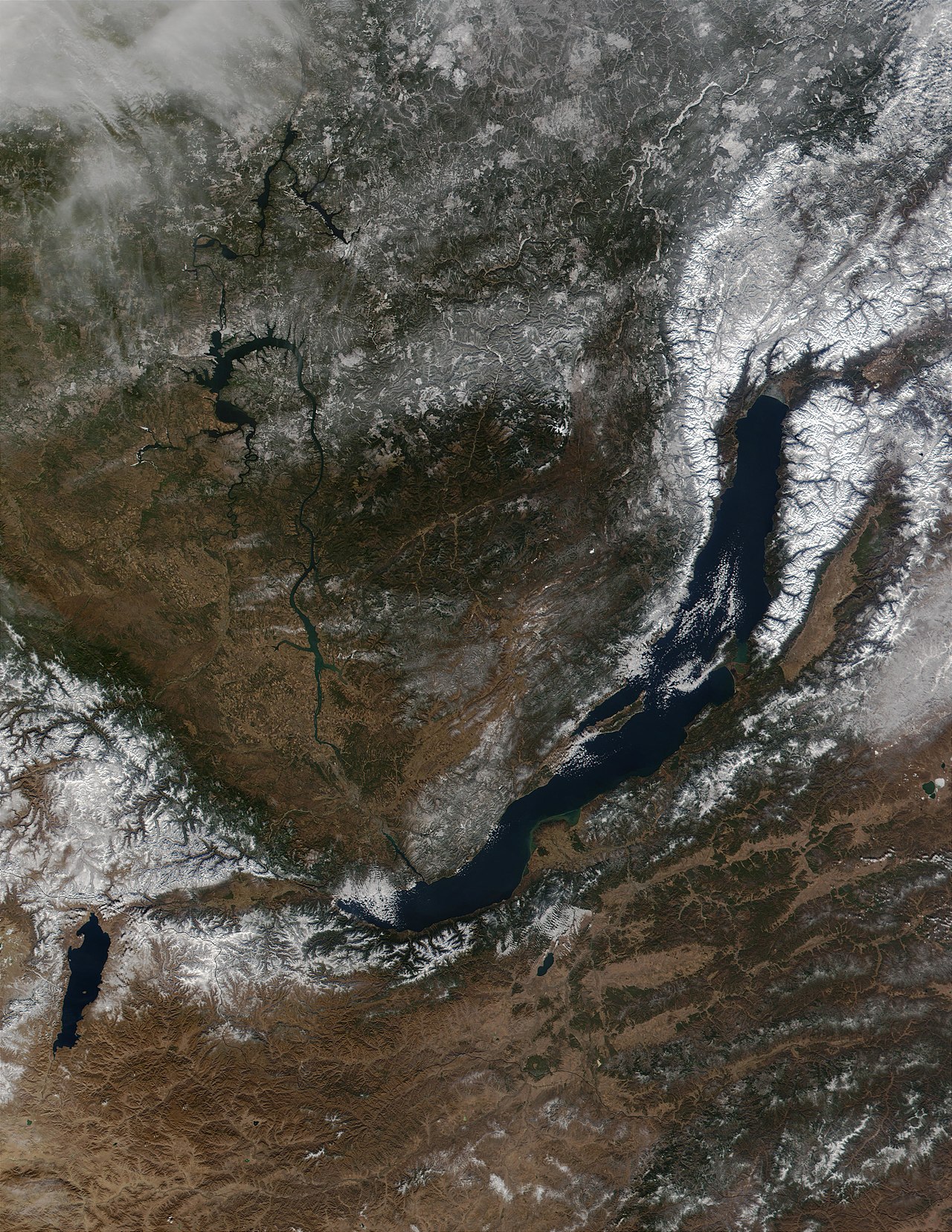
On a world map, Lake Baikal is the distinctive crescent-shaped lake in southern Siberia. Find Russia on a map and look east of the Ural Mountains to Siberia — Baikal is the long, narrow lake roughly midway between Moscow and the Pacific coast, just north of Mongolia. It is easily visible on world maps due to its large size.
The lake lies in the Baikal Rift Zone, an active continental rift where the Earth's crust is slowly pulling apart. Irkutsk, a Siberian city of about 620,000 people, is the main gateway to the lake, located roughly 70 kilometers from its southern tip. The Trans-Siberian Railway runs along the lake's southern shore.
Surrounding Countries & Borders
- Russia: Entirely within Russia (Irkutsk Oblast and Buryatia)
- Mongolia: ~70 km south of the lake
- Key Towns: Irkutsk, Listvyanka, Severobaikalsk
Lake Baikal lies entirely within Russia, shared between Irkutsk Oblast on the western shore and the Republic of Buryatia on the eastern shore. The Buryat people, a Mongolic ethnic group, have lived around the lake for centuries and consider it sacred.
The lake is surrounded by mountain ranges: the Primorsky Range on the west, the Baikal Range on the northwest, and the Barguzin Range on the east. Olkhon Island, the largest island in the lake at 730 square kilometers, is considered the most sacred place in Siberian shamanism.
Geographic Context
- Tectonic Setting: Baikal Rift Zone (continental rift)
- Outflow: Angara River (only outlet)
- Inflow: Over 330 rivers and streams
Lake Baikal occupies an active continental rift that is widening by approximately 2 centimeters per year. In millions of years, this rift could eventually split the Asian continent, creating a new ocean basin. The rift valley is filled with sediment up to 7 kilometers thick beneath the lake floor, meaning the actual bedrock basin is far deeper than the water column.
Over 330 rivers and streams flow into Lake Baikal, with the Selenga River from Mongolia providing about half the total inflow. The lake has only one outlet: the Angara River, which flows north and west to eventually join the Yenisei River and reach the Arctic Ocean.
Physical Characteristics
- Maximum Depth: 1,642 m (world's deepest lake)
- Length: 636 km
- Width: Up to 79 km
- Volume: 23,615 km³ (~20% of world's unfrozen surface freshwater)
- Age: ~25 million years (world's oldest lake)
Lake Baikal holds a staggering array of superlatives. It is the deepest (1,642 m), oldest (~25 million years), and by volume the largest (23,615 km³) freshwater lake on Earth. Its water is exceptionally pure and clear, with visibility sometimes exceeding 40 meters — a result of the filtering action of microscopic crustaceans.
The lake freezes completely in winter, with ice typically 1-2 meters thick forming from January to May. The winter ice is so clear in places that you can see down to remarkable depths. In spring, the ice produces dramatic cracking sounds and beautiful ice formations that attract tourists.
Why It Matters
- Freshwater Reserve: 20% of world's unfrozen surface freshwater
- Biodiversity: Over 2,500 species, ~80% found nowhere else
- Climate Record: Sediments preserve millions of years of climate data
Lake Baikal is home to over 2,500 species of plants and animals, roughly 80 percent of which are endemic — found nowhere else on Earth. The Baikal seal (nerpa) is one of the world's only freshwater seal species. The omul fish is a staple food around the lake. Giant amphipods, sponges, and flatworms in the lake's depths include species found nowhere else.
As a UNESCO World Heritage Site, Baikal faces environmental threats including pollution from industrial cities, agricultural runoff, and climate change. Warming temperatures are reducing the ice season and altering the lake's ecology. Russian and international scientists maintain research stations around the lake to monitor these changes.
Key Facts
- Lake Baikal is centered at approximately 53°N, 108°E in southeastern Siberia, Russia.
- At 1,642 m, it is the deepest lake on Earth, and at ~25 million years, the oldest.
- It holds ~20% of the world's unfrozen surface freshwater (23,615 km³).
- About 80% of its 2,500+ species are endemic — found nowhere else.
- The lake sits in an active continental rift widening by ~2 cm per year.
Fun Facts
- If Lake Baikal were emptied, all the world's major rivers combined would take over a year to refill it.
- The Baikal seal is one of the very few freshwater seal species in the world.
- Baikal's water is so clear that visibility can exceed 40 meters in some areas.
- The lake's winter ice can be so transparent that it's possible to see the lake floor in shallow areas.
Final Thoughts
Lake Baikal lies in southeastern Siberia at approximately 53°N, 108°E, a crescent-shaped rift lake that holds virtually every superlative for freshwater lakes: deepest, oldest, and most voluminous. Containing 20 percent of the world's unfrozen surface freshwater and harboring thousands of unique species, Baikal is one of the most extraordinary natural features on the world map.
Test Your Knowledge!
Think you know where things are on the map? Test your skills!
Play Geography Games →