
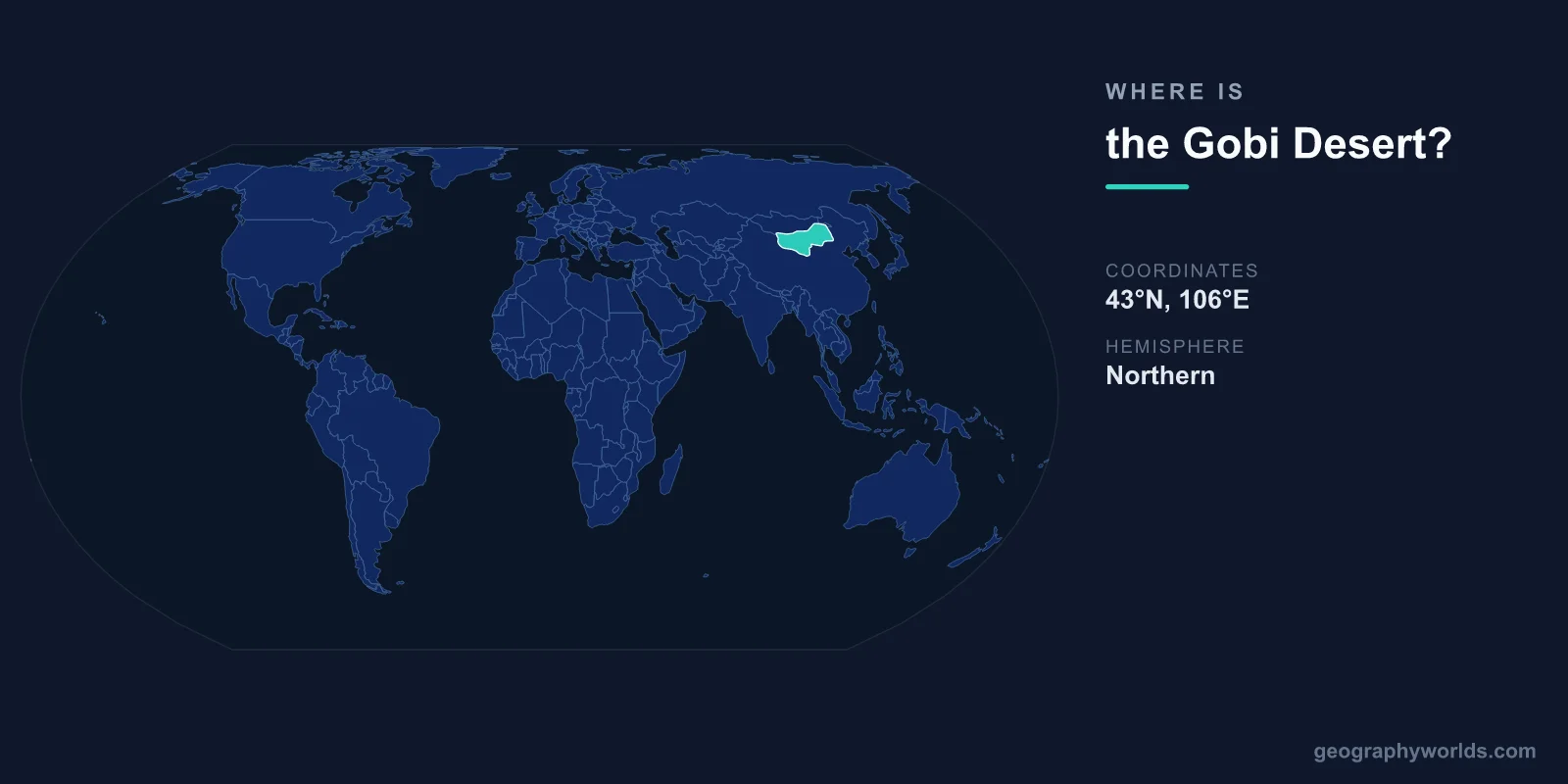
The Gobi Desert is located in Central and East Asia, centered at approximately 42°N latitude and 105°E longitude. It stretches across southern Mongolia and northern China, covering approximately 1,295,000 square kilometers. The Gobi is Asia's largest desert and the fifth-largest in the world.
Introduction
Unlike the sandy Sahara, the Gobi is predominantly a cold desert of bare rock, hard-packed earth, and gravel plains. Its name comes from the Mongolian word meaning "waterless place." The ancient Silk Road crossed the Gobi's fringes, and the desert contains some of the world's richest dinosaur fossil beds.

Exact Location & Coordinates
- Center Coordinates: 42°N, 105°E
- Region: Central/East Asia, Mongolia and China
- Extent: ~1,600 km east-west, ~800 km north-south
On a world map, the Gobi Desert occupies the broad, arid expanse between the Mongolian steppe to the north and the Chinese agricultural regions to the south. It sits in the rain shadow of the Himalayas, which block moisture-laden clouds from the Indian Ocean from reaching this far north.
To locate the Gobi, find Mongolia on a map and look at its southern half — the Gobi covers roughly one-third of Mongolia's territory. In China, it extends across the Inner Mongolia Autonomous Region and parts of Gansu and Xinjiang provinces.
Surrounding Countries & Borders
- Mongolia: Northern and central Gobi
- China: Southern and eastern Gobi (Inner Mongolia, Gansu)
Mongolia's southern aimags (provinces), including Omnogovi, Dundgovi, and Dorngovi, contain the Gobi's most iconic landscapes. The Mongolian Gobi is sparsely populated, with nomadic herders and their livestock being the primary inhabitants. Ulaanbaatar, Mongolia's capital, sits roughly 300 kilometers north of the desert's edge.
China's portion of the Gobi includes the Badain Jaran, Tengger, and Mu Us desert areas within Inner Mongolia. The Chinese section is more developed, with railways and roads crossing the desert. The city of Dunhuang, at the Gobi's western edge, was a major Silk Road oasis and is home to the famous Mogao Caves.
Geographic Context
- Rain Shadow: Himalayas block moisture from the south
- Bordered By: Altai Mountains (north), North China Plain (south)
- Silk Road: Ancient route crossed the Gobi's western edge
The Gobi exists primarily because of the Himalayan rain shadow. Moisture from the Indian Ocean is blocked by the world's highest mountain range, leaving the Gobi region extremely dry. The Altai Mountains define the desert's northern boundary, while the Helan and Yin Mountains mark portions of its southern edge.
The Gobi is expanding southward at a rate of roughly 3,600 square kilometers per year due to desertification and overgrazing. This expansion threatens northern Chinese cities with increasing dust storms. Beijing regularly experiences Gobi dust storms in spring, sometimes severe enough to reduce visibility to near zero.
Physical Characteristics
- Area: 1,295,000 km²
- Highest Elevation: ~1,500 m in western Gobi
- Lowest Point: ~900 m in eastern Gobi
- Temperature Range: -40°C in winter to 45°C in summer
The Gobi is a cold desert, with winter temperatures plummeting to -40°C and summer temperatures reaching 45°C. This extreme range — one of the widest annual temperature swings of any desert — is due to the Gobi's high altitude (averaging 1,000-1,500 meters) and continental position far from any moderating ocean influence.
Only about 5 percent of the Gobi consists of sand dunes. The famous Khongoryn Els dunes in Mongolia, stretching 100 kilometers and rising up to 300 meters high, are among the largest in the world. Most of the Gobi is covered by exposed rock, gravel, and sparse scrubland that supports adapted wildlife including wild Bactrian camels, snow leopards, and Gobi bears.
Why It Matters
- Paleontology: World's richest dinosaur fossil beds
- Silk Road: Ancient transcontinental trade route
- Desertification: Expanding southward, threatening Beijing with dust storms
The Gobi is one of the most important paleontological sites on Earth. In 1923, American explorer Roy Chapman Andrews discovered the first confirmed dinosaur eggs in the Flaming Cliffs (Bayanzag) of Mongolia's Gobi. Since then, dozens of dinosaur species have been found, including Velociraptor and Protoceratops, often in exceptional states of preservation.
The Gobi's expansion through desertification is a major environmental concern. China has responded with the "Great Green Wall" project, an ambitious plan to plant a 4,500-kilometer barrier of trees along the desert's southern edge to halt the spread of sand. This is one of the world's largest ecological engineering projects.
Key Facts
- The Gobi Desert is centered at approximately 42°N, 105°E across Mongolia and northern China.
- It covers about 1,295,000 km², making it Asia's largest desert.
- It is a cold desert with temperatures ranging from -40°C to 45°C.
- The Himalayas create the rain shadow that makes the Gobi so dry.
- Only about 5% of the Gobi is sandy; most is rock and gravel.
Fun Facts
- The first confirmed dinosaur eggs were discovered in the Gobi in 1923.
- The Gobi is expanding southward by roughly 3,600 km² per year.
- Wild Bactrian camels, among the rarest large mammals on Earth, survive in the Gobi.
- Gobi dust storms regularly reach Beijing, over 1,000 km to the southeast.
Final Thoughts
The Gobi Desert stretches across Mongolia and northern China at approximately 42°N, 105°E, covering 1.3 million square kilometers of Central Asia. A cold, high-altitude desert in the rain shadow of the Himalayas, it holds world-class dinosaur fossils, Silk Road history, and dramatic landscapes. Its ongoing expansion makes it one of the most dynamic and consequential desert features on the world map.
Test Your Knowledge!
Think you know where things are on the map? Test your skills!
Play Geography Games →