
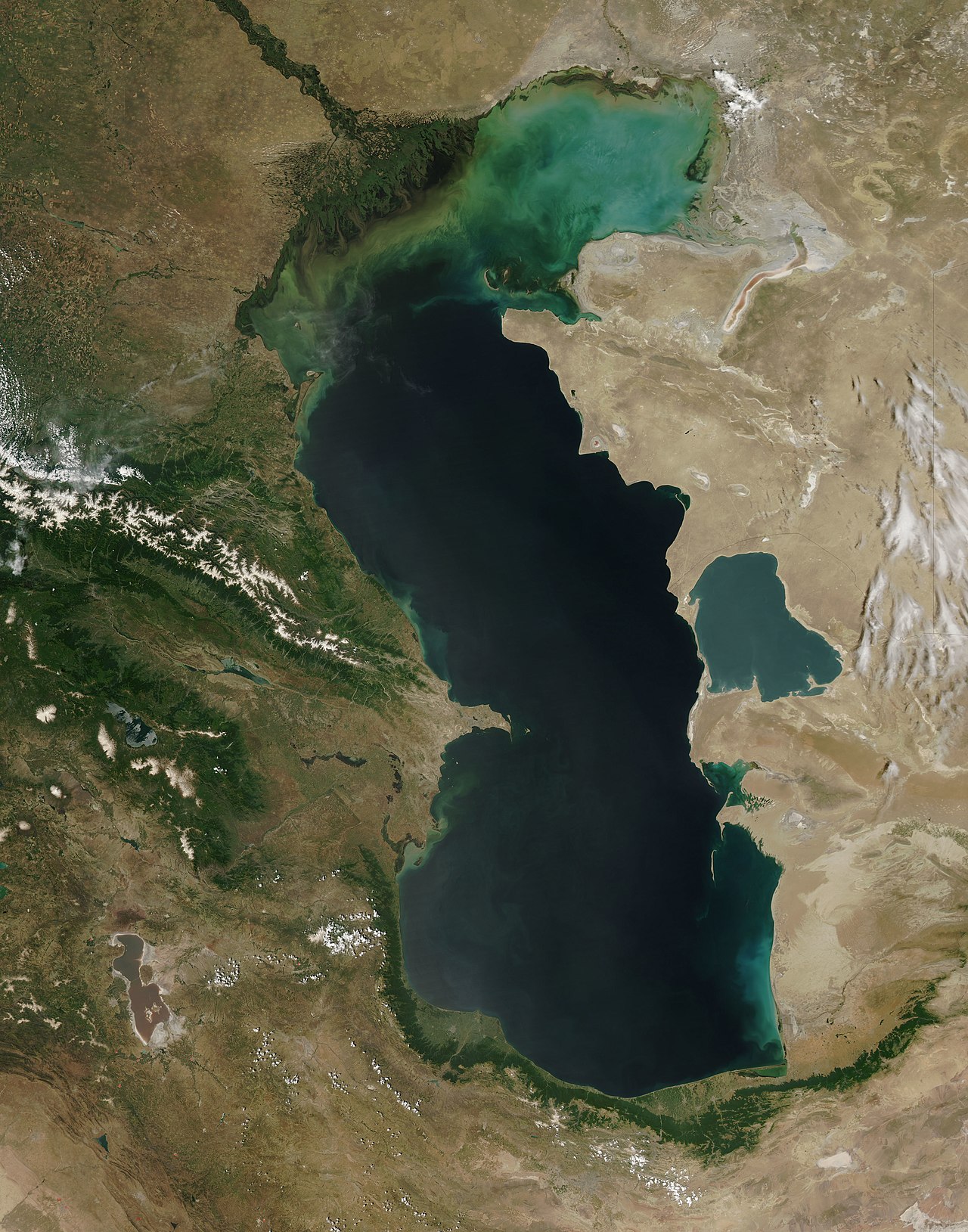
DIRECT ANSWER: The Caspian Sea is the world's largest enclosed body of water and is technically a lake, sitting below sea level with no natural link to the ocean, while the Black Sea is a true sea connected to the Mediterranean via the Turkish Straits. They differ sharply in size, depth, salinity, hydrology and legal status.

Stretched across the crossroads of Europe and Asia lie two of the planet's most remarkable inland waters. To a casual glance they seem like siblings — enormous, landlocked-looking basins ringed by nations whose histories flow through them. Yet the Caspian Sea and the Black Sea are strikingly different bodies of water, shaped by tens of millions of years of geological drama. One is technically a lake; the other is a genuine sea. Understanding what separates them reveals a fascinating story about geology, chemistry, wildlife and geopolitics.
A Shared Ancient Origin
Both seas are remnants of a vast prehistoric ocean called the Paratethys, which once covered much of Eurasia. As tectonic plates collided and mountain ranges such as the Caucasus rose, this ancient sea was carved into separate basins. Over millions of years, some of these fragments dried up entirely, while others survived as the water bodies we know today.
The crucial fork in their histories came down to connection. The Black Sea retained — or periodically regained — a link to the wider ocean through what is now the Mediterranean. The Caspian, by contrast, became fully isolated roughly five million years ago, sealed off from any ocean outlet. That single difference explains almost everything else about them: their salinity, their water levels, and even their unique wildlife. The Caspian, cut off and evolving alone, became a world unto itself.
Why isolation matters
When a basin loses its connection to the ocean, it becomes entirely dependent on the balance between river inflow and evaporation. That balance determines whether the water freshens, grows saltier, or fluctuates in level. The Caspian's isolation is precisely why scientists classify it as the world's largest lake rather than a sea, despite its name and its enormous size.
Profile: The Caspian Sea
The Caspian Sea covers roughly 371,000 square kilometres, making it the largest enclosed body of water on Earth. One of its most surprising features is its elevation: the surface sits about 28 metres below global sea level, and that level naturally rises and falls over decades depending on the flow of its feeder rivers and evaporation rates.
Its waters are brackish, with an average salinity of about 1.2 percent — roughly a third of the ocean's saltiness. This varies within the sea itself: the north is noticeably fresher, diluted by the mighty Volga River, which supplies around 80 percent of all inflow, while the southern reaches are considerably saltier. At its deepest, the Caspian plunges to about 1,025 metres.
- Bordering countries (5): Russia, Kazakhstan, Turkmenistan, Iran and Azerbaijan.
- Status: Technically a lake — no natural connection to the ocean.
- Signature resource: Vast oil and gas reserves, including Kazakhstan's giant Kashagan field and Azerbaijan's Baku fields, which have produced oil since the 19th century.
The Caspian's oil wealth has made it one of the most economically strategic bodies of water in the world. To manage competing claims, the five bordering states signed a landmark Convention on the Legal Status of the Caspian Sea in 2018, an agreement that carefully avoided defining it strictly as either a lake or a sea — a distinction with major legal and economic consequences.
Profile: The Black Sea
The Black Sea is both larger and deeper than the Caspian, spanning approximately 436,400 square kilometres with a maximum depth of around 2,212 metres. Crucially, it is a true sea: it connects to the Mediterranean through the narrow Bosporus and Dardanelles straits — collectively the Turkish Straits — by way of the small Sea of Marmara between them.
Its surface salinity averages about 1.8 percent, rising to roughly 2.2 percent in its deep waters. But the Black Sea's most extraordinary characteristic lies hidden beneath the surface. It is the world's largest meromictic basin, meaning its layers do not mix. Below about 150 to 200 metres, the water is completely anoxic — devoid of oxygen and saturated with hydrogen sulphide. As a result, roughly 90 percent of the sea's volume is a dark, lifeless deep layer where almost nothing can survive, though this same environment preserves ancient shipwrecks in remarkable condition.
- Bordering countries (6): Turkey, Bulgaria, Romania, Ukraine, Russia and Georgia.
- Major rivers in: the Danube, Dnieper, and the Don (via the Sea of Azov).
- Strategic feature: The Bosporus, a critical maritime chokepoint linking the sea to the Mediterranean and beyond.
That connection to the wider ocean makes the Black Sea a vital trade and naval artery, and the Bosporus one of the most geopolitically sensitive waterways on Earth.
Caspian vs Black Sea: Key Differences at a Glance
Placing the two side by side makes their contrasts clear. While both are enormous Eurasian inland waters, nearly every defining metric sets them apart:
- Surface area: Caspian ~371,000 km²; Black Sea larger at ~436,400 km².
- Maximum depth: Caspian ~1,025 m; Black Sea more than twice as deep at ~2,212 m.
- Salinity: Caspian brackish (~1.2%, about a third of ocean levels); Black Sea saltier (~1.8% at the surface, ~2.2% at depth).
- Status: Caspian is technically a lake, fully isolated; Black Sea is a true sea connected to the Mediterranean.
- Elevation: Caspian surface sits ~28 m below sea level and fluctuates; Black Sea is at sea level.
- Bordering states: Caspian 5; Black Sea 6.
- Oxygen: Caspian is oxygenated throughout much of its column; the Black Sea's deep ~90% is anoxic and lifeless.
In short, the Black Sea is bigger, deeper, saltier and connected, while the Caspian is a below-sea-level, isolated, brackish, oil-rich lake with wildlife found nowhere else. If you enjoy this kind of comparison, you might also like our look at the Danube versus the Rhine or our roundup of the largest lakes in the world.
Ecology and Wildlife
Because it evolved in isolation, the Caspian Sea is home to species found nowhere else on the planet. The most charismatic is the Caspian seal, one of the world's smallest seals and now endangered. The sea is also famous for its sturgeon — several species that are the source of the world's most prized caviar. Sadly, decades of overfishing and pollution have devastated these populations, with some declining by more than 90 percent from historic levels.
The Black Sea supports its own rich ecosystem, but only in its upper, oxygenated layers. Its shallower shelves and river deltas — particularly around the Danube — teem with fish and birdlife. Yet the vast anoxic depths below remain biologically dead, an unusual constraint that concentrates all marine life into a relatively thin surface band.
Shared pressures
Both seas face serious environmental challenges. Pollution from industry, agriculture and shipping, along with the strain of energy extraction and fluctuating water levels, threatens the delicate balance of each basin. Conservation efforts increasingly require cooperation among the many nations that share their shores.
Economy, Geopolitics and Why They Matter
Few bodies of water carry as much strategic weight as these two. The Caspian's oil and gas reserves have drawn investment and diplomatic manoeuvring for over a century, and its resources continue to shape the fortunes of the surrounding states. The 2018 legal convention was a rare moment of consensus among five nations with often competing interests.
The Black Sea, meanwhile, is defined by access. As the gateway between landlocked interiors and the Mediterranean, it is a lifeline for grain exports, energy shipments and naval power projection. Control of the Bosporus has influenced empires and alliances for millennia and remains a flashpoint in modern geopolitics.
For anyone curious about the region, the surrounding nations are worth exploring — see our list of countries in Europe for context on the many states these waters touch. And if you want to test how well you know the world's seas, rivers and borders, try our world geography quiz.
Two seas, one lesson
The Caspian and Black seas remind us that a name can be misleading. One "sea" is really the world's greatest lake; the other is a genuine ocean arm hiding a lifeless deep. Together they tell a story of ancient geology, isolated evolution and enduring human ambition — proof that even the most familiar-looking waters can hold profound surprises.