
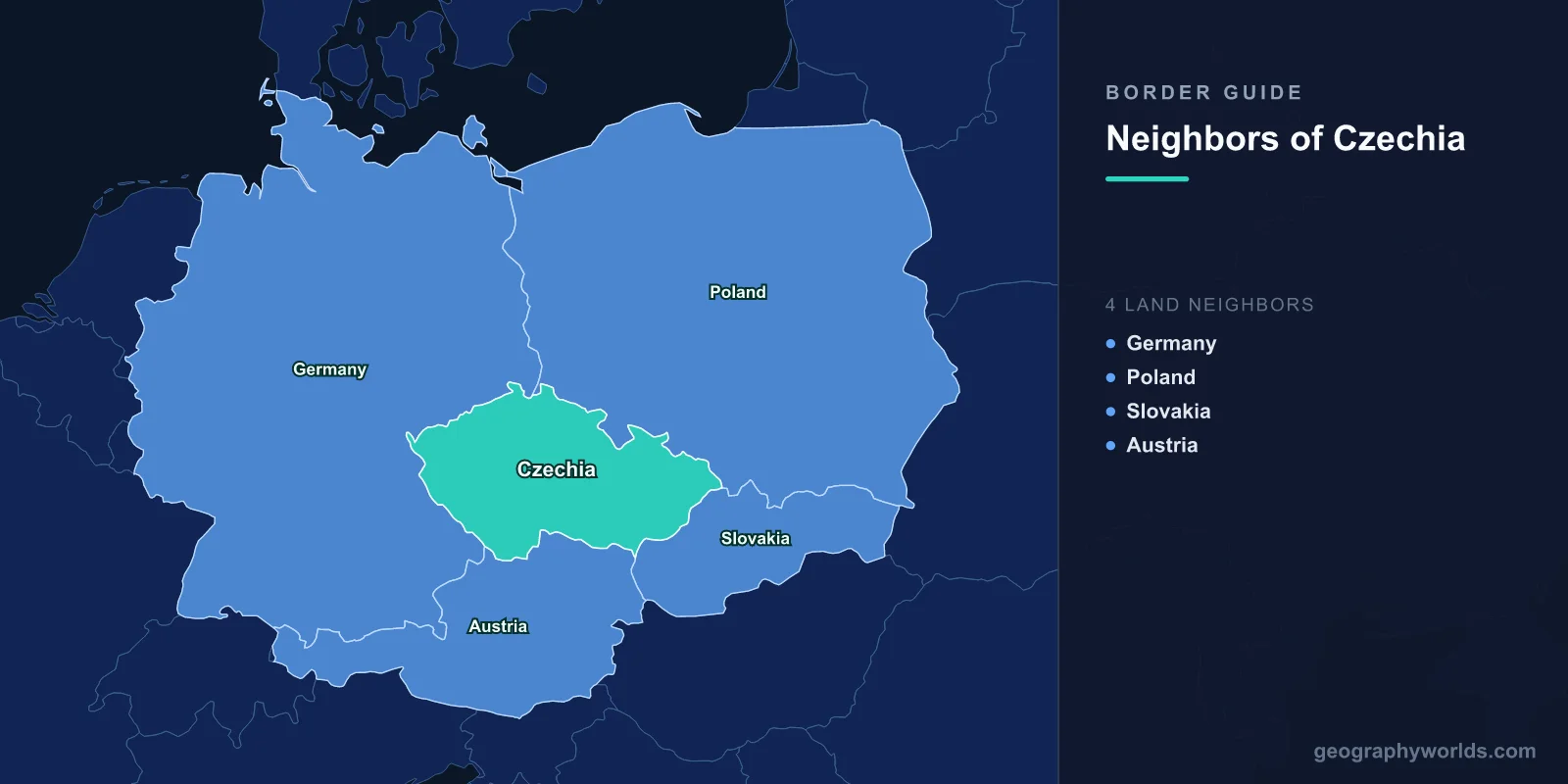
The Czech Republic (Czechia) shares land borders with four countries: Germany to the west and northwest, Poland to the north and northeast, Slovakia to the southeast, and Austria to the south.
Introduction
Czechia's borders are remarkably well-defined by natural features, particularly mountain ranges. The historical lands of Bohemia, Moravia, and Czech Silesia are largely enclosed by the Bohemian Forest, Ore Mountains, Sudeten Mountains, and Carpathian foothills, forming a natural basin that has served as a distinct geographic and political entity for over a thousand years.

Overview of Czechia's Borders
- Total Land Borders: 2,143 km
- Number of Neighbors: 4 countries
- Longest Border: Germany (704 km)
- Shortest Border: Austria (362 km)
Czechia's borders form an almost complete mountain rim around the Bohemian Basin, a geographic feature that has given the country remarkable territorial stability. The mountain borders served as natural defensive barriers throughout history and today create scenic frontier regions popular with hikers and skiers.
The country sits at a crossroads of Central Europe, bordering both Western European powers (Germany, Austria) and former Soviet-bloc nations (Poland, Slovakia). All four neighbors are in the EU and Schengen Area, making Czechia's borders fully open for travel and trade.
Western Neighbor: Germany
- Border Length: 704 km
- Key Ranges: Ore Mountains (Erzgebirge), Bohemian Forest (Sumava)
- Major Crossings: Rozvadov, Pomezi, Cinovec
Germany is Czechia's longest border at 704 km, wrapping around the western and northwestern edge of the Bohemian Basin. The Bohemian Forest (Sumava) in the southwest is one of Central Europe's largest continuous forests and a UNESCO Biosphere Reserve. The Ore Mountains (Erzgebirge/Krusne Hory) in the northwest were historically famous for silver mining that fueled the Bohemian economy.
The German-Czech border was transformed by the expulsion of 3 million Sudeten Germans after World War II, which depopulated the border region. Much of this area remained undeveloped during the communist era and has inadvertently become a wildlife corridor. Today, German tourists flock to Czech border towns for affordable healthcare, dining, and the famous Karlovy Vary (Carlsbad) spa.
Northern Neighbor: Poland
- Border Length: 796 km
- Key Ranges: Giant Mountains (Karkonosze), Jeseniky Mountains
- Major Crossings: Nachod, Harrachov, Cieszyn
The Polish border at 796 km is actually Czechia's longest when measured precisely, running through the Sudeten mountain chain. The Giant Mountains (Krkonose/Karkonosze), including Snezka (1,602 m), Czechia's highest peak, straddle this border. The Krkonose National Park and its Polish counterpart form a shared UNESCO Biosphere Reserve.
The border region includes the culturally distinct area of Tesinske Slezsko (Cieszyn Silesia), where the cities of Cesky Tesin and Cieszyn face each other across the Olza River. This area was contested between Czechoslovakia and Poland in 1919-1920 and has significant Polish-speaking communities on the Czech side. Today it is a vibrant cross-border community.
Southern and Eastern Neighbors: Austria and Slovakia
- Austria Border: 362 km
- Slovakia Border: 252 km
- Key Features: Dyje/Thaya river, White Carpathians, Morava river
The Austrian border runs 362 km across the rolling hills of southern Moravia and the Bohemian-Moravian Highlands. Unlike the mountain-defined borders elsewhere, this frontier crosses gentler terrain along the Dyje (Thaya) River and through wine-growing regions. The Iron Curtain ran along much of this border until 1989, and abandoned watchtowers and cleared strips are still visible in places.
The Slovak border at 252 km is the shortest and most historically significant. Czechoslovakia was a single country from 1918 to 1992, and the peaceful separation (the Velvet Divorce) created this border on January 1, 1993. The White Carpathians form part of the frontier, while the Morava River defines another section. Despite the split, Czech-Slovak relations remain extremely close.
Cross-Border Relations and Trade
- EU/Schengen: All 4 neighbors are in Schengen
- Largest Trade Partner: Germany (about 30% of Czech trade)
- Cross-Border Workers: Tens of thousands commute to Germany and Austria
Germany dominates Czech foreign trade, accounting for roughly 30% of both exports and imports. The Czech automotive industry, anchored by Skoda (owned by Volkswagen), is deeply integrated into German supply chains. Austrian companies are also major investors in Czechia, particularly in banking, retail, and real estate.
Cross-border tourism and commuting are significant on all borders. German day-trippers visit Czech border towns, while Czech workers commute to higher-paying jobs in Germany and Austria. Polish-Czech cross-border cooperation in the Sudeten Mountains supports joint tourism marketing, hiking trail networks, and environmental protection programs.
Key Facts
- Czechia borders 4 countries: Germany, Poland, Slovakia, and Austria.
- The Bohemian Basin is almost entirely enclosed by mountain ranges that form the country's borders.
- Snezka (1,602 m) on the Polish border is the Czech Republic's highest peak.
- The Czech-Slovak border was created in 1993 after the peaceful Velvet Divorce.
- Germany accounts for roughly 30% of Czech foreign trade.
Fun Facts
- The Sudeten Mountains gave their name to the Sudetenland crisis of 1938, a pivotal event leading to World War II.
- Czechia's border with Germany is sometimes called the "beer border" due to the many border-town breweries.
- The Bohemian Forest is home to lynx that have been reintroduced and now cross between the Czech and German sides.
- Karlovy Vary (Carlsbad), near the German border, gave its name to the mineral carlsbad twins in crystallography.
Final Thoughts
Czechia's four borders define one of Europe's most geographically coherent nations, with mountain ranges encircling the Bohemian Basin like a natural fortress. From the post-war transformation of the Sudetenland to the peaceful creation of the Slovak border, Czechia's frontiers tell the story of Central Europe's dramatic 20th century while today serving as open, prosperous corridors of European integration.
Test Your Knowledge!
Think you know which countries share borders? Try our geography games!
Play Geography Games →