
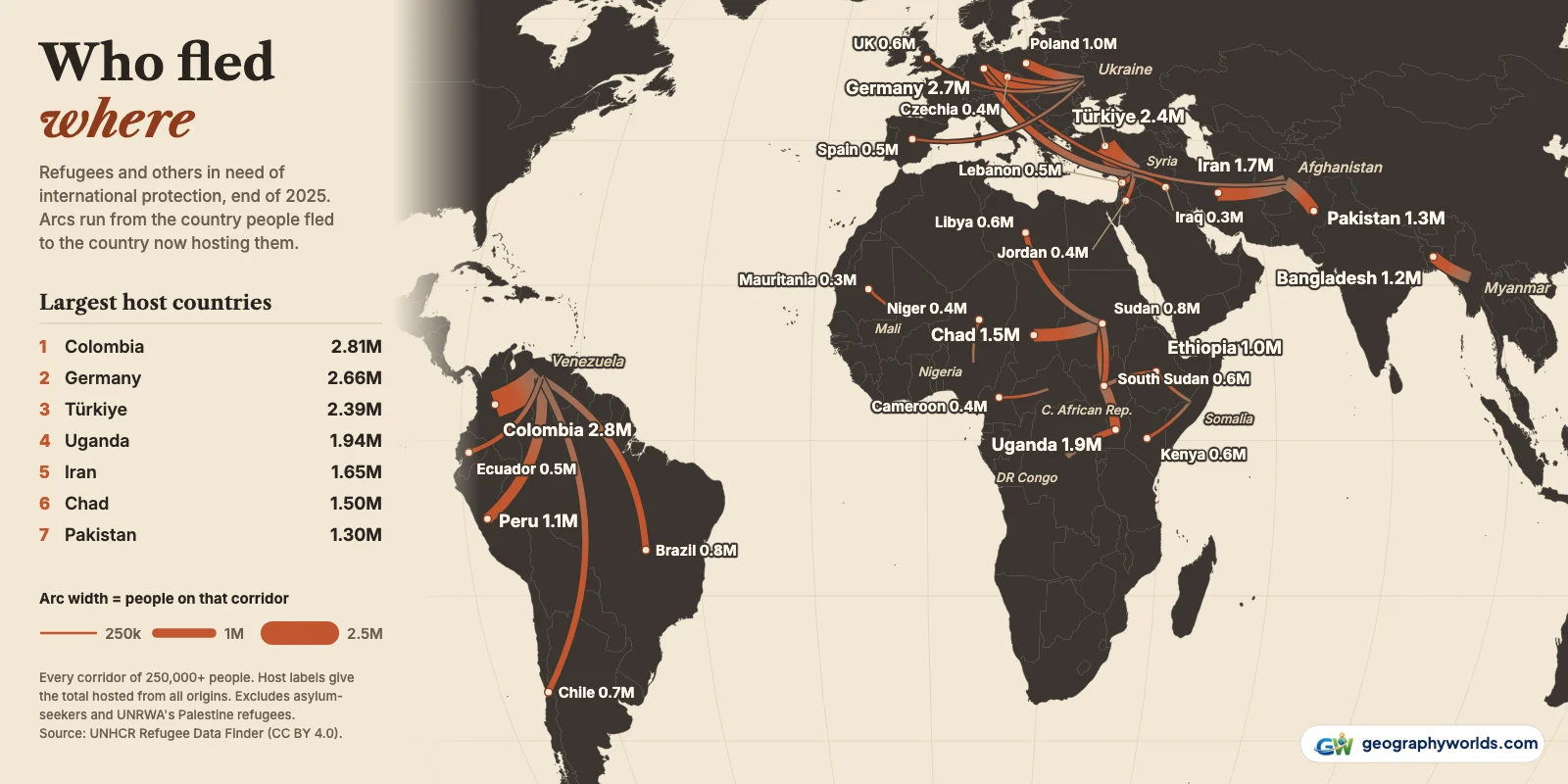
Colombia hosts the most refugees and other people in need of international protection, about 2.8 million at the end of 2025, almost all of them Venezuelan, according to the UN Refugee Agency (UNHCR). Germany is second with 2.7 million and Türkiye third with 2.4 million, followed by Uganda (1.9 million), Iran (1.7 million), Chad (1.5 million) and Pakistan (1.3 million). Counted by where people fled from, the largest country of origin is Venezuela (6.46 million), then Ukraine (5.2 million), Syria (4.9 million), Afghanistan (3.7 million) and Sudan (2.8 million). Relative to population, Lebanon carries the heaviest load of any country with a million people or more: about one resident in 11 is a refugee.
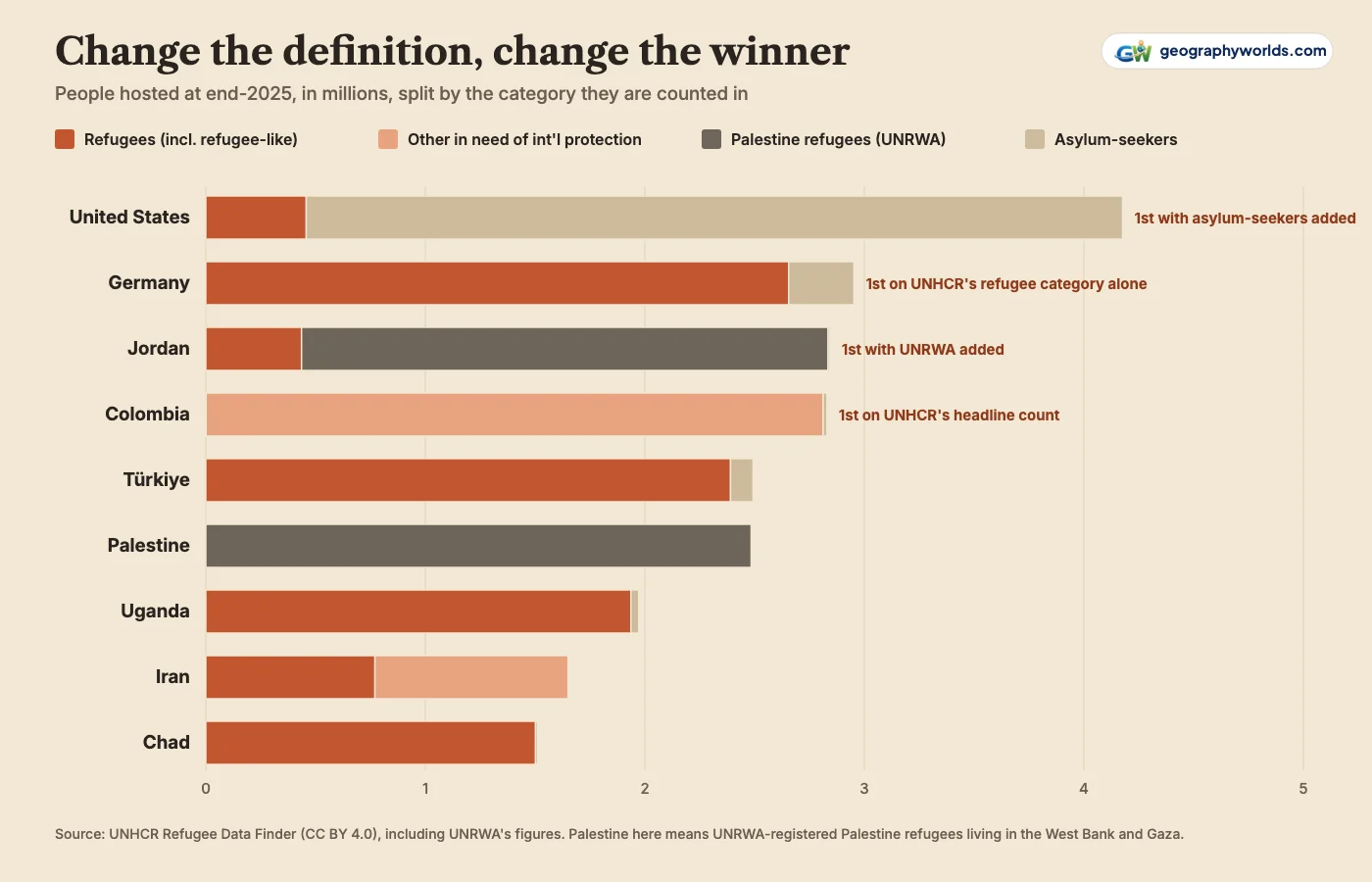
Those rankings count two of UNHCR's categories together: refugees under its mandate (including people in a refugee-like situation), and "other people in need of international protection", a category that is mostly Venezuelans (6.0 million of 7.2 million) along with Afghans in Iran and Pakistan. Worldwide that comes to 35.6 million people. It leaves out three groups that often get mixed in: the 6.0 million Palestine refugees registered with UNRWA, a separate UN agency; 9.0 million asylum-seekers still waiting for a decision; and internally displaced people, who never crossed a border. Count only UNHCR's refugee category and Germany comes first. Add UNRWA's figures and Jordan edges ahead. Add asylum-seekers and the United States leads. The chart below shows all four.
The host ranking is, above all, a map of a handful of crises. The six largest hosts hold 36% of everyone under UNHCR's mandate, and UNHCR's Global Trends 2025 report finds that 65 per cent live in a country next door to the one they fled. So the clearest way to read the list is crisis by crisis, region by region.
| Rank | Host country | Refugees* | Other in need of protection | Total | Per 1,000 residents | Largest origin |
|---|---|---|---|---|---|---|
| 1 | Colombia | 1,464 | 2,810,778 | 2,812,242 | 52.4 | Venezuela (>99%) |
| 2 | Germany | 2,655,191 | – | 2,655,191 | 31.7 | Ukraine (44%) |
| 3 | Türkiye | 2,390,414 | – | 2,390,414 | 27.2 | Syria (98%) |
| 4 | Uganda | 1,936,719 | – | 1,936,719 | 37.2 | South Sudan (53%) |
| 5 | Iran | 770,514 | 879,500 | 1,650,014 | 17.8 | Afghanistan (99%) |
| 6 | Chad | 1,502,263 | – | 1,502,263 | 70.6 | Sudan (89%) |
| 7 | Pakistan | 1,159,038 | 140,558 | 1,299,596 | 5.1 | Afghanistan (>99%) |
| 8 | Bangladesh | 1,178,038 | – | 1,178,038 | 6.7 | Myanmar (>99%) |
| 9 | Peru | 6,788 | 1,098,014 | 1,104,802 | 31.8 | Venezuela (>99%) |
| 10 | Ethiopia | 1,010,466 | – | 1,010,466 | 7.4 | South Sudan (42%) |
| 11 | Poland | 990,469 | – | 990,469 | 26.1 | Ukraine (98%) |
| 12 | Brazil | 278,966 | 549,534 | 828,500 | 3.9 | Venezuela (84%) |
| 13 | Sudan | 809,816 | – | 809,816 | 15.4 | South Sudan (78%) |
| 14 | France | 788,419 | – | 788,419 | 11.8 | Afghanistan (13%) |
| 15 | Chile | 2,631 | 662,504 | 665,135 | 33.4 | Venezuela (>99%) |
South America: Venezuela's exodus
Venezuela is the largest source on the list, with 6.46 million people abroad who need protection. Only 417,000 of them are in UNHCR's refugee category; the other 6.0 million are counted as other people in need of international protection, most of them on residence permits. UNHCR says 97 per cent stayed in Latin America or the Caribbean.
Colombia, Venezuela's western neighbour, took the largest share: 2.8 million people, which is why it tops the world table. Peru hosts 1,103,000 Venezuelans, Brazil 699,000, Chile 662,600 and Ecuador 435,800. Colombia's government counts slightly more: Migración Colombia recorded 2,841,389 Venezuelans in the country in February 2026. Colombia is also home to 7.2 million internally displaced Colombians, a legacy of its own long conflict that never appears in refugee tables.
Europe: Ukraine's refugees after four years
Ukraine is the second-largest origin, with 5.2 million refugees at the end of 2025, 2% more than a year earlier. Germany hosts 1,173,200, Poland 972,300, Czechia 393,000, the United Kingdom 270,500 and Spain 251,300. Most hold the EU's temporary protection rather than refugee status, and Eurostat's December 2025 count is close to UNHCR's: 1,215,255 in Germany and 965,655 in Poland.
Germany's total of 2.7 million is built from three crises at once: Ukrainians, 668,600 Syrians and 288,300 Afghans. That gives it the largest number in UNHCR's "refugee" category, which includes temporary protection. Germany's statistics office, Destatis, counted 2,697,565 people with a recognised protection status on 31 December 2025, within 2 per cent of UNHCR's figure; its larger total of 3.24 million protection seekers also includes pending and rejected claims. Per head, the burden sits further east. Moldova hosts 148,900 Ukrainians, 50 for every 1,000 residents, and Czechia 38 per 1,000, against Germany's 32.
The Middle East: Syrians start to go home
Syria has been one of the largest refugee crises for more than a decade. The fall of the Assad government in December 2024 changed that. UNHCR counted 4.9 million Syrian refugees at the end of 2025, down 18% in a year, after about 1.3 million went home, most of them from Türkiye (556,000) and Lebanon (465,600).
Türkiye still hosts 2,347,800 Syrians, 98% of all the refugees in the country, but its total fell 19%, from 2.9 million to 2.4 million. The Syrian figure is the Turkish government's own register of temporary protection holders, which the Asylum Information Database reports at exactly 2,347,756 on 31 December 2025. Lebanon has 532,400 registered Syrians, Jordan 420,800 and Iraq 308,200. Lebanon's government puts its Syrian population far higher, at 1.12 million according to UNHCR's report, because many were never registered.
Palestine refugees: six million counted separately
UNHCR's tables leave out the Palestine refugees registered with UNRWA, a separate UN agency that serves them. UNRWA counted 6.0 million at the end of 2025: 2,398,200 in Jordan, 2.5 million in the West Bank and Gaza, 358,000 in Syria and 228,300 in Lebanon, and about 495,800 registered refugees UNRWA no longer places in a host country, partly because Lebanon's register of 486,300 was revised to 228,300 residents, as UNHCR's report explains. Treated as one origin, Palestinians would rank second only to Venezuela.
Add them to UNHCR's figures and Jordan becomes the world's largest host, with 2,834,405 people, just 22,200 more than Colombia. That ranking needs a caveat. UNRWA reports that the majority of Palestine refugees in Jordan hold Jordanian citizenship, as a 2024 country report quoting UNRWA notes, with the roughly 180,000 who fled Gaza in 1967 the main exception. They still count as Palestine refugees under UNRWA's mandate, but most are not in the position of a newly arrived Venezuelan in Colombia.
South Asia: Afghans pushed out of Iran and Pakistan
For four decades Iran and Pakistan were home to most Afghan refugees. In 2025 both governments pushed large numbers to leave. Iran stopped renewing the documents of over 2 million Afghans in March 2025, and UNHCR's Global Trends report records 1.9 million Afghans returning from Iran during the year, sometimes more than 40,000 a day in July. About 1 million more returned from Pakistan.
The result is the sharpest fall among the 15 largest hosts. Iran's total dropped 53%, from 3.5 million to 1.7 million, and only 770,500 of those left are counted as refugees; the other 879,500 are other people in need of protection. Pakistan fell 17% to 1.3 million. Worldwide, Afghans abroad who need protection fell 36%, from 5.8 million to 3.7 million, and UNHCR judged most of the returns involuntary.
The Sahel and North Africa: Sudan's war
Sudan's is the fastest-growing of the major crises. Refugees from Sudan rose 35% in 2025, to 2.8 million, and another 9.1 million people remain displaced inside the country, what UNHCR calls the largest internal displacement crisis in the world. Chad, across Sudan's western border, has taken the most: 1,331,000 Sudanese. With 140,100 refugees from the Central African Republic as well, Chad hosts 1.5 million people, 71 for every 1,000 residents.

Libya now hosts 551,700 Sudanese, and South Sudan 571,100. Egypt is harder to read: UNHCR had registered 834,200 Sudanese there as refugees or asylum-seekers, while Egypt's government reports 1.5 million arrivals since the war began. Four of Sudan's seven neighbours, set out in our guide to the countries that border Sudan, have each taken in hundreds of thousands.
East Africa: why Uganda shelters 1.9 million
Uganda is Africa's largest host, with 1.9 million people. Of these, 1,033,600 come from South Sudan and 644,500 from the Democratic Republic of the Congo, with 92,700 Sudanese on top. Uganda has taken in refugees for decades, and its numbers are still rising: UNHCR recorded 16 per cent more Congolese and 6 per cent more South Sudanese there than a year earlier.
South Sudan's own refugee population reached 2.4 million, and the flows cross each other. While 571,100 Sudanese sheltered in South Sudan, 635,000 South Sudanese were still living in Sudan. Ethiopia hosts 1,010,500, including 422,900 South Sudanese, 317,900 Somalis and 162,100 Eritreans, and Kenya 617,100, mostly Somalis (319,500) and South Sudanese (202,800).
Bangladesh: the Rohingya camps of Cox's Bazar
Bangladesh hosts 1,178,000 refugees from Myanmar, almost all of them Rohingya, who are also stateless: UNHCR counts them both as refugees and among the 1.8 million stateless Rohingya worldwide. Most live around Kutupalong in Cox's Bazar district, which UNHCR's report calls the world's largest refugee camp, and most fled Myanmar in 2017. In 2025 another 145,900 Rohingya were recorded as seeking protection, 94 per cent of them identified through biometric registration in Bangladesh.

The countries carrying the most per resident
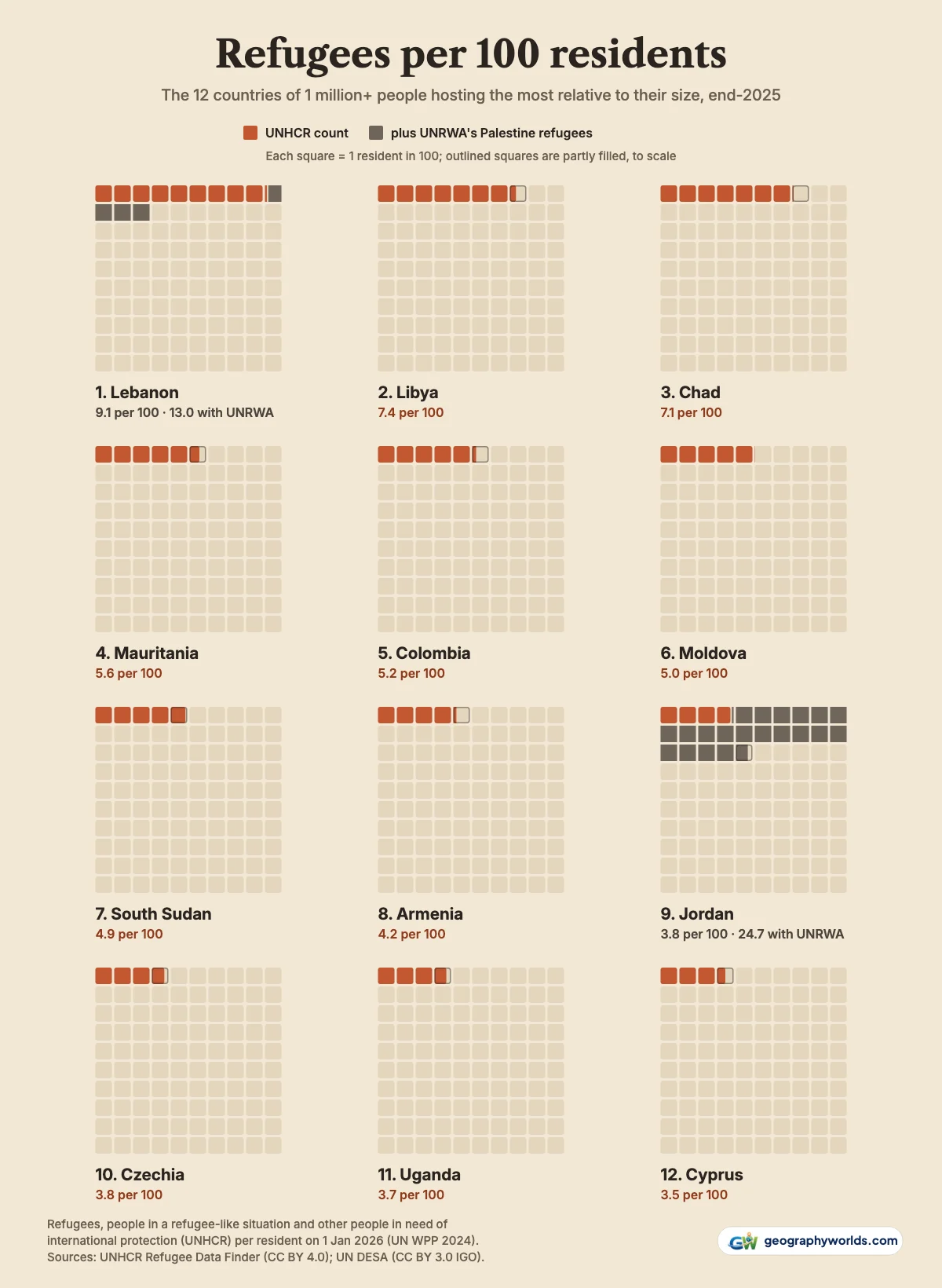
Divide each country's refugees by its population and the order changes again. Among countries of a million people or more, Lebanon leads with 91 per 1,000 residents, and about one in 8 once UNRWA's refugees are counted. Libya (74), Chad (71) and Mauritania (56, almost all Malians) follow. Armenia, at 42, hosts 115,300 refugees from Azerbaijan. Jordan, with Palestine refugees included, reaches about one in 4. Among smaller territories Aruba is higher still, with 11,500 people in need of protection, almost all Venezuelan, among about 108,200 residents.
By origin, the picture is just as concentrated. Six countries, Venezuela, Ukraine, Syria, Afghanistan, Sudan, South Sudan, account for 71% of everyone under UNHCR's mandate:
What the numbers leave out
Every figure here is a stock at 31 December 2025, compiled by UNHCR from government registers and its own registration, with data received up to 1 May 2026. Asylum-seekers are not included in the main ranking because their claims are undecided; the United States alone had 3.7 million pending, which would put it first with 4.2 million if they were added. Per-capita figures divide by the UN's population estimate for 1 January 2026. Registered counts also miss people who never registered, which is why Lebanon's and Egypt's governments report higher numbers than UNHCR does.
The table covers 178 countries and territories with every category kept in its own column, and you can download the data as a CSV; anyone who wants to turn those columns into charts of their own can load the file into Parity. Sources:
- UNHCR Refugee Population Statistics Database (Refugee Data Finder API), end-2025: refugees, people in a refugee-like situation, other people in need of international protection, asylum-seekers and IDPs by country of asylum and origin; includes UNRWA's Palestine refugee figures; data as of 1 May 2026; CC BY 4.0 (licence as stated on UNHCR's official 'refugees' data package on CRAN)
- UNHCR, Terms of Use for Datasets
- UNHCR, Global Trends: Forced Displacement in 2025 (June 2026)
- UN DESA Population Division, World Population Prospects 2024: population on 1 January 2026 (medium projection), used for per-capita figures; CC BY 3.0 IGO
- Natural Earth country outlines (via world-atlas): public domain
Most of these people travelled only as far as the next border, but some journeys run across continents, and our guide to refugee routes around the world follows them; for people who moved by choice rather than by force, see the countries with the most immigrants.