
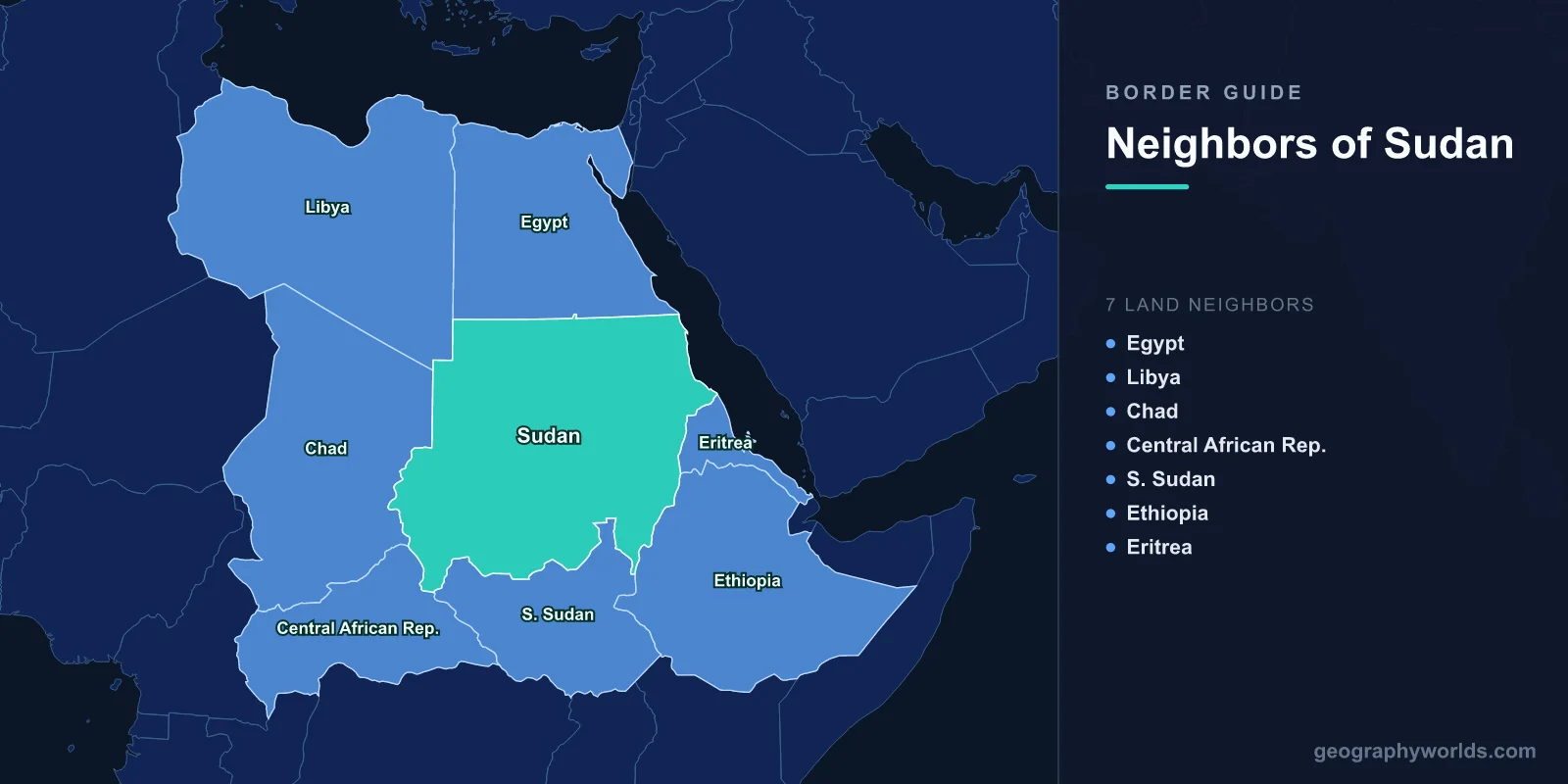
Sudan shares land borders with seven countries: Egypt to the north, Libya to the northwest, Chad to the west, Central African Republic to the southwest, South Sudan to the south, Ethiopia to the southeast, and Eritrea to the east.
Introduction
Sudan was Africa's largest country until South Sudan's independence in 2011. Even after losing its southern third, Sudan remains the third-largest country in Africa at 1.86 million km². Its borders span from the Sahara Desert in the north to tropical savanna in the south, with the Nile River system flowing through the center of the country.

Overview of Sudan's Borders
- Total Land Borders: 6,819 km
- Number of Neighbors: 7 countries
- Longest Border: South Sudan (2,158 km)
- Key Feature: Nile Valley, Sahara Desert, Darfur region
Sudan's borders cross extreme geographic diversity, from the lifeless Saharan desert in the north and west to the fertile Nile Valley in the center to the tropical areas near the South Sudanese border. The Nile (formed by the confluence of the White and Blue Nile at Khartoum) is the country's lifeline and crosses multiple border relationships.
Sudan's borders have been zones of conflict for decades. The Darfur region near the Chad border has experienced genocidal violence since 2003. The South Sudanese border was contested until South Sudan's independence in 2011, and border areas like Abyei remain disputed. The Eritrean and Ethiopian borders are affected by regional power politics.
Northern and Western Neighbors: Egypt, Libya, and Chad
- Egypt Border: 1,276 km
- Libya Border: 382 km
- Chad Border: 1,360 km
Egypt's 1,276 km border crosses the Sahara and the Nile Valley. The Nile waters agreement between the two countries governs the critical shared resource. The Hala'ib Triangle on the Red Sea coast remains disputed. Libya's 382 km border crosses the Sahara with virtually no population, but instability in Libya has allowed weapons flows into Sudan.
Chad's 1,360 km border runs through Darfur, one of the world's worst humanitarian crises. The Darfur conflict, which has killed hundreds of thousands and displaced millions since 2003, has repeatedly spilled across this border. Chad has hosted hundreds of thousands of Sudanese refugees, while Chadian armed groups have used Darfur as a base.
Southern Neighbor: South Sudan
- Border Length: 2,158 km
- Status: Contested areas remain including Abyei
- Key Issue: Oil revenues, ethnic tensions, Nile water
South Sudan's 2,158 km border is Sudan's longest and most consequential. South Sudan became independent in 2011 after decades of civil war, but several border areas remain disputed, most notably Abyei, an oil-rich region claimed by both countries with a UN peacekeeping force. The border runs through the Sudd wetlands, one of the largest freshwater ecosystems in the world.
Oil complicates the border relationship: most oil reserves are in South Sudan, but the pipeline and export terminal are in Sudan's Port Sudan. Revenue sharing and pipeline fees have been contentious. Both countries experienced civil conflicts that have created refugee flows across the border.
Eastern Neighbors: Ethiopia and Eritrea
- Ethiopia Border: 744 km
- Eritrea Border: 682 km
- Key Feature: Al-Fashaga triangle, Blue Nile
Ethiopia's 744 km border crosses the Blue Nile region and the fertile al-Fashaga triangle, a disputed agricultural area where Ethiopian farmers have cultivated land that technically falls within Sudanese territory. Sudan has periodically asserted control over al-Fashaga, leading to military clashes in 2020-2021. The Blue Nile, Ethiopia's GERD dam, and downstream water rights affect this relationship.
Eritrea's 682 km border runs along the Red Sea coast and through the eastern desert. Relations have varied, with Eritrea and Sudan sometimes using each other's rebel groups as proxies. The Kassala region near the Eritrean border hosts a significant population of Eritrean refugees, with over 100,000 in camps.
Cross-Border Relations and Current Crisis
- Civil War: Ongoing conflict since April 2023
- Refugees: Millions displaced to neighboring countries
- Strategic Position: Red Sea access, Nile water politics
Sudan's civil war, erupting in April 2023 between the Sudanese Armed Forces and the Rapid Support Forces (RSF), has transformed all its borders into humanitarian corridors. Millions of Sudanese refugees have fled to Chad, Egypt, South Sudan, Ethiopia, and the Central African Republic, creating one of the world's worst displacement crises.
Sudan's strategic position on the Red Sea, its role in Nile water politics, and its relationships with regional powers (Egypt, Saudi Arabia, UAE, Ethiopia) make its border stability a concern for the entire northeast African region. Port Sudan on the Red Sea coast has become a contested strategic asset.
Key Facts
- Sudan borders 7 countries: Egypt, Libya, Chad, Central African Republic, South Sudan, Ethiopia, and Eritrea.
- The South Sudan border at 2,158 km is Sudan's longest, with Abyei still disputed.
- The Darfur crisis near the Chad border has displaced millions since 2003.
- Sudan was Africa's largest country until South Sudan's independence in 2011.
- The ongoing civil war since 2023 has created millions of refugees across all borders.
Fun Facts
- The confluence of the Blue and White Nile at Khartoum is visible from space, as the two rivers have different colors.
- Bir Tawil between Sudan and Egypt is one of the few places on Earth claimed by no country.
- The Sudd wetland on the South Sudan border is so vast it was an obstacle to Nile exploration for centuries.
- Sudan has more pyramids than Egypt, mostly near the Egyptian border at Meroe.
Final Thoughts
Sudan's seven borders encompass one of Africa's most troubled nations, where Saharan desert meets Nile valley meets tropical savanna. The ongoing civil war has turned every border into a refugee corridor, while longstanding disputes in Darfur, Abyei, and the Nile basin ensure that Sudan's borders remain at the center of northeast Africa's most pressing crises.
Test Your Knowledge!
Think you know which countries share borders? Try our geography games!
Play Geography Games →