
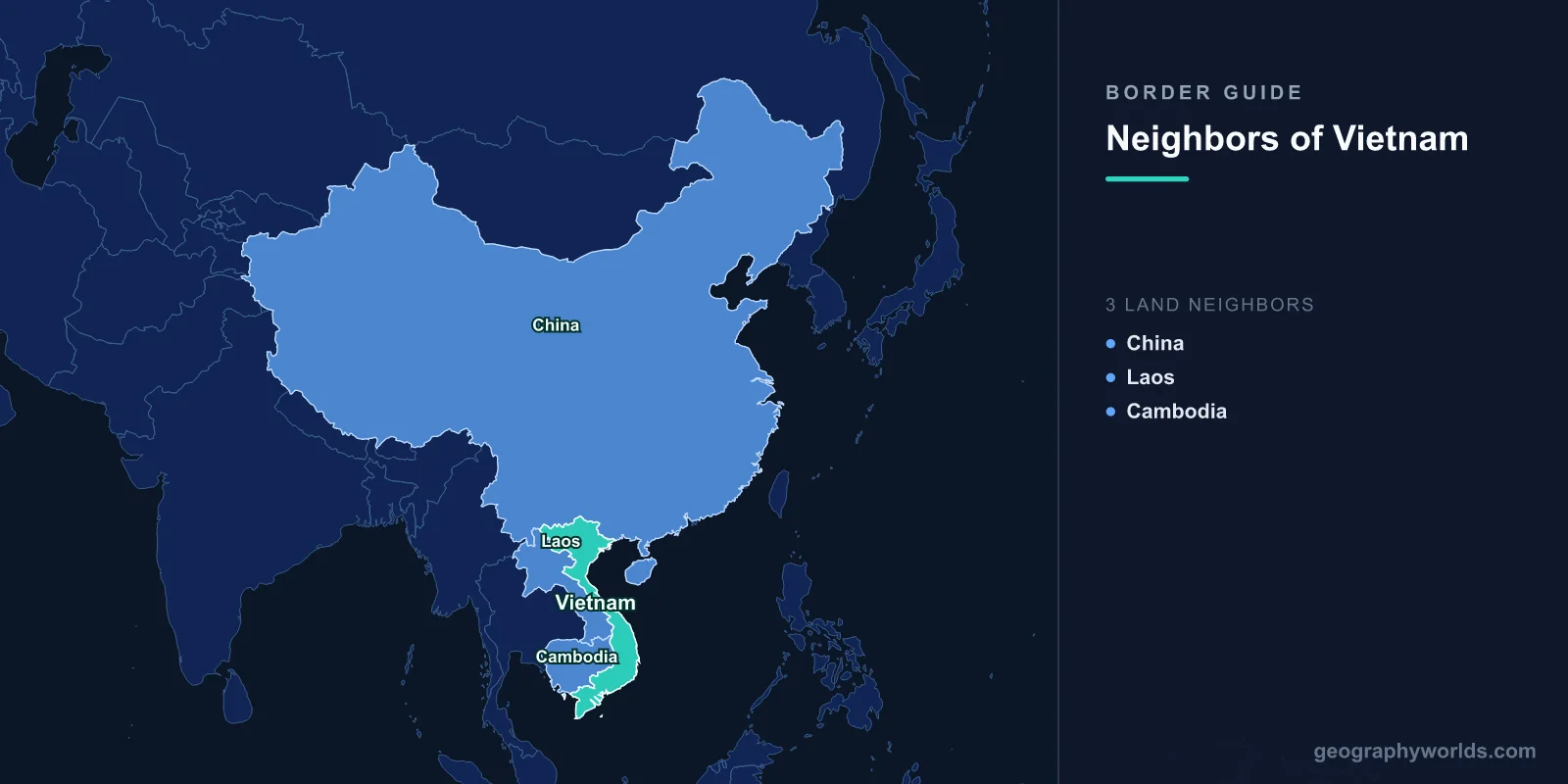
Vietnam shares land borders with three countries: China to the north, Laos to the west, and Cambodia to the southwest.
Introduction
Vietnam's distinctive S-shaped geography, stretching 1,650 km from north to south but only 50 km wide at its narrowest point, creates a country with extensive borders relative to its width. The Annamite Mountains (Truong Son range) form the backbone separating Vietnam from Laos and Cambodia, while the Red River delta marks the Chinese frontier. These borders have been shaped by over two millennia of Chinese influence, French colonialism, and the Vietnam War.

Overview of Vietnam's Borders
- Total Land Borders: 4,616 km
- Number of Neighbors: 3 countries
- Longest Border: Laos (2,130 km)
- Shortest Border: China (1,297 km)
Vietnam's borders follow the Annamite Mountains (Truong Son range) for most of their western extent, creating a natural barrier with Laos and Cambodia. The Chinese border in the north crosses more varied terrain, from the Red River valley to the limestone karst mountains of Ha Giang. The 3,444 km coastline facing the South China Sea adds a maritime dimension with multiple territorial disputes.
All three of Vietnam's borders have been the site of major military conflicts in living memory: the Sino-Vietnamese War of 1979 with China, the Cambodian-Vietnamese War of 1978-1991, and the use of the Ho Chi Minh Trail through Laos during the Vietnam War. Today, all borders are peaceful, though the South China Sea disputes with China remain a major concern.
Northern Neighbor: China
- Border Length: 1,297 km
- Key Features: Red River, karst mountains of Ha Giang
- Major Crossings: Dong Dang-Pingxiang, Lao Cai-Hekou
The Chinese border runs 1,297 km through mountainous terrain from the Gulf of Tonkin to the Laos tripoint. The border was formally demarcated in 2009 after decades of negotiations, resolving land disputes dating back to the French colonial era. The Red River crosses this border near Lao Cai, and the stunning karst landscapes of Ha Giang province run along the frontier.
Despite the 1979 border war and ongoing South China Sea disputes, China is Vietnam's largest trading partner. The Dong Dang-Pingxiang and Lao Cai-Hekou crossings handle massive volumes of trade. Cross-border economic zones have been established to promote commerce. However, Vietnam maintains a cautious diplomatic stance, balancing economic ties with China against sovereignty concerns in the South China Sea.
Western Neighbor: Laos
- Border Length: 2,130 km
- Key Feature: Annamite Mountains (Truong Son range)
- Historical Significance: Ho Chi Minh Trail
The Lao border at 2,130 km is Vietnam's longest, following the Annamite Mountains through remote and heavily forested terrain. The Ho Chi Minh Trail, the famous supply route used by North Vietnam during the war, ran through Laos parallel to this border. Many sections of the border are still contaminated with unexploded ordnance from American bombing of the trail.
Vietnam and Laos maintain a "special relationship," with Vietnam being the dominant partner. Vietnamese influence in Laos is significant, from military cooperation to economic investment. Cross-border trade is growing, with new road connections through mountain passes improving connectivity. The border region is home to ethnic minorities (Hmong, Tai, Khmu) that straddle both sides.
Southwestern Neighbor: Cambodia
- Border Length: 1,189 km
- Key Features: Mekong River, Central Highlands
- Historical Significance: Vietnamese occupation 1978-1989
Cambodia's 1,189 km border runs from the Lao tripoint through the Central Highlands to the Mekong Delta. Vietnam's 1978 invasion of Cambodia, which ousted the Khmer Rouge regime, kept Vietnamese troops in Cambodia until 1989. This history creates lingering sensitivity in bilateral relations, though the two countries now cooperate on border management and trade.
The Mekong River enters Vietnam from Cambodia, making water management a critical cross-border issue. The Mekong Delta, Vietnam's rice bowl, depends on water flow from upstream Cambodia and Laos. The Moc Bai-Bavet border crossing connects Ho Chi Minh City to Phnom Penh and handles significant trade and tourist traffic.
Cross-Border Relations and Maritime Disputes
- ASEAN Member: Regional cooperation framework
- South China Sea: Disputes with China over Spratly and Paracel Islands
- Trade: China is Vietnam's largest trading partner
Vietnam's land borders are now peaceful, but the South China Sea disputes with China remain its primary security concern. Vietnam claims the Paracel and Spratly Islands, both also claimed by China. These maritime disputes affect the overall Sino-Vietnamese relationship and Vietnam's diplomatic strategy of balancing between major powers.
Vietnam's economic integration with its neighbors is deepening through ASEAN, the CPTPP trade agreement, and bilateral investment. The Hanoi-Kunming railway connects Vietnam to China, while new road and rail links to Laos and Cambodia are under development. Vietnam's dynamic economy makes it an increasingly important hub in the regional trade network.
Key Facts
- Vietnam borders 3 countries: China, Laos, and Cambodia.
- Vietnam's longest border is with Laos at 2,130 km along the Annamite Mountains.
- The Sino-Vietnamese border was formally demarcated in 2009 after decades of negotiation.
- The Ho Chi Minh Trail ran through Laos parallel to the Vietnamese border.
- The Mekong River crosses from Cambodia into Vietnam, feeding the vital Mekong Delta.
Fun Facts
- Vietnam is only 50 km wide at its narrowest point, making it extremely vulnerable to being cut in two.
- The 1979 Sino-Vietnamese War lasted only 27 days but killed tens of thousands on both sides.
- Ha Giang province on the Chinese border has some of the most spectacular karst scenery in the world.
- Vietnam and China share a maritime border in the Gulf of Tonkin that was demarcated in 2000.
Final Thoughts
Vietnam's three land borders tell a story of war, resilience, and growing prosperity. From the contested Chinese frontier to the Ho Chi Minh Trail along the Lao border to the complex legacy of the Cambodian occupation, Vietnam's borders have been forged in conflict but are now channels of increasing economic integration and regional cooperation.
Test Your Knowledge!
Think you know which countries share borders? Try our geography games!
Play Geography Games →