

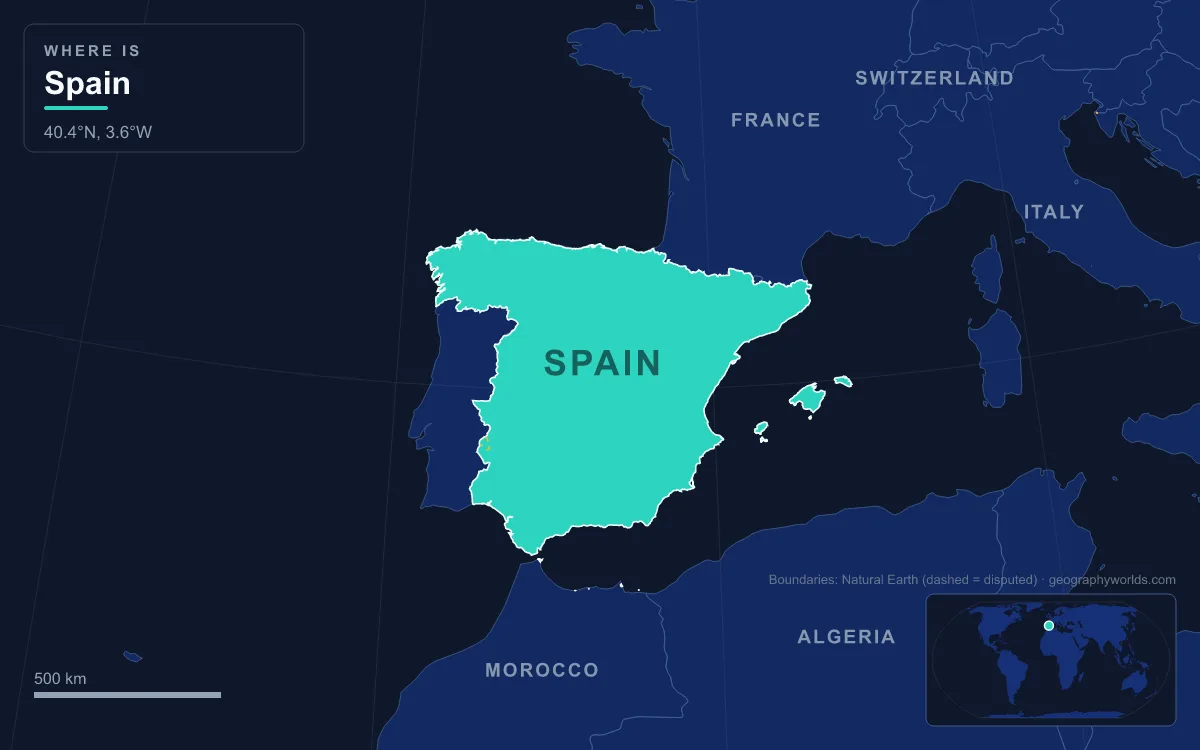
Spain's most famous people include Miguel de Cervantes, who wrote Don Quixote; Pablo Picasso, co-founder of Cubism and painter of Guernica; Diego Velázquez, court painter of Las Meninas; Antoni Gaudí, architect of Barcelona's Sagrada Família; Salvador Dalí, the Surrealist of The Persistence of Memory; Queen Isabella I of Castile, who backed Columbus in 1492; Rafael Nadal, winner of 22 Grand Slam tennis titles; and the film director Pedro Almodóvar. Spain is a country of strong regional identities, and most of these people are claimed first by a home town: Cervantes by Alcalá de Henares, Picasso by Málaga, Dalí by Figueres, Nadal by Manacor. The guide below follows that map, region by region.
Alcalá de Henares, Madrid and the Castilian heartland
Miguel de Cervantes (1547–1616) was born in Alcalá de Henares, a university town just east of Madrid, the son of a barber-surgeon. He lost the use of his left hand at the naval Battle of Lepanto in 1571, spent five years as a captive in Algiers, and worked as a tax collector before publishing the first part of Don Quixote in 1605. The second part followed in 1615, the year before he died in Madrid. The novel is often called the first modern novel, and Spain's leading literary award, the Premio Cervantes, carries his name.
His rival Lope de Vega (1562–1635) was born in Madrid itself. Cervantes nicknamed him the "Monster of Nature" for his output: Lope wrote hundreds of plays and, with Pedro Calderón de la Barca, set the pattern of the Spanish Golden Age theatre.
Two women from the Castilian plateau shaped the country's religious and political history. Isabella I (1451–1504) was born in Madrigal de las Altas Torres, near Ávila. Her marriage to Ferdinand of Aragon in 1469 joined Spain's two largest crowns, and in 1492 the couple took Granada, the last Muslim state in Iberia, and funded Christopher Columbus's first voyage. Teresa of Ávila (1515–1582), born either in Ávila or nearby Gotarrendura, reformed the Carmelite order and founded the Discalced Carmelites with John of the Cross; her book The Interior Castle is still widely read.
Modern Madrid is tied to cinema. Pedro Almodóvar (born 1949) came from Calzada de Calatrava in Castilla-La Mancha and made his first films in Madrid during La Movida, the cultural boom that followed Francisco Franco's death. He won the Academy Award for Best Foreign Language Film for All About My Mother (1999) and for Best Original Screenplay for Talk to Her (2002). Penélope Cruz (born 1974), from Alcobendas on Madrid's northern edge, has acted in seven of his films and won the Academy Award for Best Supporting Actress for Vicky Cristina Barcelona (2008).
Córdoba, Seville, Málaga and Granada: Andalusia's philosophers, painters and poets
Córdoba produced three thinkers across twelve centuries. The Stoic philosopher Seneca (c. 4 BC–AD 65) was born there when it was the Roman city of Corduba, and later became tutor and adviser to the emperor Nero. Under Muslim rule, the city was home to Ibn Rushd, known in Latin as Averroes (1126–1198), whose commentaries on Aristotle were so widely used in medieval Europe that he was simply called "the Commentator". The Jewish scholar Maimonides (1135 or 1138–1204) was also born in Córdoba; his family fled after the Almohads took the city in 1148, and he settled in Egypt, where he wrote his major works of law and philosophy.
Diego Velázquez (1599–1660) was baptised in Seville and trained there before moving to Madrid as court painter to Philip IV. His portraits of the royal family culminate in Las Meninas (1656), now in the Prado, a painting in which Velázquez includes himself at his easel.
Pablo Picasso (1881–1973) was born in Málaga, in a house on the Plaza de la Merced. He trained in A Coruña and Barcelona and moved to France in the early 1900s, where he spent most of his adult life. With Georges Braque he co-founded Cubism; Les Demoiselles d'Avignon (1907) pointed the way, and Guernica (1937) recorded the bombing of the Basque town by German and Italian aircraft during the Spanish Civil War.

Federico García Lorca (1898–1936) was born in Fuente Vaqueros, a farming village 17 km west of Granada. His Gypsy Ballads (1928) drew on Andalusian folk forms, and his plays Blood Wedding (1932), Yerma (1934) and The House of Bernarda Alba (1936) are staged around the world. He was killed near Granada by Nationalist forces in August 1936, weeks after the Civil War began. The guitarist Paco de Lucía (1947–2014), from the port of Algeciras on the Strait of Gibraltar, carried flamenco into jazz and classical settings; the rumba "Entre dos aguas" became his best-known recording.
Barcelona, Reus and Figueres: the Catalans
Antoni Gaudí (1852–1926) was born in Reus, or possibly neighbouring Riudoms, in the province of Tarragona. He took over the Sagrada Família in Barcelona in 1883, a year after construction began, and worked on it until he was struck by a tram in 1926. His Casa Batlló, Casa Milà and Park Güell are part of a UNESCO World Heritage listing of his work.

Salvador Dalí (1904–1989) was born in Figueres, near the French border, studied in Madrid, and joined the Surrealists in Paris in 1929. The Persistence of Memory, with its melting watches, followed in 1931, and he later turned the ruined municipal theatre of Figueres into his own museum. Joan Miró (1893–1983), born in Barcelona, developed a playful style of signs and bright colour; the Fundació Joan Miró opened in his native city in 1975.
The cellist Pau Casals (1876–1973), born in El Vendrell, made landmark recordings of Bach's Cello Suites and refused to perform in Spain after Franco's victory in 1939, living for years in Prades, just over the French border. The soprano Montserrat Caballé (1933–2018), from Barcelona, became internationally known after stepping in for a Carnegie Hall performance in 1965, and recorded "Barcelona" with Freddie Mercury in 1987. Aitana Bonmatí (born 1998), from Vilanova i la Geltrú and raised in Sant Pere de Ribes, came through Barcelona's La Masia academy and in 2025 became the first player to win the Ballon d'Or Féminin three times, after also winning it in 2023 and 2024.
Fuendetodos, Petilla de Aragón, Azpeitia and Getaria: Aragon, Navarre and the Basque coast
Francisco Goya (1746–1828) was born in the village of Fuendetodos, south of Zaragoza. He rose to be court painter to Charles IV and then recorded the horrors of the French occupation in The Third of May 1808 and the etchings The Disasters of War. He died in exile in Bordeaux.
Santiago Ramón y Cajal (1852–1934), born in Petilla de Aragón, a Navarrese village surrounded by Aragon, showed that the nervous system is made of separate cells, the neurons. He shared the 1906 Nobel Prize in Physiology or Medicine with Camillo Golgi and was the first Spaniard to win a scientific Nobel; his drawings of brain cells are still used in teaching.
The Basque province of Gipuzkoa produced two figures of Spain's age of expansion. Ignatius of Loyola (c. 1491–1556) was born in the castle of Loyola near Azpeitia; with Francis Xavier and others he founded the Society of Jesus, approved by Pope Paul III in 1540. Juan Sebastián Elcano (c. 1486–1526), from the fishing port of Getaria, sailed with Ferdinand Magellan's expedition, eventually took command of the ship Victoria after Magellan was killed in the Philippines, and brought it back to Spain in 1522, completing the first circumnavigation of the Earth. The cyclist Miguel Induráin (born 1964), from Villava on the edge of Pamplona, won five consecutive Tours de France from 1991 to 1995.
Santiago, Ferrol, Luarca, Oviedo and Manacor: Galicia, Asturias and Mallorca
Rosalía de Castro (1837–1885), born in Santiago de Compostela, published Cantares gallegos on 17 May 1863, a landmark of writing in the Galician language; the date is now celebrated every year as Galician Literature Day. The novelist and critic Emilia Pardo Bazán (1851–1921), from A Coruña, brought naturalism to Spanish fiction and argued for women's education. The same province also produced Francisco Franco (1892–1975), born in the naval town of Ferrol, who led the Nationalist side in the Civil War of 1936–1939 and ruled Spain as dictator until his death.
Amancio Ortega (born 1936) was born in Busdongo de Arbas in León and moved to A Coruña at fourteen. He opened the first Zara shop there in 1975, and his Inditex group grew into one of the world's largest clothing retailers. In Asturias, the biochemist Severo Ochoa (1905–1993), from the fishing town of Luarca, shared the 1959 Nobel Prize in Physiology or Medicine with Arthur Kornberg for work on how cells build nucleic acids. Fernando Alonso (born 1981), from Oviedo, won the Formula One world championship in 2005 and 2006 with Renault and has twice won the 24 Hours of Le Mans.
Rafael Nadal (born 1986) grew up in Manacor on Mallorca, where his uncle Toni coached him from the age of three. His 14 French Open titles are a record at any single major.
He won 92 ATP singles titles, two Olympic gold medals and spent 209 weeks as world number one before retiring in 2024.
Most of these home towns now carry the name of the person they produced, from Picasso's Málaga to the Dalí Theatre-Museum in Figueres. For a sense of where they sit on the map, see our guide to Spain's regions; the languages spoken in Spain explain why Rosalía de Castro wrote in Galician and Casals spoke Catalan; and the rankings of the largest cities in Spain show how Madrid and Barcelona came to host so many of the careers that began in smaller towns.