

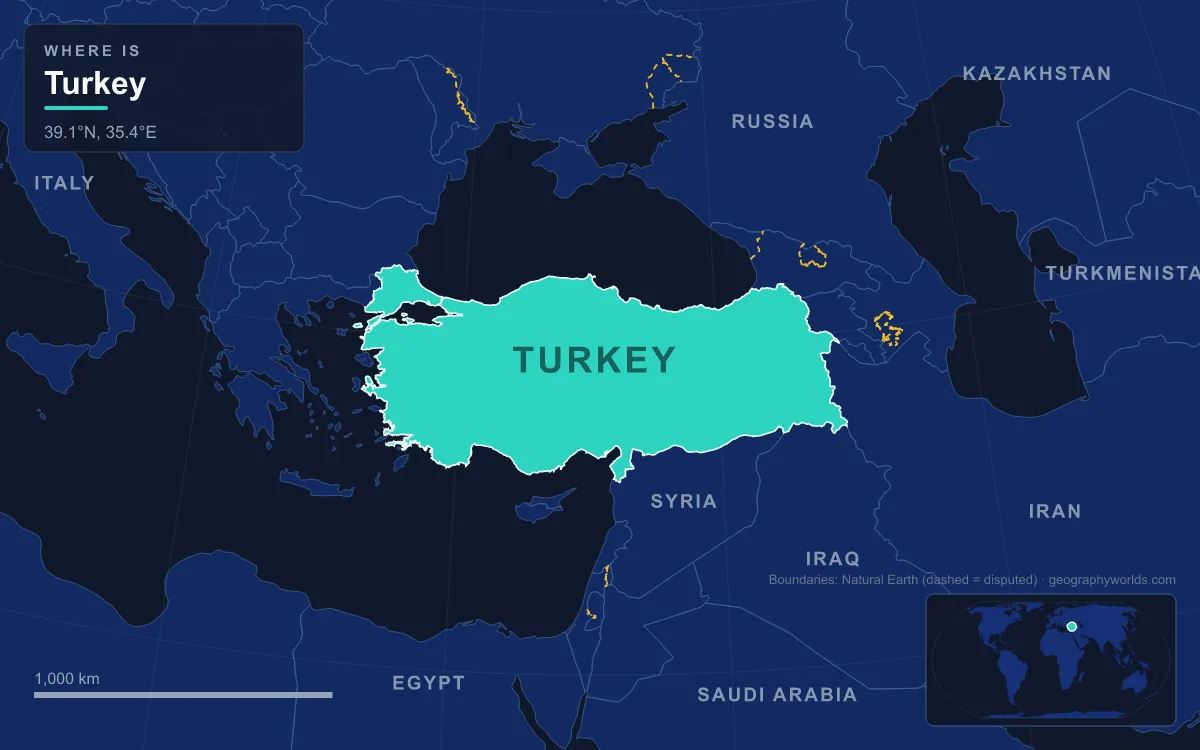
The most famous people from Turkey include Mustafa Kemal Atatürk, who founded the Republic of Turkey and served as its first president from 1923 to 1938; Orhan Pamuk, the Istanbul novelist who became the first Turkish Nobel laureate in 2006; Suleiman the Magnificent, the longest-reigning Ottoman sultan; Mimar Sinan, the architect of more than 300 major Ottoman buildings; Aziz Sancar, who shared the 2015 Nobel Prize in Chemistry for work on DNA repair; and Naim Süleymanoğlu, the weightlifter who won three Olympic gold medals. Add the singer Sertab Erener, the novelist Halide Edib Adıvar, the film director Nuri Bilge Ceylan and the boxer Busenaz Sürmeneli, and a pattern appears: nearly every one of them is tied to a particular city or province, and several were born in places that now lie outside Turkey altogether. This guide follows that map, from Istanbul out to the Black Sea, central Anatolia, the south-east and the diaspora.
Istanbul, the City That Produced Pamuk, Halide Edib and Sertab Erener
Istanbul has been the country's largest city for centuries, and it is the birthplace of more of the people on this list than anywhere else. Orhan Pamuk (born 1952) grew up in a wealthy but declining family in the city and has written about it throughout his career. His memoir Istanbul: Memories and the City is an extended portrait of the place, and novels such as The Black Book, My Name Is Red and Snow have sold more than 13 million copies in 63 languages, making him Turkey's best-selling writer. He won the Nobel Prize in Literature in 2006. In the Çukurcuma neighbourhood he also built a real museum to accompany his novel The Museum of Innocence; the house, filled with more than a thousand objects from the book's imagined 1970s Istanbul, won the European Museum of the Year Award in 2014.

A century earlier, Halide Edib Adıvar (1884–1964) was born in the same city to a family close to the Ottoman court; her father was a secretary to Sultan Abdul Hamid II. She became a novelist whose books criticised the low social status of Turkish women, and in 1919 she was one of the main speakers at the Sultanahmet demonstrations, mass protests in Istanbul against the Greek occupation of Smyrna. She lectured in literature at Istanbul University and, after years abroad, returned in 1939 as its professor of English literature. Her record is not simple: during the First World War she oversaw for six months an orphanage at Antoura, in present-day Lebanon, where Armenian children were subjected to forced assimilation, and historians still debate her role there.
Sertab Erener (born 1964) was born in Istanbul and grew up in the Eyüp district. She began as a backing singer for Sezen Aksu, released her first album, Sakin Ol!, in 1992, and in 2003 won the Eurovision Song Contest in Riga with "Everyway That I Can", Turkey's first victory, 28 years after the country's debut in 1975. The city also produced Hedo Türkoğlu (born 1979), from the Gaziosmanpaşa district, who played 15 seasons in the NBA, won its Most Improved Player award for 2007–08 and has led the Turkish Basketball Federation since 2016. For a sense of the place that shaped all four, see our guide to Istanbul, Turkey's largest city.
Salonica and Edirne: Founders From the Ottoman Balkans
Two of the most important figures in Turkish history were born in cities that are no longer in Turkey or sit right on its European edge. Mustafa Kemal Atatürk (c. 1881–1938) was born in Salonica, today's Thessaloniki in Greece, when it was an Ottoman port. As a divisional commander at Gallipoli in 1915 he correctly anticipated where the Allies would land and held the line. After the First World War he led the nationalist movement, and in 1923 he became the first president of the new republic, a post he held until his death. His government replaced Arabic script with a Latin-based Turkish alphabet in 1928 and introduced surnames by law in 1934; the parliament gave him the name Atatürk, "father of the Turks".
Salonica was also the birthplace of the poet Nâzım Hikmet (1902–1963), who went to school in Istanbul, spent much of his adult life in prison or exile for his communist politics, and died in Moscow. His poetry has been translated into more than 50 languages. The mathematician Cahit Arf (1910–1997) was born there too; his family left during the Balkan War of 1912 and settled in İzmir. Arf studied in Paris and Göttingen, gave his name to the Arf invariant, which is used in knot theory, and appears on the reverse of the 10 lira banknote issued in 2009.
Edirne, in Turkish Thrace near the Greek and Bulgarian borders, was the Ottoman capital when Mehmed II (1432–1481) was born there. In 1453, aged 21, he conquered Constantinople and ended the Byzantine Empire, then made the city his capital. Edirne kept its grand status: the city's skyline is still dominated by the Selimiye Mosque, which Sinan built for Sultan Selim II.

Trabzon, Kayseri and İzmir: A Sultan, an Architect and a Composer
Suleiman the Magnificent (1494–1566) was born in Trabzon on the Black Sea coast, the son of the future Selim I. He ruled from 1520 to 1566, the longest reign of any Ottoman sultan. Belgrade fell to him in 1521, Rhodes in 1522 and much of Hungary after the Battle of Mohács in 1526, though the failed siege of Vienna in 1529 marked the limit of his advance into Europe. By the end of his reign the empire had at least 25 million subjects.
The man who built for him came from the heart of Anatolia. Mimar Sinan (c. 1488/1490–1588) was born in Ağırnas, a village near Kayseri; his origins, usually given as Armenian or Greek, are disputed. He was drafted into the Janissaries, learned engineering on campaign and became chief architect to Suleiman, Selim II and Murad III. More than 300 major structures are credited to him, including the Süleymaniye Mosque in Istanbul, the Selimiye in Edirne and the Mehmed Paša Sokolović Bridge at Višegrad in Bosnia.
İzmir, on the Aegean, produced two figures of the early republic. İsmet İnönü (1884–1973) was Atatürk's closest ally: as foreign minister he negotiated the 1923 Treaty of Lausanne, which replaced the harsher Treaty of Sèvres, and he succeeded Atatürk as president from 1938 to 1950. The composer Ahmed Adnan Saygun (1907–1991), also born in İzmir, was one of the "Turkish Five" who brought Western classical forms to Turkey; his oratorio Yunus Emre, setting poems by a 13th-century Anatolian mystic, won him international attention in 1946.
Back on the Black Sea, Trabzon is where the boxer Busenaz Sürmeneli (born 1998) grew up after her family moved from Bursa. She took up boxing at ten, became world champion in 2019 and won the women's welterweight gold at the Tokyo 2020 Olympics, adding a second world title in Istanbul in 2022.
Osmaniye, Mardin and Çanakkale: Voices From Rural Anatolia
Some of the most internationally known Turkish names come from small places far from the big cities. The novelist Yaşar Kemal (1923–2015) was born in Hemite, now Gökçedam, a hamlet in Osmaniye province on the edge of the Çukurova plain. He grew up in the only Kurdish family in a Turkmen village, and his village paid for him to study in Istanbul. His 1955 novel Memed, My Hawk, about a bandit in the Taurus foothills, made him a perennial Nobel candidate. He was tried in 1995 over an article in Der Spiegel about the army's destruction of Kurdish villages.
The chemist Aziz Sancar (born 1946) came from a family of eight children in the Savur district of Mardin province, in the south-east. His parents had little education, but he graduated top of his class in medicine from Istanbul University in 1969, worked as a doctor near Savur and then moved to the United States, where he is a professor at the University of North Carolina. In 2015 he shared the Nobel Prize in Chemistry with Tomas Lindahl and Paul Modrich for mechanistic studies of DNA repair, making him the second Turkish-born Nobel laureate after Pamuk.
The film director Nuri Bilge Ceylan (born 1959) was born in Bakırköy, Istanbul, but spent most of his childhood in his father's home town of Yenice in Çanakkale province, and rural Anatolia fills his films. Winter Sleep, set in a Cappadocian hotel, won the Palme d'Or at Cannes in 2014, and six of his nine features were chosen as Turkey's entry for the Academy Award for Best International Feature Film.
Born Abroad: Kardzhali, Alzey and Strasbourg
Turkey's story has always included Turks born outside its borders. Naim Süleymanoğlu (1967–2017) was born in Ptichar, in Bulgaria's Kardzhali Province, to a Turkish-speaking family. Standing 147 cm tall, he set a world record as a teenager, but Bulgaria's boycott kept him out of the 1984 Olympics. At a competition in Melbourne in 1986 he slipped away from his minders and defected at the Turkish embassy in Canberra. Competing for Turkey, he won Olympic gold in 1988, 1992 and 1996, set 51 world records and became known as the "Pocket Hercules".
The pop singer Tarkan (born 1972) was born and raised in Alzey, in West Germany, and moved to Turkey with his family in 1986. His 1998 song "Şımarık" became popular in a number of countries, helped by its English version, "Kiss Kiss". The novelist Elif Shafak (born 1971) was born in Strasbourg, France, and raised in Ankara by her mother and grandmother. Writing in both Turkish and English, she has published 21 books, including The Bastard of Istanbul and The Forty Rules of Love, translated into almost sixty languages. After legal action in Turkey over subjects in her fiction, including a 2006 prosecution for "insulting Turkishness" over the Armenian genocide in The Bastard of Istanbul, which ended in acquittal, she settled in the United Kingdom and holds British as well as Turkish nationality.
Read together, these birthplaces trace the old shape of the Ottoman world, from Salonica and Kardzhali to Trabzon and Mardin, as much as the borders of the modern republic. For the country these people shaped, and the cities that produced them, continue with our guide to the largest cities in Turkey, or read why a country with land on both sides of the Bosphorus raises the question of whether Turkey is in Europe or Asia.