
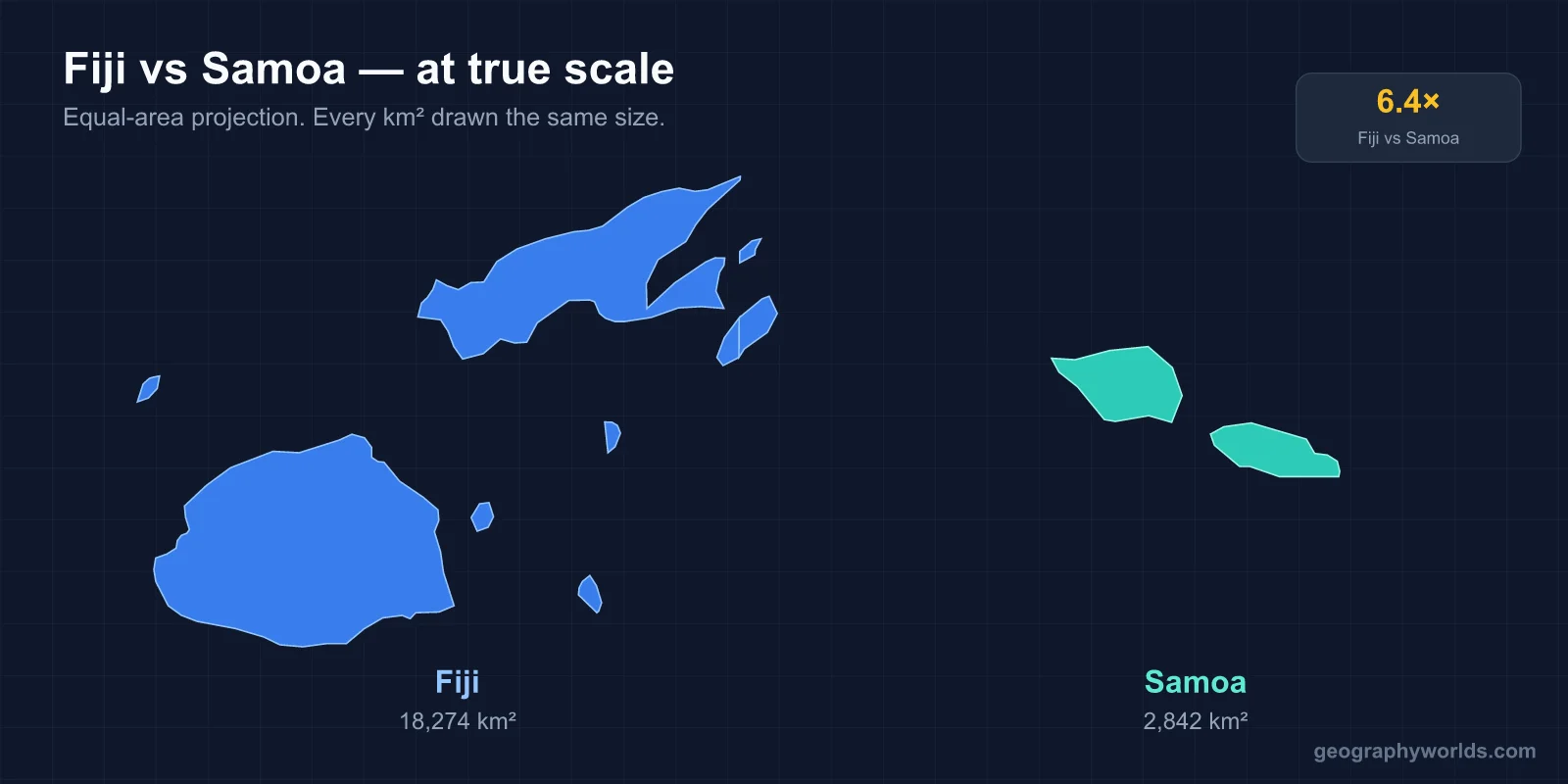
Fiji and Samoa played their first international rugby match against each other in Apia on 18 August 1924. More than a century later, rugby is still the best-known link between two neighbours that lie 1,152 km apart in the South Pacific. Of the two, Fiji is the bigger, more populous and richer country. It covers 18,274 km², about six and a half times Samoa's 2,831 km². Its 2017 census counted 884,887 people, over four times the 205,557 in Samoa's 2021 census. The IMF puts Fiji's nominal GDP per capita at about US$6,000 (2023), against about US$4,400 for Samoa (2024). Fiji's capital is Suva, on Viti Levu, and its languages are English, Fijian and Fiji Hindi. Samoa's capital is Apia, on Upolu, and its official languages are Samoan and English. Despite being much smaller, Samoa is the higher country, and it became independent first.
Apia, 18 August 1924: Rugby, Voyaging and the Pacific Games
That first match was fitted around the working day. It kicked off at 7 am so that the Samoan players could get to work afterwards and the Fijians could catch their sailing. Fiji, playing barefoot, won 6–0. Western Samoa, as the country was then known, won the return match 9–3 to draw the series, and the Fijians went on to a nine-match tour of Tonga. The three island nations went on to meet regularly in competitions such as the Pacific Tri-Nations. In 2002, the Fiji, Samoa and Tonga unions set up the Pacific Islands Rugby Alliance. On the world stage, Samoa reached the Rugby World Cup quarter-finals in 1991 and 1995, and Fiji won the first Olympic rugby sevens gold in Rio in 2016, beating Great Britain in the final. It won again at the Tokyo Games, held in 2021, beating New Zealand.

The link is much older than rugby. Samoa was settled by the Lapita people, Austronesian seafarers who came from Island Melanesia. The earliest human remains found in Samoa, at a Lapita site at Mulifanua on Upolu, date to roughly 2,900 to 3,500 years ago. People had lived in Fiji since the second millennium BCE. Archaeology and Samoan oral genealogies both record voyaging and intermarriage between Samoans, Fijians and Tongans long before Europeans arrived. The main difference in origin is a matter of classification. Samoa is counted as part of Polynesia, while Fiji is counted as part of Melanesia, though with Polynesian influences.
Modern regional institutions tie the two capitals together. The first South Pacific Games were held in Suva in 1963. Western Samoa was the only independent island nation taking part, so it was the only team to compete under its own flag and anthem. Since then, Fiji has hosted the Games three times (1963, 1979 and 2003), and so has Samoa (1983, 2007 and 2019). The University of the South Pacific, founded in 1968 and owned by 12 island governments, has its main campus at Laucala Bay in Suva. In 1977, Western Samoa leased its tropical agriculture college at Alafua to the university, and it became the university's Alafua campus. Both countries are also members of the Commonwealth and the Pacific Islands Forum.
British Fiji Against German, Then New Zealand, Samoa
The two countries came under colonial rule by different routes, and that shaped who lives in them today. Fiji was briefly a kingdom under Seru Cakobau from 1871. The kingdom defeated the Kai Colo hill clans of Viti Levu, but settlers and Fijians refused to pay taxes and the cotton price had collapsed. Cakobau, Ma'afu and other senior chiefs signed a Deed of Cession on 10 October 1874, and Fiji became a British crown colony. To work the new sugar plantations, the colonial government brought in indentured labourers from India. The first 463 arrived on 14 May 1879, and 60,553 had arrived by the time the scheme ended in 1916. Most stayed. Indigenous iTaukei Fijians make up about 54 percent of the population and Indo-Fijians about 38 percent. That history is why Fiji Hindi is one of the country's languages.
Samoa was divided among outside powers. After years of rivalry, the Tripartite Convention of 1899 split the archipelago. Germany took the western islands, which became German Samoa in 1900, and the United States took the east, which became American Samoa. On 29 August 1914, in the first month of the First World War, New Zealand troops landed unopposed on Upolu. New Zealand then ruled Western Samoa as a League of Nations mandate from 1920 and as a UN trust territory from 1946. Under its administration, about a fifth of the Samoan population died in the influenza epidemic of 1918–1919. On 1 January 1962, Western Samoa became independent, almost nine years before Fiji. It changed its name to Samoa on 4 July 1997. The population is about 96 percent Samoan.
Fiji became independent on 10 October 1970, exactly 96 years after the cession. Its politics since then have been far more turbulent than Samoa's. A series of coups in 1987 ended with the country being declared a republic. In 2000, a coup led by George Speight toppled the government of Mahendra Chaudhry, Fiji's first Indo-Fijian prime minister. On 5 December 2006, Commodore Frank Bainimarama seized power. Fiji adopted its current constitution in 2013 and held an election in September 2014 that international observers judged credible.
Samoa kept its chiefly system at the centre of its parliament. The 51-seat Legislative Assembly, the Fono, has 49 seats elected by Samoans, and only holders of matai (chiefly) titles may stand for them. Universal suffrage was adopted only in 1990. The country has more than 25,000 matai, about five percent of them women.
Fiji's 330 Islands Against Savai'i and Upolu
Fiji is an archipelago of more than 330 islands, about 110 of them permanently inhabited, plus more than 500 islets. The two largest islands, Viti Levu and Vanua Levu, hold about 87 percent of the population, and most people live on the coasts of Viti Levu. Suva is on the south-east coast, Nadi is the tourism hub in the west, and Lautoka is the centre of the sugar industry. The mountainous interior of Viti Levu is thinly settled. At its heart stands Mount Tomanivi, an extinct volcano and Fiji's highest mountain at 1,324 m. The Rewa, Navua, Sigatoka and Ba rivers all rise in these central highlands. Our guide to Fiji's geography covers the island groups in detail, and Fiji vs Tonga compares it with its other Polynesian neighbour.
Samoa is compact by comparison. It has two main islands, Savai'i and Upolu, two smaller inhabited islands, Manono and Apolima, and a few uninhabited islets. All of them are volcanic, formed by the Samoa hotspot, but only Savai'i is still active. Mount Matavanu erupted from 1905 to 1911 and left about 50 km² of solidified lava on the island's north coast. Samoa's highest point, Mount Silisili on Savai'i, reaches 1,858 m. That is more than 500 m higher than anything in Fiji, on an island group less than a sixth of Fiji's size.
Samoa has also moved itself on the map in two ways. On 7 September 2009, it switched from driving on the right to driving on the left, the side used in Australia and New Zealand, home to large numbers of Samoans, and in Fiji. At the end of December 2011, it moved to the west side of the International Date Line, changing from UTC−11 to UTC+13 and skipping Friday 30 December altogether. Before the change, Samoa was 21 hours behind Sydney. Now it is three hours ahead, and one hour ahead of Fiji's standard time of UTC+12, even though Apia lies north-east of Suva.

Sugar, Remittances and Coconut Cream: How Fiji's and Samoa's Economies Compare
Fiji has one of the most developed economies in the Pacific islands. Its nominal GDP was about US$5.5 billion in 2023, compared with about US$909 million for Samoa in 2024. Per person, the gap is narrower in nominal terms, at about US$6,024 against US$4,420. At purchasing power parity, it is much wider: about US$16,563 in Fiji against US$5,962 in Samoa. On the UN Human Development Index for 2023, Fiji scored 0.731 (111th) and Samoa 0.708 (122nd). Fiji uses the Fijian dollar, and Samoa the tālā.
Fiji's main foreign-exchange earners are tourism, remittances from Fijians working abroad, bottled water and sugar cane. The sugar industry still reflects the plantation system that brought Indo-Fijians to the country. Samoa's economy is smaller and more agricultural. Agriculture employs about two-thirds of the workforce and provides most of its exports, mainly coconut cream, coconut oil, noni juice and copra. Development aid and family remittances from abroad also matter. Tourism made up about 20 percent of Samoa's GDP in 2024, when about 200,000 visitors arrived. The largest numbers came from New Zealand, Australia and the United States, and in 2019, 37 percent of arrivals came to visit friends and family.
The two economies have one pattern in common. Both depend on money sent home by citizens working abroad, and both are exposed to cyclones and tsunamis. Samoa's tourism share of GDP fell from 24.5 percent in 2019 to about 20 percent in 2024. The sector has been hit by the 2019 measles outbreak, the COVID-19 pandemic, cyclones and the 2009 tsunami. If you are thinking of making the 1,152 km trip between the two, our guide to the best time to visit Samoa explains why the dry months from June to September suit the islands best.