
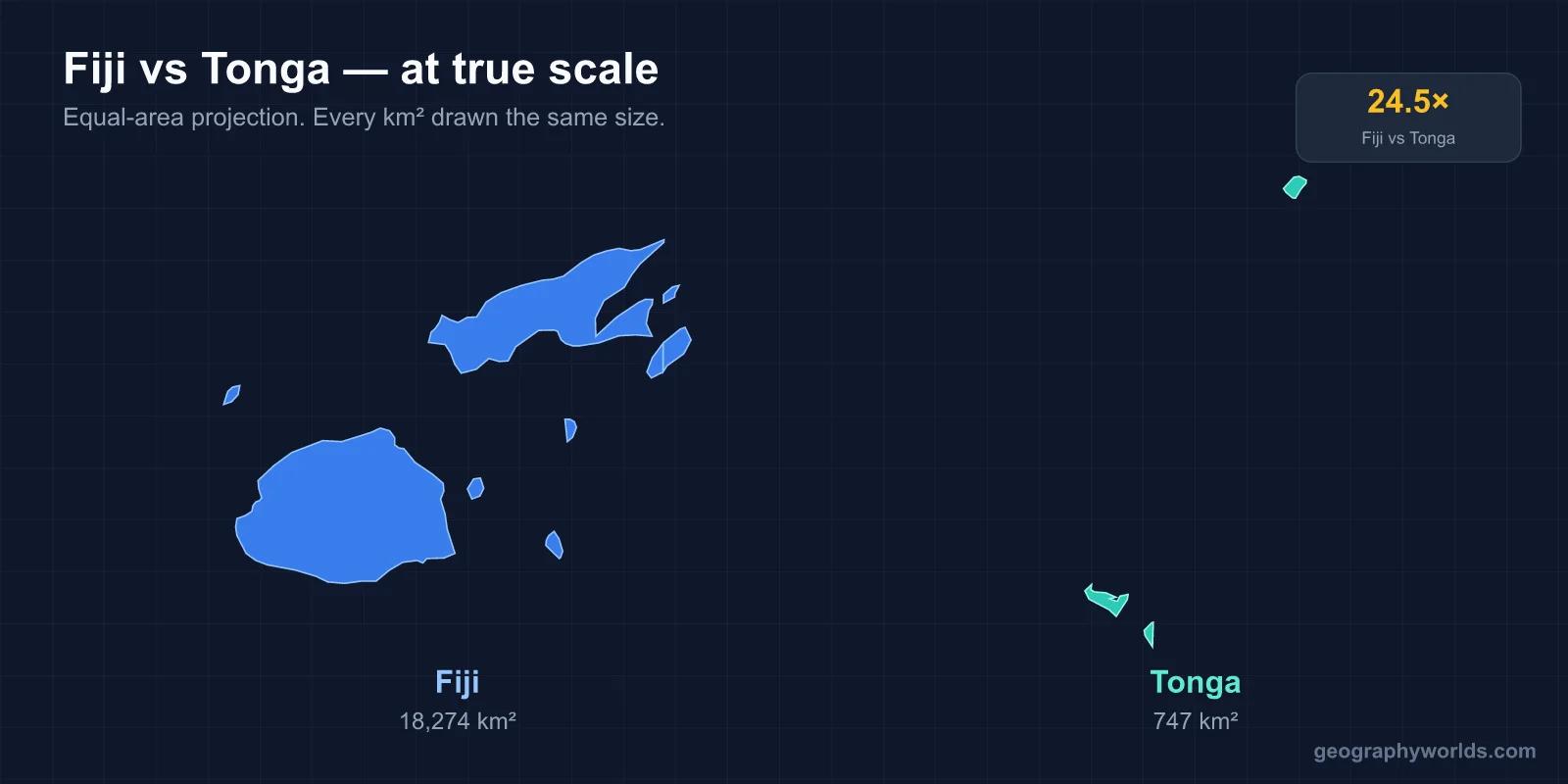
Fiji is the bigger, more populous and slightly richer of the two. It covers about 18,274 km² against Tonga’s 747 km², roughly 24 times as much, and its 2017 census counted 884,887 people against 100,179 at Tonga’s 2021 census, close to nine times as many. On IMF figures Fiji’s GDP per person was about US$6,024 in 2023, while Tonga’s last comparable IMF figure was about US$4,888 in 2019. Fiji is a republic governed from Suva, on the island of Viti Levu, with English, iTaukei (Fijian) and Hindi recognised in its 2013 constitution. Tonga is a kingdom governed from Nukuʻalofa, on Tongatapu, with Tongan and English as its official languages. The two are close neighbours across the waters of Fiji’s Lau Group, and their histories are knotted together more tightly than any table of numbers suggests.
Viti Levu’s Volcanic Highlands Against Tonga’s Uplifted Coral
Fiji is a heavyweight archipelago by Pacific standards: more than 330 islands, about 110 of them permanently inhabited, plus some 500 islets. Two islands dominate. Viti Levu alone holds about 57% of the land and around 69% of the people; Vanua Levu, 64 km to the northeast, adds just over 30% of the land. Most of Fiji was built by volcanic activity, and both big islands are mountainous, with peaks rising abruptly from the shore. The highest is Mount Tomanivi on Viti Levu, at 1,324 m (4,344 ft). The mountains split each island into a wet side and a dry side: up to about 3,000 mm of rain a year falls on the windward southeast, where Suva sits, while the sheltered west around Nadi and Lautoka has a marked dry season that suits sugarcane.
Tonga is lower, flatter and stretched out. Its roughly 170 islands run in an 800 km north–south line in three main groups, Tongatapu, Haʻapai and Vavaʻu, and only a few dozen are inhabited. Geologists see two parallel chains. The western chain, including Tofua, Kao and Late, is a string of true volcanoes fed by the Pacific Plate sinking into the Tonga Trench. The eastern chain, where almost everyone lives, is mostly coral limestone lifted above the sea: Tongatapu, Vavaʻu and Lifuka are all of this type, and only ʻEua rises high enough to expose older volcanic rock. Tonga’s highest point, 1,033 m (3,389 ft), is on the uninhabited volcano Kao. Tongatapu itself, the largest island, covers only 257 km², about 1.4% of the size of Fiji’s land area.

The sea is where the gap narrows. Because Tonga’s islands are strung over such a long line, its exclusive economic zone reaches about 659,558 km², nearly 900 times its land area. Fiji’s zone is larger in absolute terms, about 1.28 million km², but only about 70 times its land. Both countries live on the Pacific Ring of Fire. Tonga was reminded of it in January 2022, when the submarine volcano Hunga Tonga–Hunga Haʻapai, 65 km north of Tongatapu, erupted with a blast compared to Krakatoa in 1883; the tsunami that followed, with waves up to 20 m high, killed at least four people in Tonga, and damage to the undersea cable cut the kingdom off for days. Fiji’s activity is gentler: some geothermal heat still reaches the surface on Vanua Levu and Taveuni, while Viti Levu’s warm springs are not volcanic in origin.
iTaukei and Indo-Fijians Against a Single Tongan Nation
The deepest human difference between the two is that Fiji has two large communities and Tonga essentially one. At the 2017 census, 62.8% of Fiji’s people were iTaukei (Indigenous Fijians) and 32.7% were Indo-Fijians, with Rotumans, Europeans, Chinese and others making up the remaining 4.5%. The Indo-Fijian community exists because of a decision made by the British governor Arthur Gordon in 1878. The first 463 indentured labourers from India landed on 14 May 1879, and some 61,000 followed before the scheme ended in 1916, most to work on the sugarcane estates. The great majority stayed. Their descendants speak Fiji Hindi, a language built mainly on Awadhi, and religion follows the same line: the 2017 census counted 69.2% Christians, 24.0% Hindus and 5.8% Muslims.
Relations between the two communities have shaped Fijian politics since independence, including the coups of 1987 and 2000. Even the word “Fijian” was contested. Earlier constitutions called citizens “Fiji Islanders”, and in 2008 the deposed prime minister Laisenia Qarase argued that “Fijian” belonged to Indigenous Fijians alone; the constitution now uses it for every citizen. Fiji’s Methodist Church, which counts almost two-thirds of iTaukei as members, gives Fiji a higher share of Methodists, 34.6% of the population at the 2007 census, than any other country.
Tonga, by contrast, is overwhelmingly Tongan by ancestry and Polynesian in language and custom; its main minorities are small groups of Europeans, other Pacific Islanders and a few hundred Chinese. Tongan is spoken by around 187,000 people, a figure larger than the kingdom itself because so many Tongans live abroad. The kingdom has no official religion today, but in 1928 Queen Sālote Tupou III made the Free Wesleyan Church the state church, and its chief pastor still anoints and crowns each new monarch.
Sugar Mills and Resorts Against Remittances and Squash
Fiji has one of the most developed economies among the Pacific islands, drawing on forests, minerals, fish and farmland. Its main earners of foreign currency are tourism, remittances from Fijians working abroad, bottled water and sugar. The geography of that economy is easy to see on Viti Levu: Nadi, beside the international airport, lives on tourists heading to the Mamanuca and Yasawa groups; Lautoka, the second city, is a sugar-mill and port town; and gold has been mined at Vatukoula. Suva, with 93,874 people in the city proper and about 268,000 across its metropolitan corridor to Nausori in 2017, is the country’s political, economic and cultural centre, and hosts the South Pacific Stock Exchange.
Tonga’s economy is smaller and leans far harder on its people overseas. More than twice as many Tongans live abroad, mainly in New Zealand, Australia and the United States, as live in the kingdom, and the economy depends heavily on their remittances. Tourism is modest, under 90,000 visitors a year, and much of it is focused on Vavaʻu, where cruise ships call for whale watching, game fishing and beaches. The development plan has long focused on farm exports such as squash and vanilla. Land rules differ sharply from Fiji’s: Tonga’s constitution bars the sale of land to foreigners, though it may be leased.
A Republic Shaped by Coups Against the Pacific’s Only Indigenous Monarchy
The two countries took opposite routes through the colonial era. Fiji was ceded to Britain in 1874, after the chief Seru Epenisa Cakobau had reigned over a short-lived Kingdom of Fiji from 1871. The colonial capital moved from Levuka on Ovalau to Suva in 1882. Fiji became independent as a dominion on 10 October 1970, and after two coups in 1987 its military government declared a republic. A further coup in 2006 brought Commodore Frank Bainimarama to power, and elections were not held until 17 September 2014, under the 2013 constitution.
Tonga was never colonised. The warrior-chief Tāufaʻāhau united the islands around 1845, took the name George Tupou I, and in 1875 issued a constitution that made Tonga a constitutional monarchy, freed commoners from serfdom and set out land tenure. From 18 May 1900 Britain handled Tonga’s foreign affairs under a Treaty of Friendship, but sovereignty stayed in Nukuʻalofa, and the arrangement ended on 4 June 1970, four months before Fiji’s independence. The same royal line has ruled without interruption. After pro-democracy riots in Nukuʻalofa on 16 November 2006, reforms in 2010 moved Tonga from an absolute to a semi-constitutional monarchy with its first partly representative elections. King Tupou VI, crowned in 2015, is the current monarch.

Hong Kong Sevens Trophies and the ʻIkale Tahi
Rugby is the shared passion. Fiji’s national sport is rugby sevens, and its sevens team has won the Hong Kong Sevens a record 18 times since the tournament began in 1976, along with the Rugby World Cup Sevens in 1997 and 2005. Tonga’s national side, the ʻIkale Tahi or Sea Eagles, has played at nine Rugby World Cups, missing only 1991, winning two of four matches at both the 2007 and 2011 tournaments; in 2007 it lost only 30–25 to South Africa, the eventual champions, and in 2011 it beat France 19–14.
Older traditions run side by side as well. Both countries prize kava, called yaqona in Fiji, whose preparation is part of ceremonial life in Fiji and which Tonga grows as an export crop, and both make bark cloth: masi in Fiji, ngatu in Tonga. Fiji’s material culture includes the drua, great double-hulled sailing canoes that Fijians built and exported to Tonga, and tabua, polished sperm-whale teeth that once served as currency. Tonga’s most striking monument is the Haʻamonga ʻa Maui on eastern Tongatapu, a stone trilithon raised around AD 1200 under Tuʻitātui, the eleventh Tuʻi Tonga.

Fisi, Maʻafu and the Minerva Reefs: Where the Two Histories Cross
Fiji and Tonga have been entangled for a thousand years. From around the 10th century the Tuʻi Tonga, the sacred Tongan kings, built a maritime sphere of influence that took in Fiji, carrying Polynesian customs and words westward. The very name “Fiji” is Tongan: Fijians called their home Viti, the Tongans said Fisi, and Captain James Cook, who met Fijians while in Tonga, spread the Tongan version. In the 1840s the Tongan prince Enele Maʻafu set himself up on Lakeba in Fiji’s Lau Group, forcibly converted its people to Methodism and became a rival to Cakobau, later running a stable administration over the Lau Islands.
The one live dispute between the neighbours lies in empty sea. The Minerva Reefs, two submerged atolls between the countries, are claimed by both. Tonga annexed them in 1972 after a group led by the property millionaire Michael Oliver tried to found a libertarian “Republic of Minerva” there. In 2005 Fiji rejected Tonga’s maritime claims around the reefs and complained to the International Seabed Authority; Tonga lodged a counter-claim. The Fijian navy destroyed navigation lights at the reefs in 2010 and Tongan-installed equipment again in May 2011, and in June 2011 two Tongan navy ships sailed out to replace it. In July 2014 Tonga floated the idea of trading its claim for the Lau Group. The reefs remain disputed, a reminder that on a map of the South Pacific even a reef that is under water at high tide can matter because of the sea around it.
For a closer look at the larger of the two archipelagos, see our guide to Fiji’s geography; the deep trench that feeds Tonga’s volcanoes is covered in our Tonga Trench guide, and Fiji’s other Polynesian neighbour gets the same treatment in Fiji vs Samoa.