
Introduction
Ghana 🇬🇭 and Senegal 🇸🇳 sit on the Atlantic-facing edge of West Africa, two countries often grouped together as cultural and political anchors of the region yet shaped by very different colonial pasts. This comparison sets them side by side on area, population, capitals, climate, and the features that give each its character.
Whether you are brushing up for a geography class, planning travel through West Africa, or just curious how the two stack up, the figures below cover the essentials.
Size & Geography
| Feature | Ghana 🇬🇭 | Senegal 🇸🇳 |
|---|---|---|
| Area | 238,535 km² | 196,722 km² |
| Continent | Africa | Africa |
| Region | West Africa | West Africa |
| Land Borders | Ivory Coast, Burkina Faso, Togo | Mauritania, Mali, Guinea, Guinea-Bissau, Gambia |
| Landscape | low plains, Volta Basin, coastal savanna | generally low, rolling plains; foothills in southeast |
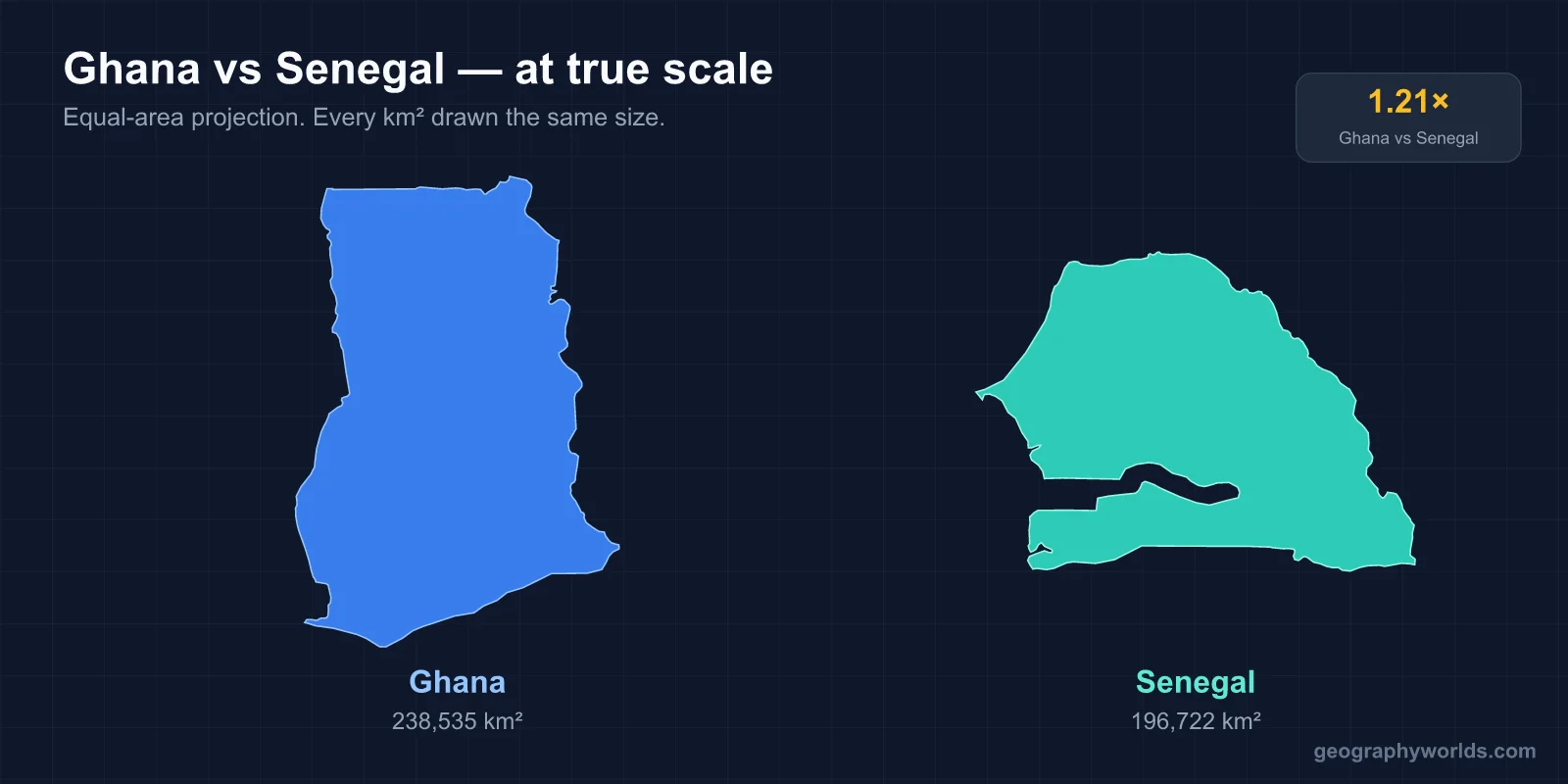
The two are close in size, with Ghana's 238,535 km² about 1.2 times Senegal's 196,722 km². Both are mostly low-lying, Ghana spreading across low plains, the Volta Basin, and coastal savanna, Senegal across gently rolling plains that rise to foothills only in the southeast. Their borders, though, tell different stories. Ghana sits among Ivory Coast, Burkina Faso, and Togo, while Senegal wraps almost entirely around The Gambia, an unusual arrangement in which one country nearly surrounds another, and also meets Mauritania, Mali, Guinea, and Guinea-Bissau.
Population & Demographics
| Metric | Ghana 🇬🇭 | Senegal 🇸🇳 |
|---|---|---|
| Population | 35.7 million | 19.4 million |
| Population Density | 149.7 per km² | 98.4 per km² |
The demographic gap is wider than the difference in land. Ghana's 35.7 million people are about 1.8 times Senegal's 19.4 million. Because the countries are similar in size, that translates into a clear density difference too: Ghana averages 149.7 people per km² against Senegal's 98.4, roughly 51.2 more people per km². Ghana, in other words, is both the more populous and the more crowded of the pair.
Capital Cities
Accra is the capital of Ghana and Dakar the capital of Senegal, both coastal cities within West Africa. Dakar occupies the Cap-Vert peninsula, the westernmost point of the African mainland, which long made it a key Atlantic port. Accra anchors Ghana's southern coast along the Gulf of Guinea.
Language, Currency & Culture
| Aspect | Ghana 🇬🇭 | Senegal 🇸🇳 |
|---|---|---|
| Languages | English (official), Akan, Mole-Dagbani, Ewe, Ga | French (official), Wolof widely spoken |
| Currency | Ghanaian Cedi (GHS) | West African CFA Franc (XOF) |
Language marks the clearest line between them, tracing back to which European power once ruled. Ghana, a former British colony, uses English as its official language alongside Akan, Mole-Dagbani, Ewe, and Ga. Senegal, a former French colony, has French as its official language, with Wolof the most widely spoken everyday tongue. The same split shows up in money: Ghana issues its own Ghanaian Cedi (GHS), while Senegal uses the West African CFA Franc (XOF), a currency shared across several francophone West African states.
Climate & Natural Features
| Aspect | Ghana 🇬🇭 | Senegal 🇸🇳 |
|---|---|---|
| Climate | tropical; warm and dry southeast coast | tropical; hot, humid; rainy and dry seasons |
| Key Features | Lake Volta, Kakum National Park, Gold Coast | Senegal River, Casamance region, Lac Rose |
| Economy | gold, cocoa, oil, agriculture | agriculture (peanuts), fishing, mining, tourism |
Both countries are tropical, but with their own rhythms. Ghana is warm with a drier stretch along the southeast coast, while Senegal swings between distinct rainy and dry seasons in a hot, humid setting. Ghana's notable features include Lake Volta, one of the world's largest reservoirs by surface area, Kakum National Park, and the historic Gold Coast. Senegal counts the Senegal River, the lush southern Casamance region, and Lac Rose, the famous pink lake. Their economies reflect different endowments: Ghana draws on gold, cocoa, oil, and agriculture, while Senegal builds on agriculture led by peanuts, plus fishing, mining, and tourism.
What Makes Each Country Unique
Ghana is known for its Gold Coast heritage, its cocoa production, and the vibrant tradition of Kente cloth. It was the first sub-Saharan African country to win independence from colonial rule, in 1957.
Senegal is famous for the Dakar Rally, for teranga, its celebrated culture of hospitality, and for its rich traditions of music and wrestling. Senegal's Lac Rose takes its distinctive pink hue from Dunaliella salina algae, most vivid during the dry season.
Key Differences at a Glance
- Area: Ghana (238,535 km²) vs Senegal (196,722 km²) — Ghana is 1.2x larger
- Population: Ghana (35.7 million) vs Senegal (19.4 million) — Ghana is 1.8x more populous
- Capitals: Accra vs Dakar
- Currency: Ghanaian Cedi (GHS) vs West African CFA Franc (XOF)
- Continents: Africa vs Africa
- Density: Ghana is more densely populated (difference of ~51.2 people per km²)
- Languages: English (official) vs French (official)
Verdict
As two of West Africa's cultural anchors, Ghana and Senegal share a region and a tropical climate while differing in scale and inheritance. Ghana is the larger and more populous, about 1.2 times the area and 1.8 times the population, and the more densely settled by a wide margin. Senegal is slightly smaller and less crowded, with its capital marking the westernmost reach of the African mainland.
Ghana's character comes through in Lake Volta, its Gold Coast history, and an economy of gold and cocoa. Senegal's shows in the Senegal River, Lac Rose, and an economy rooted in peanuts and fishing. The deepest contrast is colonial: English-speaking Ghana with its own cedi versus French-speaking Senegal within the CFA franc zone.
Looked at together, the two show how neighboring countries can share so much yet diverge along the lines history drew. For students, travelers, and the merely curious, comparing the numbers is a clear way to see what unites West Africa and what still sets its nations apart.
Test Your Knowledge!
Think you know your countries? Try our interactive geography quiz!
Play Geography Games →