
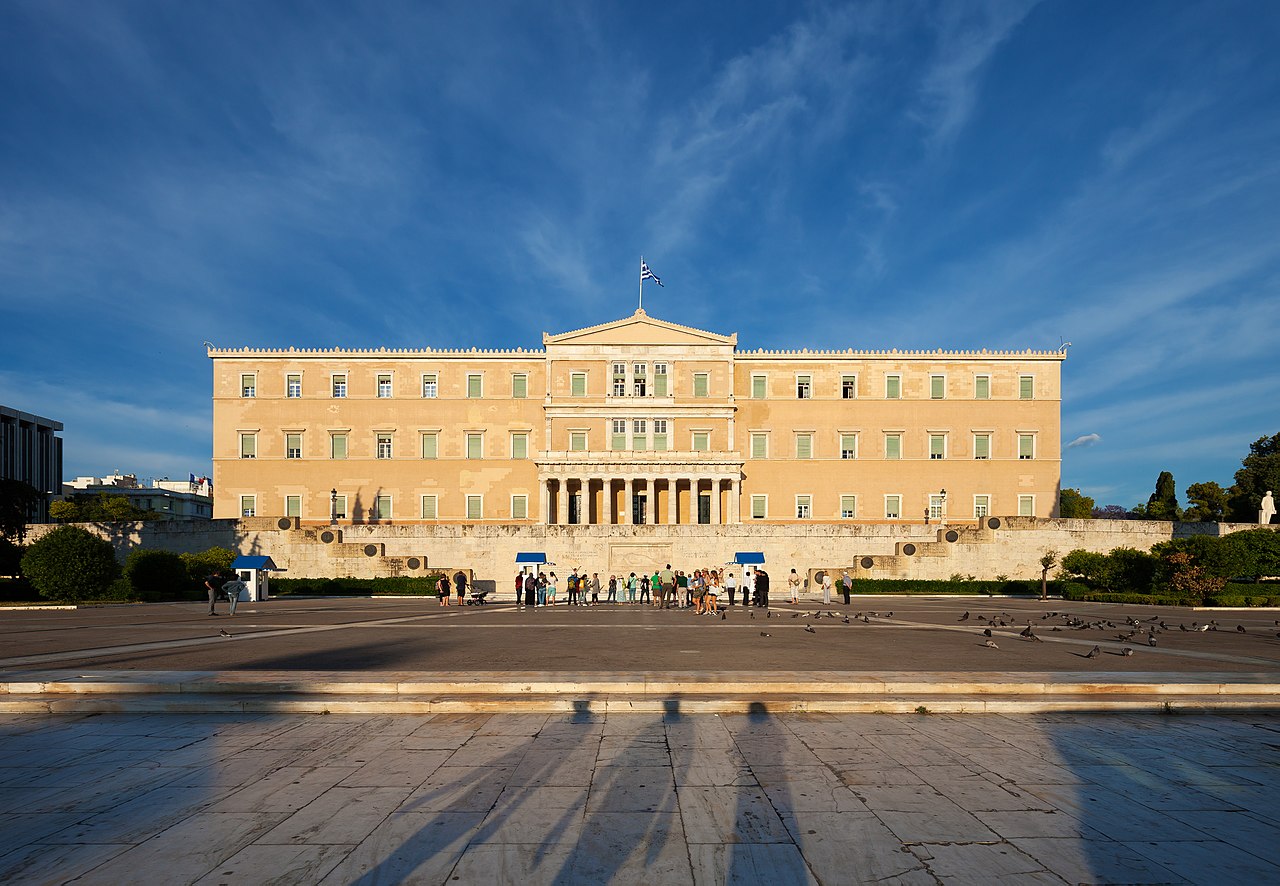
Greece is a unitary parliamentary republic in which the President serves as a largely ceremonial head of state and the Prime Minister, as head of government, holds real executive power, while legislative authority rests with the single-chamber 300-seat Hellenic Parliament. Often described as the birthplace of democracy, modern Greece governs itself under the constitution of the Third Hellenic Republic, adopted in 1975 after the collapse of military dictatorship. Power is balanced among an elected legislature, a government answerable to that legislature, and an independent judiciary.
The Type of Government
Greece is a unitary parliamentary republic. "Parliamentary" means the executive draws its authority from, and remains answerable to, the elected legislature rather than from a separately elected president. "Republic" means the head of state is an elected official rather than a monarch — a status confirmed by referendum in 1974, when roughly 69% of voters chose to abolish the monarchy. "Unitary" means power is centralised in the national government in Athens rather than divided among sovereign states as in a federation.
This system places the Prime Minister, not the President, at the centre of national decision-making. It contrasts with presidential republics like the United States, where the head of state and head of government are the same elected person, and resembles instead the parliamentary models of Germany, Italy and much of the rest of the European Union, of which Greece has been a member since 1981. Greece adopted the euro in 2001, binding its economic governance closely to EU institutions in Brussels and Frankfurt.
Who Holds Power: President, Prime Minister and Cabinet
The President of the Hellenic Republic is the formal head of state and is elected by Parliament — not by direct popular vote — for a five-year term, renewable once. The role is mostly symbolic and ceremonial: the President promulgates laws, formally appoints the Prime Minister, represents the country abroad and acts as a guardian of the constitution, but rarely intervenes in day-to-day politics. A constitutional revision in 1986 deliberately trimmed the presidency's powers, removing the ability to dissolve Parliament at will or dismiss the government, and concentrating real authority in the elected Cabinet.
The Prime Minister is the head of government and the most powerful figure in Greek politics. By convention the Prime Minister is the leader of the party or coalition that commands a majority in Parliament. The Prime Minister sets policy, leads the Cabinet (the Council of Ministers) and directs the work of the ministries — among them powerful portfolios such as Finance, Foreign Affairs, National Defence and the Interior. The Cabinet is collectively responsible to Parliament, meaning it must retain the confidence of a majority of deputies to stay in office. The Prime Minister's official residence and the seat of government is the Maximos Mansion in central Athens.
The Hellenic Parliament
Legislative power is vested in the Hellenic Parliament (Vouli ton Ellinon), a unicameral body of 300 members elected for terms of up to four years. Unlike many large democracies, Greece has no second chamber or senate — all national lawmaking flows through this single assembly. Members are chosen through a system of proportional representation, and recent electoral law has at times awarded bonus seats to the leading party to help produce workable governing majorities.
Parliament debates and passes legislation, approves the national budget, ratifies treaties, elects the President and can bring down a government through a vote of no confidence. To form a government, a party or coalition must win a vote of confidence; if no group can, the President may call fresh elections. Parliament convenes in the Old Royal Palace on Syntagma ("Constitution") Square in central Athens — the same square where the building's forecourt hosts the Tomb of the Unknown Soldier and the ceremonial Evzones guards. Voting in Greece is, in principle, compulsory for citizens aged 17 and over, although the obligation is not enforced with penalties in practice.
Courts and the Independent Judiciary
Greek justice is independent of the executive and legislature. At the top sit several high courts with separate areas of responsibility: the Court of Cassation (Areios Pagos) heads the civil and criminal justice system, the Council of State is the supreme administrative court, and the Court of Audit oversees public finances. A Special Highest Court resolves disputes over which court has jurisdiction and rules on the validity of elections.
A distinctive feature of the Greek system is that there is no single dedicated constitutional court, as exists in Germany. Instead, every court has the duty to review the constitutionality of laws in the cases before it — a model known as diffuse judicial review. Judges are appointed and promoted by an independent judicial council, and the constitution guarantees their tenure and independence from political pressure.
Regions, Local Government and the Constitution
As a unitary state, Greece delegates limited authority to elected local government. Under the 2010 "Kallikratis" reform, the country is divided into 13 administrative regions (periferies), one autonomous monastic community on Mount Athos, and 325 municipalities (dimoi), each with elected councils handling regional development and local services. Ultimate sovereignty, however, remains with the national institutions in Athens. The 1975 constitution, amended in 1986, 2001, 2008 and 2019, sets out these arrangements and guarantees civil liberties, a free press, and the separation of powers. Greek law follows the civil-law tradition, with codified statutes rather than reliance on judicial precedent.
Key Facts
- Official name: Hellenic Republic (Elliniki Dimokratia)
- Government type: Unitary parliamentary republic
- Head of state: President, elected by Parliament for a renewable five-year term
- Head of government: Prime Minister, leader of the parliamentary majority
- Legislature: Hellenic Parliament — unicameral, 300 seats, four-year terms
- Capital and seat of government: Athens
- Current constitution: Adopted 1975 (Third Hellenic Republic), amended four times since
From Ancient Democracy to the Third Republic
Greece's political identity stretches back to ancient Athens, where around 508 BCE citizens introduced demokratia — direct rule by the people — voting on laws in the Assembly and choosing many officials by lot. The modern state emerged after the War of Independence from the Ottoman Empire, conventionally dated to 1821. Since then Greece has cycled through monarchy, republic, foreign occupation during World War II, a bitter civil war from 1946 to 1949, and a military junta that seized power from 1967 to 1974. The junta's collapse, hastened by the Cyprus crisis, ushered in the present Third Hellenic Republic. Two parties, the centre-left PASOK and the centre-right New Democracy, long dominated politics until the sovereign debt crisis of the 2010s reshaped the landscape and propelled new movements such as the left-wing SYRIZA to power. For broader context on the country, see our greece country guide.
Frequently Asked Questions
Is Greece a democracy or a republic?
It is both. Greece is a democratic parliamentary republic, meaning citizens elect representatives to Parliament and the head of state is an elected president rather than a king or queen. It consistently ranks as a free democracy with protected civil liberties and a free press.
Who is more powerful, the President or the Prime Minister of Greece?
The Prime Minister is far more powerful. The President's role is largely ceremonial, while the Prime Minister leads the government, sets policy and controls the Cabinet, depending on the support of a parliamentary majority. A 1986 constitutional revision deliberately reduced the presidency's powers.
How is the Greek Prime Minister chosen?
The Prime Minister is not directly elected by the public. After parliamentary elections, the President appoints as Prime Minister the leader of the party or coalition that can command a majority of the 300 seats in the Hellenic Parliament.
What is the capital of Greece and where does Parliament meet?
The capital is Athens. The Hellenic Parliament meets in the Old Royal Palace on Syntagma Square in the heart of the city, overlooking the Tomb of the Unknown Soldier.