
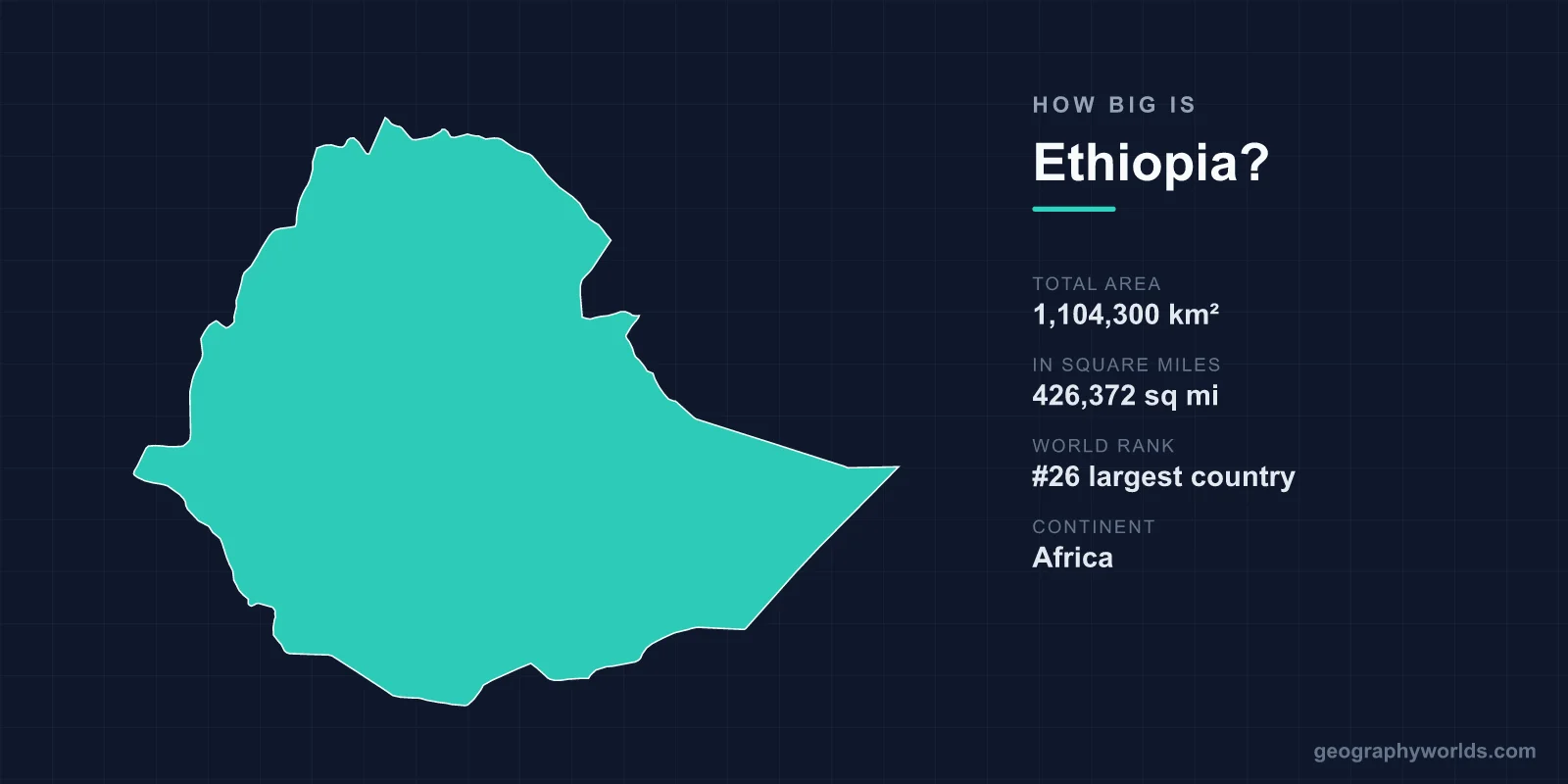
Ethiopia covers a total area of 1,104,300 km² (426,372 sq mi), making it the 26th largest country in the world — roughly twice the size of France and large enough to swallow the United Kingdom about four times over. Sitting in the Horn of Africa, it is also the most populous landlocked country on Earth, packing a vast and dramatically varied landscape into a single national border.
Just How Large Is Ethiopia?
At 1,104,300 square kilometres, Ethiopia accounts for around 0.74% of the planet's total land area of roughly 148.94 million km². That places it comfortably in the upper tier of the world's nations, ahead of every country in Western Europe and most of Asia. Within Africa it ranks among the ten largest states, anchoring the eastern flank of the continent. Its capital, Addis Ababa, sits near the geographic centre of the country at an altitude of around 2,355 metres, making it one of the highest capital cities in the world.
To picture the scale another way: Ethiopia's land area is larger than France and Spain combined, and more than four times the size of the United Kingdom. Yet despite its size, it has no coastline at all — every kilometre of its border touches another country rather than the sea.
Dimensions and Borders
Ethiopia stretches roughly 1,600 km from north to south and about 1,500 km from east to west, giving it a broad, rounded shape rather than a long or narrow one. It is bordered by six nations:
- Eritrea to the north
- Djibouti to the northeast
- Somalia to the east and southeast
- Kenya to the south
- South Sudan to the west
- Sudan to the northwest
Ethiopia became fully landlocked in 1993, when Eritrea gained independence and took with it the country's former Red Sea coastline. Today Ethiopia relies heavily on the port of Djibouti for access to international shipping, a dependence that shapes much of its trade and infrastructure planning.
A Land of Extremes
What makes Ethiopia's size so striking is how much altitude variation it contains. The country is dominated by the Ethiopian Highlands — a rugged plateau so extensive it is nicknamed the "Roof of Africa," with average elevations of 2,000 to 3,000 metres. The highest point, Ras Dashen in the Simien Mountains, rises to 4,550 m (14,928 ft).
Cutting diagonally through the country is the Great Rift Valley, a colossal geological fracture that splits the highlands and eventually feeds into the Red Sea system. At the opposite extreme lies the Danakil Depression in the northeast, which sinks to about 125 m below sea level. With recorded air temperatures around 64°C, it is widely regarded as the hottest inhabited place on Earth. Few countries pack such a range — from glacial-feeling alpine peaks to a sun-blasted salt desert — into one territory.
How Ethiopia Compares
Size comparisons help anchor the numbers:
- About twice the size of France (640,679 km²).
- Roughly four times the size of the United Kingdom (243,610 km²).
- A little larger than the US states of Texas and Oklahoma combined.
- Comparable in area to Bolivia or Egypt.
Within East Africa, Ethiopia is larger than neighbouring Kenya and dwarfs smaller states like Djibouti and Eritrea. For a deeper look at its regions, climate and culture, see our ethiopia country guide.
Why Ethiopia's Geography Matters
Ethiopia's vast highlands are not just scenic — they are the source of the Blue Nile, which begins at Lake Tana and supplies an estimated 80% of the Nile River's water downstream. This makes Ethiopia's terrain hugely important to Egypt and Sudan and a frequent subject of regional water diplomacy. The same elevation gives the country its temperate, agriculture-friendly climate, supporting a population of well over 100 million people across that single landlocked expanse. Highland Ethiopia is also famous as the likely birthplace of coffee and home to ancient sites like the rock-hewn churches of Lalibela, carved from solid bedrock in the 12th century.
Frequently Asked Questions
Is Ethiopia bigger than France?
Yes. Ethiopia's 1,104,300 km² is roughly 1.7 times the area of France (640,679 km²), making it nearly twice as large.
What rank is Ethiopia by area in the world?
Ethiopia is the 26th largest country in the world by total area, and one of the ten largest in Africa.
Does Ethiopia have a coastline?
No. Ethiopia is landlocked and has had no coastline since Eritrea became independent in 1993. It is, in fact, the most populous landlocked country on Earth.
What is the highest and lowest point in Ethiopia?
The highest point is Ras Dashen at 4,550 m (14,928 ft) in the Simien Mountains, while the lowest is the Danakil Depression at about 125 m below sea level.
