
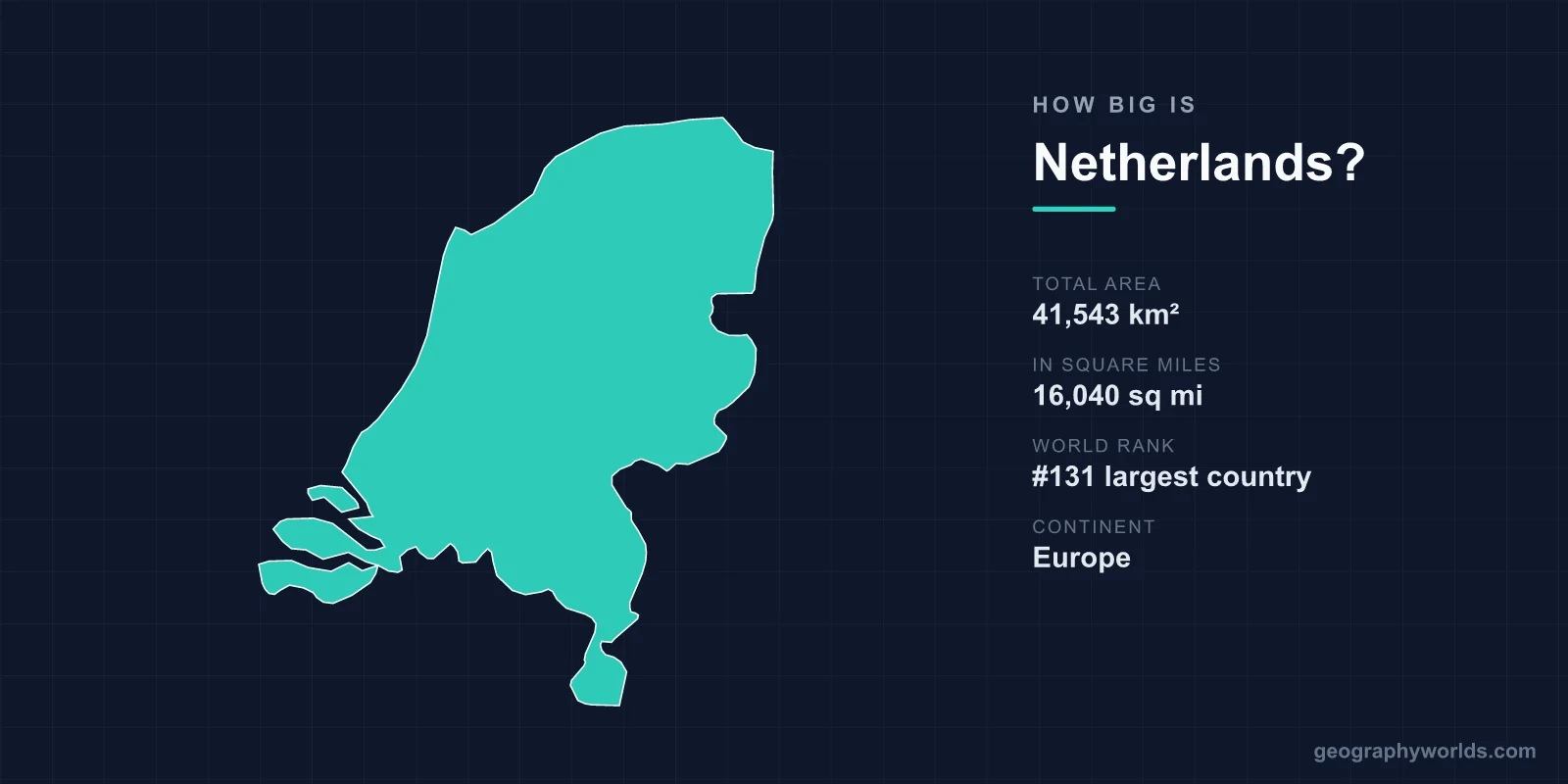
The Netherlands covers a total area of about 41,543 km² (16,040 sq mi), making it the 131st largest country in the world — roughly the size of Switzerland or the U.S. states of Maryland and Delaware combined. It is one of Europe's smaller and more densely populated nations, yet it punches far above its size thanks to centuries of land reclamation, dense cities, and world-leading water engineering.
The Numbers Behind the Size
The Netherlands spans 41,543 km², which equals 16,040 square miles. That figure includes inland water such as the IJsselmeer; the land-only area is closer to 33,500 km². The country accounts for roughly 0.03% of the Earth's total land surface of about 148.94 million km², so on a world map it occupies only a tiny sliver of northwestern Europe.
- Total area: 41,543 km² (16,040 sq mi)
- World rank: 131st largest country
- Continent: Europe (bordering Germany and Belgium)
- Capital: Amsterdam (seat of government: The Hague)
- Coastline: roughly 451 km along the North Sea
Despite its modest footprint, the Netherlands is home to more than 17 million people, giving it one of the highest population densities in Europe at over 500 people per square kilometre.
Geographic Dimensions and Terrain
The country measures only about 300 km from north to south and roughly 200 km from east to west, so no point in the mainland Netherlands is far from a border, a city, or the sea. You can drive across the entire country in a few hours.
What truly defines the Netherlands' size is its elevation rather than its width. It is one of the flattest and lowest countries on Earth: about 26% of the land lies below sea level, and the lowest point reaches roughly -7 metres near Rotterdam. The highest point, the Vaalserberg in the far southeast, rises to just 323 m (1,060 ft) — modest enough that the Dutch affectionately call it a mountain. The southeast features gently rolling hills, while the rest is famously flat polder, dune, and reclaimed wetland.
How the Netherlands Compares
Size comparisons help put 41,543 km² in perspective. The Netherlands is:
- About 1.4 times larger than Belgium (30,528 km²), its southern neighbour.
- Roughly the same size as Switzerland (41,285 km²).
- A little smaller than the U.S. state of West Virginia.
- Only about 1/9 the size of Germany, which it borders to the east.
- Far smaller than fellow European powers like France or Spain, yet larger than many micro-states and island nations.
For a country so compact, the Netherlands has long held outsized economic and maritime influence — a reminder that geographic size and global reach are not the same thing.
Land Made by Hand
One of the most remarkable facts about the Netherlands' size is that much of it did not exist naturally. The Dutch have reclaimed an estimated 17% of their current land area from the sea, lakes, and marshes using dykes, dams, pumps, and drained basins called polders. This is the origin of the famous saying, "God created the world, but the Dutch created the Netherlands."
The newest province, Flevoland, was drained from the former Zuiderzee in the 1950s and 1960s and only became dry land within living memory. Protecting all this low-lying territory is the Deltaworks, a vast network of storm-surge barriers, sluices, and dykes regarded as one of the modern engineering wonders of the world. The Afsluitdijk, a 32-km dam, sealed off the Zuiderzee to create the freshwater IJsselmeer, while Schiphol Airport sits about 3 metres below sea level on reclaimed ground.
Climate and Notable Features
The Netherlands has a temperate maritime climate, with cool summers around 17–20°C and mild winters of 2–5°C. Rain falls fairly evenly through the year, and the North Sea keeps temperatures moderate. Within its small area you can find the UNESCO-listed Wadden Sea tidal flats, the canal ring of Amsterdam, sprawling spring tulip fields, and more than 35,000 km of dedicated bicycle paths — more per capita than any other nation, and one reason there are more bicycles than people in the country. For more on its regions, cities, and culture, see our netherlands country guide.
Frequently Asked Questions
Is the Netherlands a small country?
Yes. At 41,543 km² it ranks 131st in the world and is one of Europe's smaller countries, though it is among the most densely populated thanks to its large population packed into a compact area.
What U.S. state is the Netherlands closest to in size?
The Netherlands is similar in area to West Virginia, and a bit larger than Maryland. It is also almost exactly the size of Switzerland, which is a useful European reference point.
How much of the Netherlands is below sea level?
About 26% of the country lies below sea level, with the lowest point reaching roughly -7 metres. An extensive system of dykes, dams, and polders keeps this land dry and habitable.
What is the highest point in the Netherlands?
The highest point on the European mainland portion is the Vaalserberg at 323 m (1,060 ft), located in the far southeast where the country meets Germany and Belgium.