
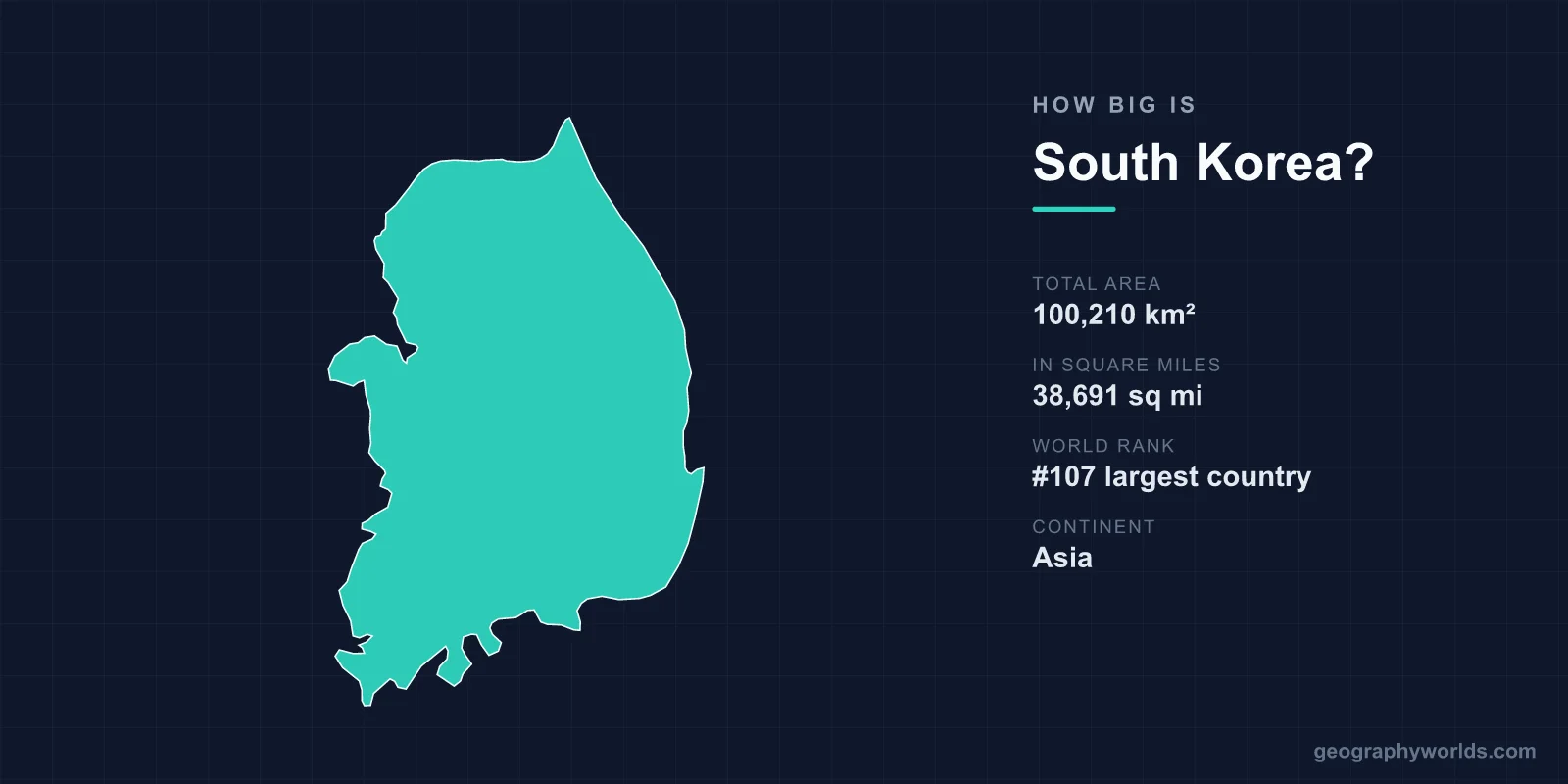
South Korea covers a total area of 100,210 km² (38,691 sq mi), making it the 107th largest country in the world — roughly the size of the U.S. state of Indiana or slightly bigger than Iceland. Occupying the southern half of the Korean Peninsula in East Asia, South Korea is a compact nation that fits an outsized economy, population, and cultural footprint into a relatively small space.
South Korea's Area in Numbers
At 100,210 square kilometres, South Korea ranks 107th by land area out of roughly 195 countries, placing it firmly in the smaller half of the world's nations. That figure represents only about 0.07% of the planet's total land surface of nearly 149 million km². Geographically, the country stretches about 500 km from north to south and around 300 km from east to west — distances short enough that a high-speed KTX train can cross most of the peninsula in a few hours.
South Korea also possesses a remarkably long and intricate coastline of about 2,413 km relative to its modest size. This is because its southern and western shores are deeply indented and fringed by thousands of islands, giving the country far more coast than its land area alone would suggest. You can explore more about its location and statistics in our south korea country guide.
How South Korea Compares to Other Places
Size comparisons make South Korea's scale easier to grasp:
- vs. U.S. states: Almost identical in area to Indiana, and a little larger than Kentucky or Virginia.
- vs. the United Kingdom: South Korea is roughly 41% the size of the UK (243,610 km²).
- vs. North Korea: The northern neighbour is larger at about 120,540 km², so South Korea is around 83% of North Korea's area despite holding twice the population.
- vs. Iceland: South Korea is slightly larger than Iceland (103,000 km²) but home to roughly 150 times as many people.
- vs. Portugal: The two countries are close in size, with Portugal at about 92,000 km².
What truly sets South Korea apart is not its land area but its density. With about 52 million residents, it has a population density exceeding 500 people per square kilometre — one of the highest of any country that is not a city-state. Roughly half the entire population lives in or around the Seoul Capital Area, which packs around 26 million people into just over a tenth of the national territory.
Terrain: A Mountainous, Crowded Land
One reason South Korea feels so densely settled is that about 70% of its terrain is mountainous and heavily forested, leaving relatively little flat land for cities and farming. The Taebaek Mountains form a rugged spine running down the eastern side of the peninsula, while broader plains and river valleys open up along the western and southern coasts where most agriculture and major cities are concentrated.
The highest point in the country is Hallasan, a dormant volcano on Jeju Island, rising 1,950 m (6,398 ft) above sea level. Jeju itself is a volcanic island studded with more than 360 smaller "parasitic" cones and recognised as a UNESCO biosphere reserve. Off the southern coast lie over 3,000 islands of varying sizes, creating one of the most intricate maritime landscapes in Asia.
Climate Across a Small Country
Despite its compact footprint, South Korea experiences four distinct seasons. Summers are hot, humid, and shaped by the East Asian monsoon, which brings heavy rainfall between June and August. Winters are cold and dry, especially in the mountainous interior and north. The southern coast and Jeju Island enjoy noticeably milder, near-subtropical conditions, while the western tidal flats — among the largest in Asia — provide critical stopover habitat for migratory birds.
This climatic variety, combined with dramatic elevation changes over short distances, means South Korea offers ski resorts, temperate forests, and palm-lined beaches all within a single day's travel.
A Landscape Transformed by People
South Korea's modest size has shaped its modern history. After the Korean War left its hillsides largely barren, the country launched one of the most successful national reforestation campaigns ever recorded, restoring green cover to mountains across the peninsula within a few decades. Meanwhile, limited buildable land pushed cities upward, making South Korea one of the most vertically built and efficiently planned societies on Earth. The result is a country that, while small on the map, exerts global influence in technology, manufacturing, and culture.
Frequently Asked Questions
Is South Korea bigger or smaller than North Korea?
South Korea is smaller in area. North Korea covers roughly 120,540 km² compared with South Korea's 100,210 km², so the South is about 83% the size of the North — yet it has roughly double the population.
What U.S. state is South Korea the same size as?
South Korea is almost exactly the size of Indiana, and just slightly larger than Kentucky or Virginia. It is far smaller than states such as Texas or California.
How long is South Korea from north to south?
The country stretches about 500 km from north to south and roughly 300 km east to west, making it possible to travel from Seoul to the far southern coast in only a few hours by high-speed rail.
Why does South Korea feel so densely populated?
About 70% of the land is mountainous, so most of its 52 million people are concentrated in lowland and coastal areas. This pushes the effective population density very high, especially around Seoul, which holds roughly half the national population.
