
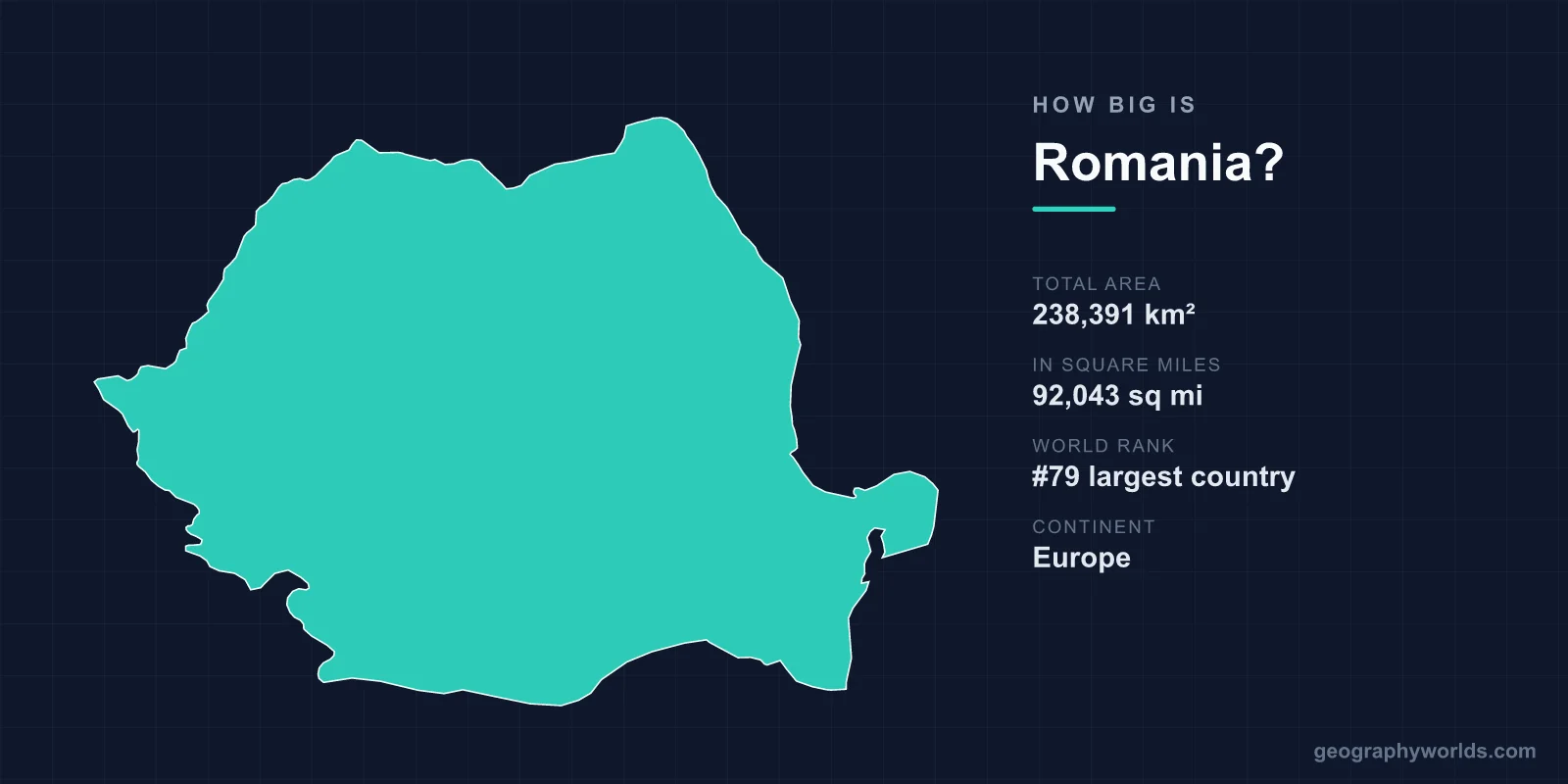
Romania covers a total area of 238,391 km² (92,043 sq mi), making it the 79th largest country in the world and the 12th largest in Europe. That puts it slightly below the United Kingdom in size, yet large enough to pack in mountains, plains, a Black Sea coastline, and one of Europe's great river deltas within a single border.
Romania's Area in Numbers
At 238,391 square kilometres, Romania accounts for roughly 0.16% of the Earth's total land area of about 148.94 million km². Among European nations it ranks comfortably in the upper tier, sitting above countries like Belarus's neighbours in central Europe and far ahead of the small Balkan states to its south.
- Total area: 238,391 km² (92,043 sq mi)
- World rank: 79th largest country
- Rank in Europe: 12th largest
- Share of global land: approximately 0.16%
- Capital: Bucharest
- Coastline: 225 km along the Black Sea
The country measures roughly 670 km from east to west and about 530 km from north to south, giving it a fairly compact, rounded shape rather than the long, stretched outline of countries like Chile or Norway.
How Romania Compares to Other Countries
Size is easiest to grasp through direct comparison. Romania is just a little smaller than the United Kingdom (243,610 km²), so picturing the UK gives you a close mental image of Romania's footprint. Against larger European powers the gap widens: Romania is about 37% the size of France (640,679 km²) and roughly half the area of Spain.
Looking beyond Europe, Romania is about 63% the size of Japan (377,975 km²) and slightly larger than the U.S. state of Oregon. Compared with the entire United States, Romania would fit roughly 41 times over. These comparisons show that while Romania is mid-sized on the world stage, it is a genuinely substantial country by European standards, with enough room for sharply contrasting landscapes.
The Land Within Romania's Borders
What makes Romania's size interesting is how its territory is divided into three broadly equal shares of mountains, hills, and plains. The Carpathian Mountains sweep through the centre of the country in a great horseshoe, enclosing the Transylvanian Plateau in their embrace. To the south lies the Wallachian Plain, drained by the Danube, while the Moldavian Plateau rolls across the northeast.
The highest point is Moldoveanu Peak, rising to 2,544 m (8,346 ft) in the Făgăraș range of the Southern Carpathians. The lowest reaches are at sea level along the Black Sea coast and in the marshy Danube Delta. This vertical range — from coastal wetland to alpine summit — is one reason Romania supports such a wide variety of habitats within a moderate land area.
The Danube River forms much of Romania's southern border before turning north and emptying into the Black Sea through the Danube Delta, Europe's largest and best-preserved wetland and a UNESCO World Heritage Site.
A Big Country for Wildlife and Wilderness
Romania's relatively generous area, combined with its mountainous core, has preserved some of the continent's most important natural strongholds. The Romanian Carpathians hold a large share of Europe's remaining old-growth forest and are estimated to contain around a third of all plant species found in Europe.
The country is also a stronghold for large carnivores: Romania is home to roughly 60% of Europe's brown bear population (outside Russia), along with significant numbers of wolves and lynx. Few European countries of comparable size can claim such intact wilderness, a direct consequence of how much rugged, forested upland fits inside Romania's borders. For more on the country's landscapes and culture, see our romania country guide.
Climate Across Romania's Territory
Spanning this much land means Romania experiences a temperate continental climate with four distinct seasons. Summers are warm, often reaching 25–30°C on the lowland plains, while winters can be cold, averaging around -3 to -5°C in many areas. The Black Sea coast enjoys milder, more moderated conditions, whereas the Carpathians receive heavy snowfall and stay cool well into spring. This climatic spread, from coast to high mountain, mirrors the country's physical variety.
Frequently Asked Questions
Is Romania bigger than the UK?
No, but only just. Romania covers 238,391 km² while the United Kingdom spans 243,610 km², so Romania is slightly smaller — a difference of only about 2%. For everyday purposes the two countries are very close in size.
Where does Romania rank in Europe by size?
Romania is the 12th largest country in Europe by area and the largest in southeastern Europe. It is considerably bigger than its Balkan neighbours such as Bulgaria, Serbia, and Hungary.
How long is Romania's coastline?
Romania has a 225 km coastline along the Black Sea in the southeast. While short relative to the country's overall size, the coast includes the Danube Delta and popular resort towns near Constanța.
What is the highest point in Romania?
The highest point is Moldoveanu Peak at 2,544 m (8,346 ft), located in the Făgăraș Mountains of the Southern Carpathians. The lowest point is sea level along the Black Sea coast.
