
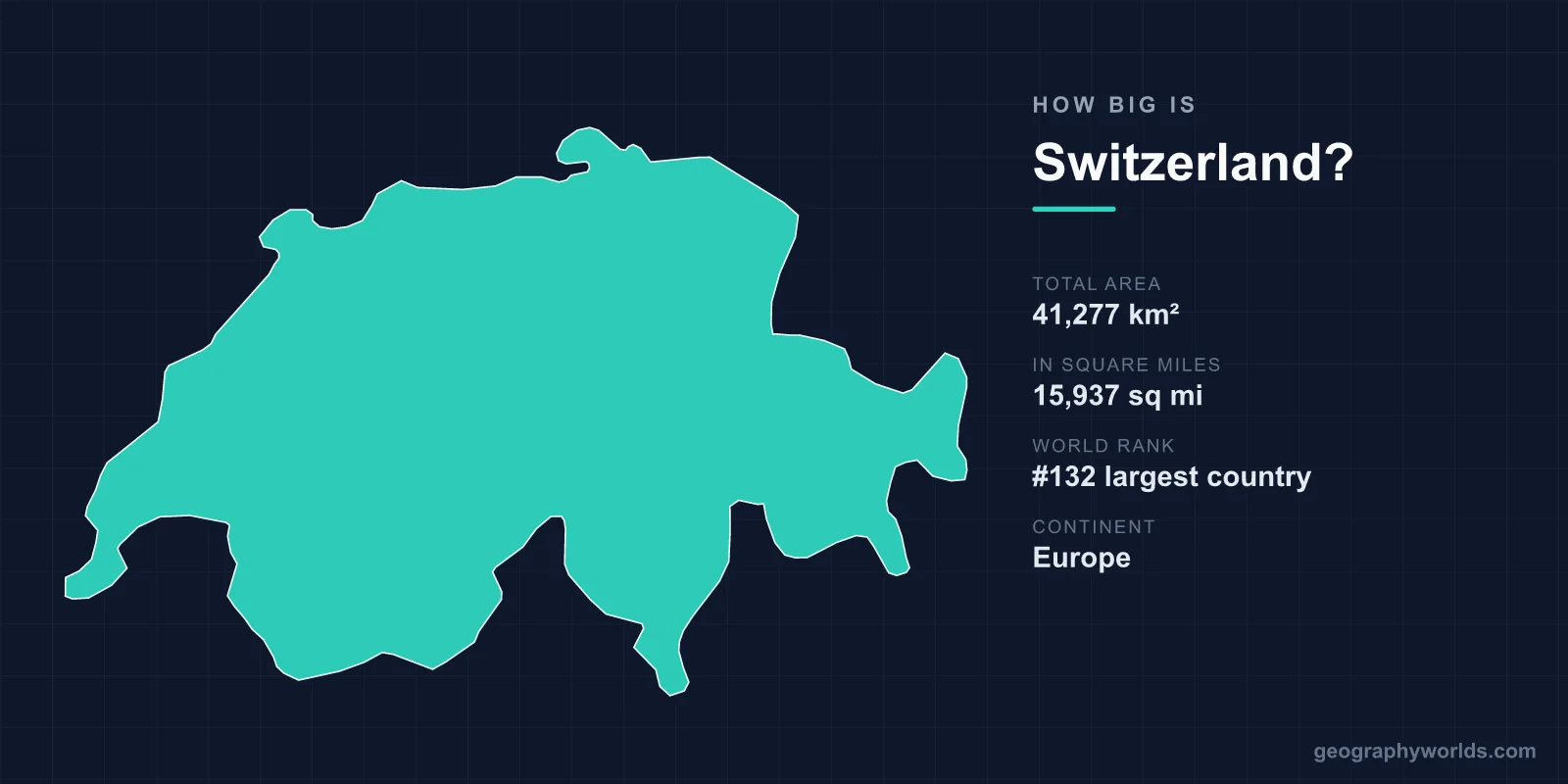
Switzerland covers a total area of 41,277 km² (15,937 sq mi), making it roughly the 132nd largest country in the world — about twice the size of the U.S. state of New Jersey. Despite ranking among the smaller nations on Earth, this Central European country packs an extraordinary range of landscapes into its compact borders, from glaciated alpine peaks to broad lowland plains.
Switzerland's Area in Numbers
At 41,277 square kilometres, Switzerland represents only about 0.03% of the planet's total land area of roughly 148.94 million km². It is a landlocked nation with no coastline, sharing borders with five countries: Germany, France, Italy, Austria, and the tiny principality of Liechtenstein. Its capital is Bern, though Zürich and Geneva are larger and more internationally recognised.
- Total area: 41,277 km² (15,937 sq mi)
- World rank: approximately 132nd largest country
- Share of global land: about 0.03%
- Continent: Europe (Central Europe)
- Capital: Bern
To picture the scale, imagine a country you could drive across in just a few hours — yet one whose vertical relief makes those hours feel like crossing several worlds.
How Far Does Switzerland Stretch?
Switzerland measures roughly 350 km from east to west and only about 220 km from north to south. That east-west span is its longest dimension, running from the shores of Lake Geneva in the southwest to the Austrian border in the east. The country's borders total around 1,935 km, an unusually long perimeter for such a small area — a reflection of how mountains and rivers carve its frontier into a jagged outline rather than a tidy rectangle.
This compactness is part of what makes Switzerland so efficient to traverse. Modern engineering has shrunk distances further still: the Gotthard Base Tunnel, the world's longest railway tunnel at 57 km, bores straight through the Alps to connect the country's north and south.
A Vertical Country: Terrain and Elevation
What Switzerland lacks in horizontal size it more than makes up for in altitude. The Alps cover about 60% of the national territory, while the Jura Mountains run along the northwest and the Swiss Plateau (the Mittelland) forms the populated lowland belt between them. Although the plateau makes up only around 30% of the land, it is home to the large majority of the population and most major cities.
The highest point is Dufourspitze in the Monte Rosa massif, rising to 4,634 m (15,203 ft). Switzerland contains more than 48 peaks exceeding 4,000 m, including the instantly recognisable Matterhorn at 4,478 m. The terrain is so rugged that a large share of the land cannot be settled or farmed, concentrating people and industry into the flatter valleys and plateau.
How Switzerland Compares
Size comparisons help put 41,277 km² in context:
- About twice the size of New Jersey in the United States.
- Roughly 1.4 times larger than Belgium (30,528 km²).
- Smaller than Austria, Ireland, or Portugal, and far smaller than neighbouring France or Germany.
- Comparable in area to the Netherlands, though far more mountainous.
So while Switzerland is one of Europe's smaller states by area, its geographic and economic influence vastly exceeds its footprint. For a fuller picture of the nation's regions, cantons, and culture, see our switzerland country guide.
Water, Glaciers, and Natural Features
For a landlocked country, Switzerland is remarkably rich in water. It holds around 1,500 lakes — including Lake Geneva and Lake Zürich — and locals like to say you are never more than about 16 km from one. The country acts as a natural water tower for Europe, feeding several of the continent's major rivers: the Rhine, the Rhône, the Inn (a Danube tributary), and the Ticino (which flows to the Po).
Its glaciers store a significant portion of the region's freshwater reserves. The Aletsch Glacier, the longest in the Alps at about 23 km, anchors a UNESCO World Heritage area, while the Rhine Falls near Schaffhausen rank among Europe's most powerful waterfalls. Climate varies sharply with elevation: the plateau is temperate, the high Alps endure heavy snow and ice, and the southern canton of Ticino enjoys an almost Mediterranean feel.
Frequently Asked Questions
Is Switzerland a small country?
Yes. At 41,277 km² it ranks around 132nd in the world by area, placing it firmly among the smaller nations. However, it is densely developed and highly prosperous, so it feels far larger in influence than its size suggests.
How does Switzerland's size compare to a U.S. state?
Switzerland is about twice the size of New Jersey, or slightly larger than the combined area of Maryland. It would fit many times over inside larger states such as Texas or California.
What is the highest point in Switzerland?
The highest peak is Dufourspitze at 4,634 m (15,203 ft), part of the Monte Rosa massif on the Italian border. The famous Matterhorn, at 4,478 m, is slightly lower but more iconic.
Why does such a small country have four languages?
Despite its modest area, Switzerland recognises four official languages — German, French, Italian, and Romansh — a legacy of its position at the crossroads of major European cultures and its federation of historically independent cantons.
