
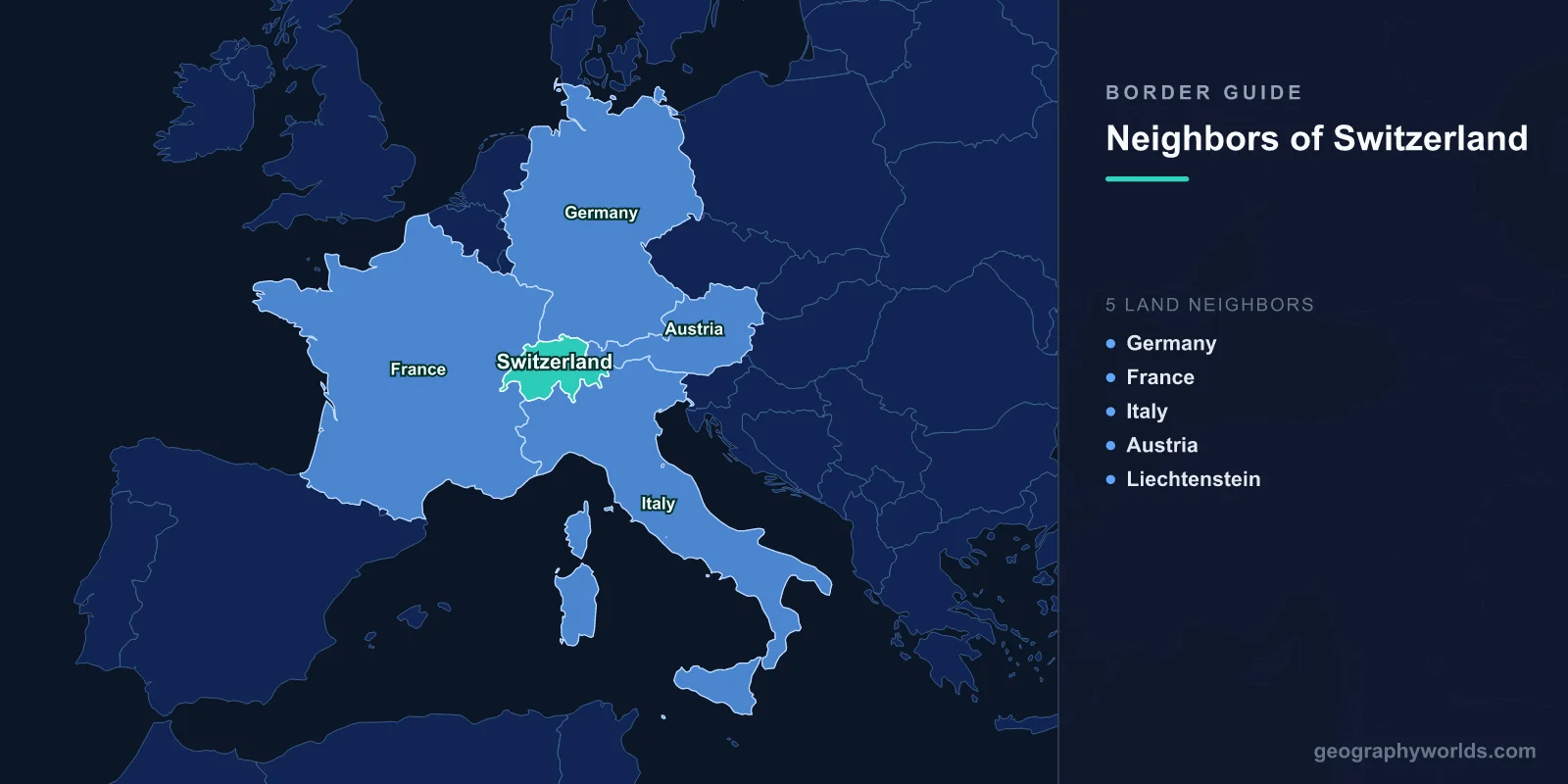
Switzerland shares land borders with 5 countries: Germany (347 km), France (573 km), Italy (698 km), Austria (158 km), and Liechtenstein (41 km), totaling approximately 1,817 km of land boundaries.
Introduction
Nestled in the heart of the European Alps, Switzerland is a landlocked nation whose borders touch five countries and four major European language families. The country's position at the crossroads of Europe has shaped its multilingual, multicultural identity — with German, French, Italian, and Romansh as official languages, each reflecting the influence of a neighboring nation. Despite not being an EU member, Switzerland is surrounded entirely by EU and EEA nations and participates in the Schengen Area, allowing free movement across its Alpine frontiers.

Complete List of Countries Bordering Switzerland
- Italy: 698 km
- France: 573 km
- Germany: 347 km
- Austria: 158 km
- Liechtenstein: 41 km
Switzerland's five borders total 1,817 km, almost entirely through mountainous terrain. The country sits at the watershed of three major European river systems — the Rhine (flowing to the North Sea), the Rhône (to the Mediterranean), and the Po (to the Adriatic) — making it a natural meeting point of European geography.
Italian and French Borders
- Italy border: 698 km — Switzerland's longest, through the southern Alps
- France border: 573 km — from Lake Geneva through the Jura Mountains
The Swiss-Italian border is Switzerland's longest at 698 km, weaving through the southern Alps including the dramatic peaks around the Matterhorn (4,478 m) and Monte Rosa (4,634 m). The Italian-speaking canton of Ticino lies entirely south of the Alpine divide, culturally and linguistically Italian despite being Swiss. The Simplon Tunnel, Gotthard Road Tunnel, and the new Gotthard Base Tunnel (57 km, the world's longest railway tunnel) are critical links through this mountainous frontier.
The Franco-Swiss border extends 573 km from Lake Geneva (Lac Léman) through the Jura Mountains to the tripoint with Germany near Basel. Geneva is a unique border city — largely surrounded by French territory, with the city's airport actually straddling the border. The French-speaking cantons of western Switzerland (Romandie) share deep cultural ties with France, from cuisine to literature.
German, Austrian, and Liechtenstein Borders
- Germany border: 347 km — follows the Rhine River and Lake Constance
- Austria border: 158 km — Alpine terrain in the Rhine Valley and Engadin
- Liechtenstein border: 41 km — tiny principality in the Rhine Valley
The Swiss-German border stretches 347 km, largely following the Rhine River and the southern shore of Lake Constance (Bodensee). Basel, Switzerland's third-largest city, sits at the tripoint of Switzerland, Germany, and France. The Rhine Falls near Schaffhausen, Europe's largest waterfall by volume, lies close to the German border.
The Swiss-Austrian border of 158 km runs through the Alps in the east, connecting through the Rhine Valley and the high passes of the Engadin region. Graubünden, Switzerland's largest canton, borders both Austria and Italy.
Liechtenstein's 41 km border with Switzerland lies along the Rhine Valley between the Swiss canton of St. Gallen and the Austrian province of Vorarlberg. The microstate uses the Swiss franc as currency and delegates its diplomatic representation to Switzerland in countries where it has no embassy.
Historical Border Changes
Switzerland's borders have been remarkably stable since the Congress of Vienna in 1815 established the country's permanent neutrality. The last significant border change occurred in 1815-1816 when the cantons of Valais, Neuchâtel, and Geneva joined the Confederation. Switzerland's neutrality kept it out of both World Wars, meaning its borders remained unchanged through the 20th century's most destructive conflicts. The country joined the Schengen Area in 2008, transforming its Alpine borders from customs checkpoints into open crossings — though Switzerland remains outside the EU itself, maintaining border controls for goods and customs.
Key Facts
- Switzerland borders 5 countries and has 4 official languages reflecting each neighbor
- The Italian border (698 km) is Switzerland's longest
- Switzerland's borders have been essentially unchanged since 1815
- The Gotthard Base Tunnel (57 km) is the world's longest railway tunnel, linking Switzerland to Italy
- Switzerland is in the Schengen Area but not the EU, creating a unique border arrangement
Fun Facts
- Geneva's airport has a French sector — you can walk through a door from Switzerland directly into France without passing through any border control.
- The Swiss town of Büsingen am Hochrhein is actually a German exclave completely surrounded by Swiss territory.
- Switzerland sits at the source of the Rhine, Rhône, and tributaries of the Po — water from Swiss mountains flows to three different seas.
- Liechtenstein and Switzerland share such close ties that Swiss border guards patrol Liechtenstein's borders with Austria.
Final Thoughts
Switzerland's five borders connect it to the major cultural spheres of Europe while maintaining its distinctive identity as a neutral, multilingual federation. The Alps that define most of these frontiers have been both a barrier and a bridge, with remarkable engineering feats like the Gotthard tunnels allowing Swiss borders to serve as vital links in European connectivity.
Test Your Knowledge!
Think you know your borders and boundaries? Try our interactive geography quiz!
Play Geography Games →