
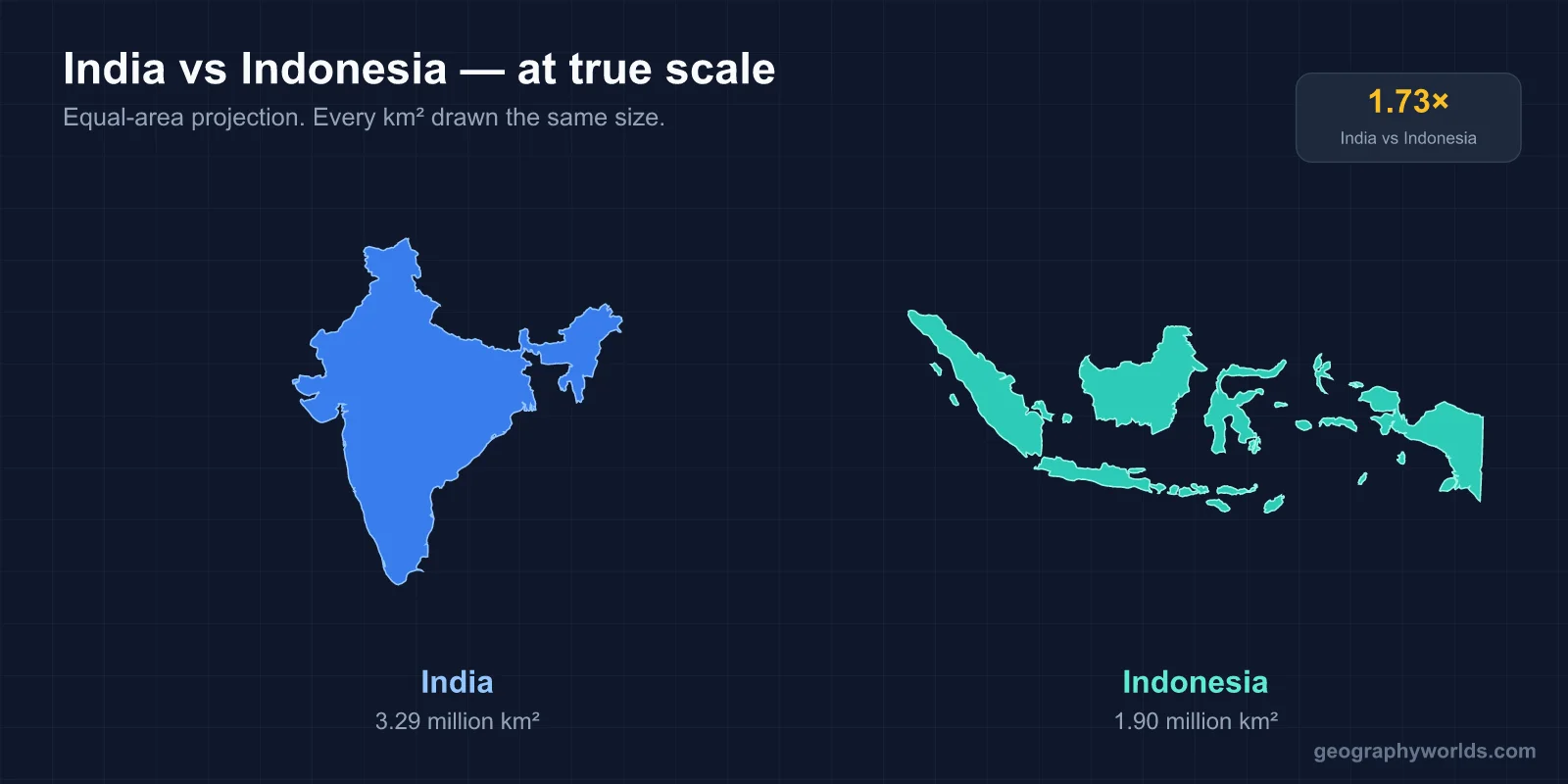
Only about 140 km of sea separates Indira Point, India's southernmost point in the Nicobar Islands, from Rondo Island, Indonesia's northernmost island off Aceh, and the name Indonesia itself comes from "India" and the Greek nesos, island. Of the two neighbours, India is the bigger and more populous. It covers 3,287,263 km², about 1.7 times Indonesia's 1,904,569 km², and had about 1.46 billion people in 2025, roughly five times Indonesia's 288 million. Indonesia is the richer of the two per person. The IMF's 2026 estimates put its nominal GDP per capita at about US$5,360, nearly double India's US$2,810, although India's total economy is more than two and a half times larger. India's capital is New Delhi, and its official languages are Hindi and English. Indonesia's capital is Jakarta, with a new capital, Nusantara, planned in East Kalimantan since 2022, and its official and national language is Indonesian.
The Himalaya Against the Ring of Fire
India is a single block of the Asian mainland. Indonesia is spread across the sea between the Indian and Pacific oceans. India's land borders run to Pakistan, China, Nepal, Bhutan, Bangladesh and Myanmar, and it is the seventh-largest country in the world by area. Indonesia is the world's largest archipelagic state and the 14th-largest country. Counts of its islands range from 13,466 named islands to more than 17,500, depending on the method, and about 922 are permanently inhabited. It stretches 5,120 km from east to west and crosses into Oceania on New Guinea. Its only land borders are on shared islands: with Malaysia on Borneo, with Papua New Guinea on New Guinea, and with Timor-Leste on Timor.
The mountains show the difference in how each country was built. India's highest ground is the Himalaya, pushed up by the Indian plate driving into Asia. Kangchenjunga, the world's third-highest mountain at 8,586 m, stands on the border between Sikkim and Nepal. Indonesia sits where the Eurasian, India-Australia and Pacific-Philippine plates meet. Its subduction zones feed a chain of about 400 volcanoes, around 130 of them considered active. The tallest peak, however, is not a volcano. Puncak Jaya, on New Guinea, reaches 4,884 m. The same tectonics bring disaster. The Toba super-eruption on Sumatra about 74,000 years ago is the largest known explosive event of the past 2.5 million years. The eruption of Tambora in 1815 was followed by the "Year Without a Summer" in 1816. The magnitude 9.2–9.3 Sumatra–Andaman earthquake of 26 December 2004, off Aceh, sent a tsunami across the Indian Ocean that killed an estimated 227,898 people in 14 countries, India and Indonesia among them.
Rivers show the same contrast. India's heartland is the plain of the Ganges, a 2,525 km river that rises in the western Himalaya in Uttarakhand and flows through Bangladesh to the Bay of Bengal. Some of Indonesia's major rivers, the Kapuas, Barito and Mahakam, cross Borneo, and they have long been routes between the coast and the interior. The largest lake is Lake Toba, which fills the caldera of the super-eruption. For more on the islands themselves, see our guide to the Indonesian islands.
1.46 Billion on the Ganges Plain, Half of Indonesia on Java
India is now the world's most populous country. Its population has grown from 361 million in 1951 to about 1.464 billion in 2025, and it is spread across the Indo-Gangetic plain, the Deccan and the coasts. Indonesia is the fourth-most populous country, after India, China and the United States. Its 2020 census counted 270.2 million people, and later estimates put the figure above 288 million. What sets Indonesia apart is concentration. Java covers only about 7 percent of Indonesia's land but holds about 56 percent of its people, at about 1,192 people per km² in 2025. Greater Jakarta is the most populous urban area in the world, with more than 40 million inhabitants.

Religion reverses the usual image of the two countries. Indonesia has the largest Muslim population in the world, with 251 million Muslims in 2025, or 87.15 percent of its people. Christians make up 10.44 percent, and Hindus 1.66 percent, mostly on Bali. In India's 2011 census, 79.8 percent of people were Hindu and 14.2 percent Muslim. That was about 172 million people, the third-largest Muslim population of any country, after Indonesia and Pakistan. India also has the world's largest Zoroastrian (Parsi) and Bahá'í populations.
Both countries are highly multilingual, but they solved the language question in different ways. India counts 424 native languages. Hindi is the official language of the Union, English is used alongside it, and the states were reorganised along linguistic lines in 1956. Indonesia has more than 700 languages. It made Indonesian, a standardised form of Malay, the single national language and lingua franca. The national motto, Bhinneka Tunggal Ika, means "unity in diversity".
India's US$4 Trillion Economy Against Indonesia's Higher Incomes
Measured in total, India is far larger. The IMF's April 2026 estimates put its nominal GDP at about US$4.15 trillion, the sixth-largest in the world, against US$1.54 trillion for Indonesia, the 17th-largest and the biggest in Southeast Asia. Divided by population, the order flips. Indonesia's GDP per person is about US$5,362, compared with India's US$2,813. At purchasing power parity, the figures are US$18,973 and US$12,801. The UN Human Development Index follows the same pattern, at 0.728 (113th) for Indonesia against 0.685 (130th) for India in 2023.
Their growth models differ. India reversed its agricultural stagnation through the Green Revolution of the 1970s and opened its economy with the reforms of the 1990s. By the 2010s, it had a large middle class and a strong services and communications sector. Indonesia relies more on the ground and the forest. It exports coal and petroleum gas, palm oil, coffee and spices, and since 2020 its policy has pushed for more processing at home, especially of nickel. Its economic activity is concentrated on Java, where the Jakarta–Bandung high-speed railway, the first in the region, opened in 2023. Informal work is widespread in both economies. Indonesia's official poverty rate was about 8 percent in March 2026.
Ramayana in Yawadvipa: Prambanan, Sanskrit and the Chola Raid of 1025
For about two thousand years, India's culture travelled east across the Bay of Bengal. South Indian-style pottery found at a site on Bali has been carbon-dated to around 660 BCE. The Ramayana names Java as Yawadvipa, the island where the monkey king Sugriva sent his men to search for Sita. From the early centuries CE, Indian merchants and religious specialists brought Sanskrit literacy, Hindu and Buddhist practice, and models of kingship to trading ports in Sumatra, Java and Borneo. Indonesia's historical period begins with inscriptions in the Pallava script, and the Indonesian language still carries many Sanskrit loanwords.
The kingdoms that grew from this contact left some of Asia's great monuments. Srivijaya, founded in south-eastern Sumatra in the late 7th century, became a maritime power and a centre of Buddhist learning. It sent students to Nalanda, in India. In central Java, rulers raised Borobudur and the Hindu temple compound of Prambanan between the 8th and 10th centuries. Prambanan, dedicated to Brahma, Vishnu and Shiva, is the largest Hindu temple site in Indonesia.

Contact was not always peaceful. In 1025, the Chola emperor Rajendra I, from southern India, launched naval raids on Srivijaya and several ports in present-day Indonesia and the Malay Peninsula. It was an unusual event in otherwise peaceful relations, and it helped Tamil merchant guilds spread into Southeast Asia. Islam later reached the archipelago through Indian Ocean trade. A Muslim ruler is recorded at Pasai, in northern Sumatra, in 1297. The Borobudur story is told in our guide to Borobudur.
Nehru's Parliament, Sukarno's Presidency: Two Paths From August Independence
The two countries' independence days fall just two days short of two years apart. On 17 August 1945, two days after Japan's surrender, Sukarno proclaimed Indonesia's independence, with Mohammad Hatta co-signing. The Dutch fought for four years to restore colonial rule and transferred sovereignty on 27 December 1949. India became independent on 15 August 1947, when British India was partitioned into India and Pakistan, and it became a republic on 26 January 1950. India recognised Indonesia's independence on 2 September 1946, before its own, and the two established diplomatic relations on 16 April 1949. Sukarno and Jawaharlal Nehru were key organisers of the Bandung Conference of 18 to 24 April 1955, where 29 mostly newly independent Asian and African states met. It was a step towards the Non-Aligned Movement, to which both countries still belong.
Their political systems then went separate ways. India's 1950 constitution created a federal parliamentary republic, today made up of 28 states and 8 union territories. The prime minister, answerable to Parliament, leads the government. Indonesia swung between systems. After the Constituent Assembly failed to agree a permanent constitution, Sukarno dissolved it in 1959, restored the 1945 Constitution and imposed Guided Democracy. Army general Suharto took effective power in 1966, after anti-communist killings in which at least 500,000 people died, and ruled until 1998. Since then, Indonesia has decentralised power to its 38 provinces. It held its first direct presidential election in 2004, won by Susilo Bambang Yudhoyono. Today it is a unitary presidential republic, while India is a federal parliamentary one. Both are among the world's largest democracies, both sit in the G20 and BRICS, and both trace a shared past that runs, as India's own river story does, back to the Ganges.