
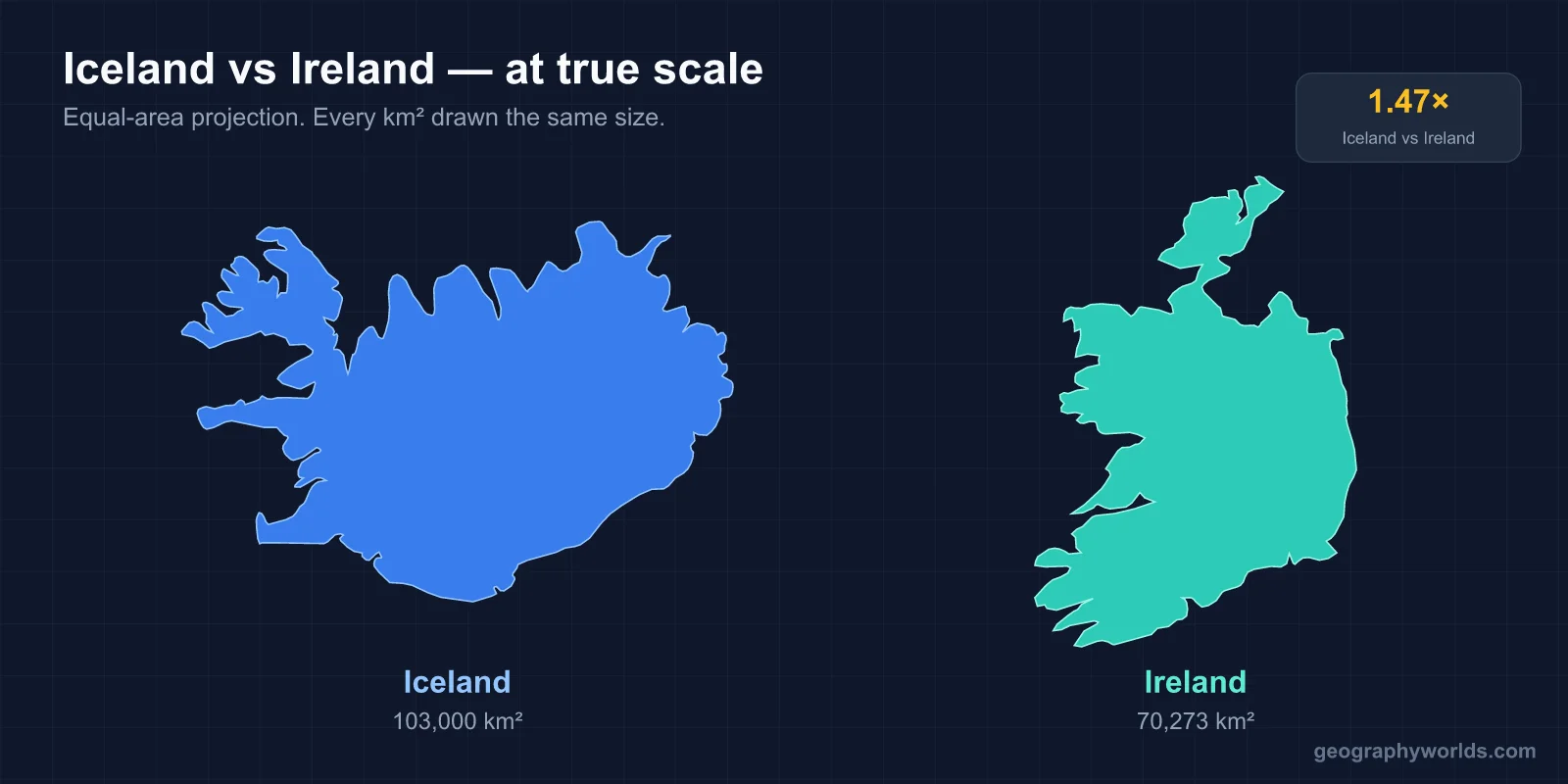
Ireland and Iceland are both North Atlantic island nations, but they are strikingly different. Iceland is the larger country by land area (about 103,000 km² to Ireland's 70,273 km²), yet Ireland has roughly 13 times more people (5.4 million versus around 402,000). Ireland is a green, low-lying maritime country in Western Europe, while Iceland is a volcanic, glacier-covered land on the edge of the Arctic in Northern Europe.
Their similar-sounding names cause endless confusion, and both sit in the cold waters of the North Atlantic. But beyond the alphabet, they share surprisingly little. This side-by-side comparison breaks down how Ireland 🇮🇪 and Iceland 🇮🇸 differ in size, population, geography, climate, language, and culture, so you can keep them straight for good.
Size and Geography
| Feature | Ireland 🇮🇪 | Iceland 🇮🇸 |
|---|---|---|
| Area | 70,273 km² | 103,000 km² |
| Continent | Europe | Europe |
| Region | Western Europe | Northern Europe |
| Land Borders | United Kingdom (Northern Ireland) | None (island nation) |
| Landscape | mostly flat to rolling central plain; hills and low mountains | volcanic; geysers, hot springs, lava fields, glaciers |
Iceland is roughly 1.5 times larger than Ireland, but the two islands could hardly look more different from the ground. Ireland is famously low and green, shaped by a broad central limestone plain rimmed by coastal hills and modest mountains. Its highest point, Carrauntoohil, reaches just 1,038 metres. The landscape is stitched together by rivers, lakes, peat bogs, and a deeply indented coastline of bays and cliffs.
Iceland, by contrast, is one of the youngest landmasses on Earth, sitting directly on top of the Mid-Atlantic Ridge where the North American and Eurasian tectonic plates pull apart. This makes it one of the most volcanically active places on the planet, with around 130 volcanoes, vast lava fields, steaming geothermal areas, and glaciers that cover roughly 11% of the country. Vatnajökull, the largest glacier in Europe by volume, dominates the southeast. Iceland's interior highlands are an almost uninhabited expanse of black sand, rock, and ice.
Population and Demographics
| Metric | Ireland 🇮🇪 | Iceland 🇮🇸 |
|---|---|---|
| Population | 5.4 million | 402 thousand |
| Population Density | 76.2 per km² | 3.9 per km² |
This is where the two countries diverge most dramatically. Despite being the smaller island, Ireland is home to about 5.4 million people, roughly 13 times Iceland's population of around 402,000. Ireland's population density of 76.2 people per km² is nearly 20 times higher than Iceland's, which at 3.9 people per km² is among the lowest in Europe.
The reason lies in Iceland's geography: much of the island is uninhabitable highland, glacier, and lava field, so settlement is concentrated in a narrow coastal ring. More than 60% of Icelanders live in the Reykjavik capital region alone. Ireland's population is more evenly spread across its workable farmland and a string of cities, though it too clusters heavily around its capital. Note that the 5.4 million figure refers to the Republic of Ireland; the island as a whole, including Northern Ireland, holds over 7 million people.
Capital Cities
Dublin serves as the capital of Ireland, while Reykjavik is the capital of Iceland. Dublin, on Ireland's east coast at the mouth of the River Liffey, is a historic European capital of over a million people in its greater urban area, with roots stretching back to a Viking settlement founded around 841 AD. It is the country's economic, cultural, and political heart.
Reykjavik, on Iceland's southwest coast, holds the title of the world's northernmost capital of a sovereign state, sitting just south of the Arctic Circle at about 64° North. Though small by global standards, it anchors the overwhelming majority of Iceland's population and economy. Its name means "Smoky Bay," a reference to the steam rising from the area's geothermal hot springs that early Norse settlers observed.
Language, Currency, and Culture
| Aspect | Ireland 🇮🇪 | Iceland 🇮🇸 |
|---|---|---|
| Languages | Irish (Gaelic) and English (both official) | Icelandic (official) |
| Currency | Euro (EUR) | Icelandic Króna (ISK) |
Ireland has two official languages: Irish (Gaelic), a Celtic language, and English, which the vast majority of the population speaks day to day. Irish is taught in schools and is the first language in pockets known as the Gaeltacht, mainly along the western seaboard. Iceland's official language is Icelandic, a North Germanic language descended from Old Norse. It has changed so little over the centuries that modern Icelanders can read the medieval sagas in their original form with relative ease.
On currency, Ireland uses the Euro as a member of the Eurozone, while Iceland keeps its own Icelandic króna and is not part of the European Union. Culturally, Ireland is celebrated for its literary heritage, traditional music, and pub culture, while Iceland's identity is bound up with its Norse sagas, folklore of elves and trolls, and a deep connection to its raw natural landscape.
Climate and Natural Features
| Aspect | Ireland 🇮🇪 | Iceland 🇮🇸 |
|---|---|---|
| Climate | maritime; mild, moist; overcast half the time | temperate; moderated by North Atlantic Current |
| Key Features | Cliffs of Moher, Ring of Kerry, Aran Islands, bogs | Geysers, glaciers, volcanoes, Northern Lights, hot springs |
| Economy | technology (European HQ hub), pharmaceuticals, agriculture | fishing, tourism, aluminum smelting, geothermal energy |
Both islands are warmer than their latitudes suggest, thanks to the North Atlantic Current carrying mild ocean water northward. Ireland's maritime climate brings mild, damp, frequently overcast weather, with temperatures rarely freezing in winter or hot in summer. This steady moisture is what keeps the "Emerald Isle" so famously green year-round. Its signature natural features include the towering Cliffs of Moher, the scenic Ring of Kerry, the Aran Islands, and vast peat bogs.
Iceland's climate is colder and far more dramatic, though milder than its sub-Arctic position would imply. It is defined by its geology rather than its weather: erupting volcanoes, the spouting Strokkur and Geysir hot springs (the latter gave the world the word "geyser"), massive glaciers, black-sand beaches, and the Northern Lights dancing across winter skies. Economically, the two also diverge. Ireland has become a European headquarters hub for technology and pharmaceutical giants, while Iceland built its economy on fishing, tourism, aluminium smelting, and abundant clean geothermal and hydroelectric power.
What Makes Each Country Unique
Ireland is internationally renowned for the Cliffs of Moher, literary giants such as James Joyce, Oscar Wilde, and W.B. Yeats, the global popularity of Guinness, and St. Patrick's Day celebrations that spread far beyond its shores. Famously, Ireland has no native snakes. Legend credits St. Patrick with banishing them, but the real reason is geographic: snakes simply never recolonised the island after the last Ice Age, when rising seas cut Ireland off from mainland Europe.
Iceland stands out for its geysers and hot springs, the aurora borealis, otherworldly volcanic terrain, and its role as a gateway to the Arctic. It has no standing army, runs almost entirely on renewable energy (roughly 85% from geothermal and hydropower), and has one of the world's oldest functioning parliaments, the Althing, founded around 930 AD. Its small, tightly knit population is so interconnected that Icelanders sometimes joke about using a genealogy app to check they aren't related to a date.
Key Facts
- Larger by area: Iceland (103,000 km²), about 1.5x Ireland's 70,273 km²
- Larger by population: Ireland (5.4 million), about 13x Iceland's 402,000
- Capitals: Dublin (Ireland) and Reykjavik (Iceland, the world's northernmost capital)
- Currencies: Euro (EUR) in Ireland; Icelandic króna (ISK) in Iceland
- Languages: Irish and English in Ireland; Icelandic in Iceland
- Land borders: Ireland shares one with the UK (Northern Ireland); Iceland has none
- Defining geology: Ireland's green plains and bogs versus Iceland's volcanoes and glaciers
Verdict
Ireland and Iceland are a study in contrasts wrapped in similar names. Iceland claims the larger land area, the more spectacular geology, and the title of Europe's volcanic frontier, yet remains thinly populated and reliant on its dramatic natural resources. Ireland packs many times more people onto a smaller, greener island and has reinvented itself as a hub for global technology and pharmaceuticals.
One is shaped by fire and ice on the edge of the Arctic; the other by rain, grass, and centuries of dense human history. Whether you are planning a trip, studying world geography, or simply trying to stop mixing the two up, knowing these differences gives you a far richer picture of two remarkable North Atlantic neighbours.
Frequently Asked Questions
Is Ireland or Iceland bigger?
Iceland is bigger in land area, covering about 103,000 km² compared with Ireland's 70,273 km², making Iceland roughly 1.5 times larger. However, Ireland has a far bigger population, with around 5.4 million people versus Iceland's 402,000.
Are Ireland and Iceland close to each other?
They are both North Atlantic islands but not especially close. They lie roughly 1,500 kilometres apart, with Iceland far to the northwest near the Arctic Circle and Ireland off the northwest coast of mainland Europe, just west of Great Britain.
Why are Ireland and Iceland so often confused?
The confusion is almost entirely down to their similar spellings and the fact that both are cool, North Atlantic island nations. Geographically and culturally they are very different: Ireland is a green, low-lying Celtic country, while Iceland is a volcanic, Norse-rooted land of glaciers and geysers.
Which country is better to visit, Ireland or Iceland?
It depends on what you want. Ireland is ideal for travellers drawn to lush coastal scenery, historic cities, literature, music, and lively pub culture. Iceland is the choice for dramatic natural wonders such as volcanoes, glaciers, hot springs, and the Northern Lights. Many visitors find the two make an excellent paired trip across the North Atlantic.
Test Your Knowledge!
Think you know your countries? Try our interactive geography quiz!
Play Geography Games →