
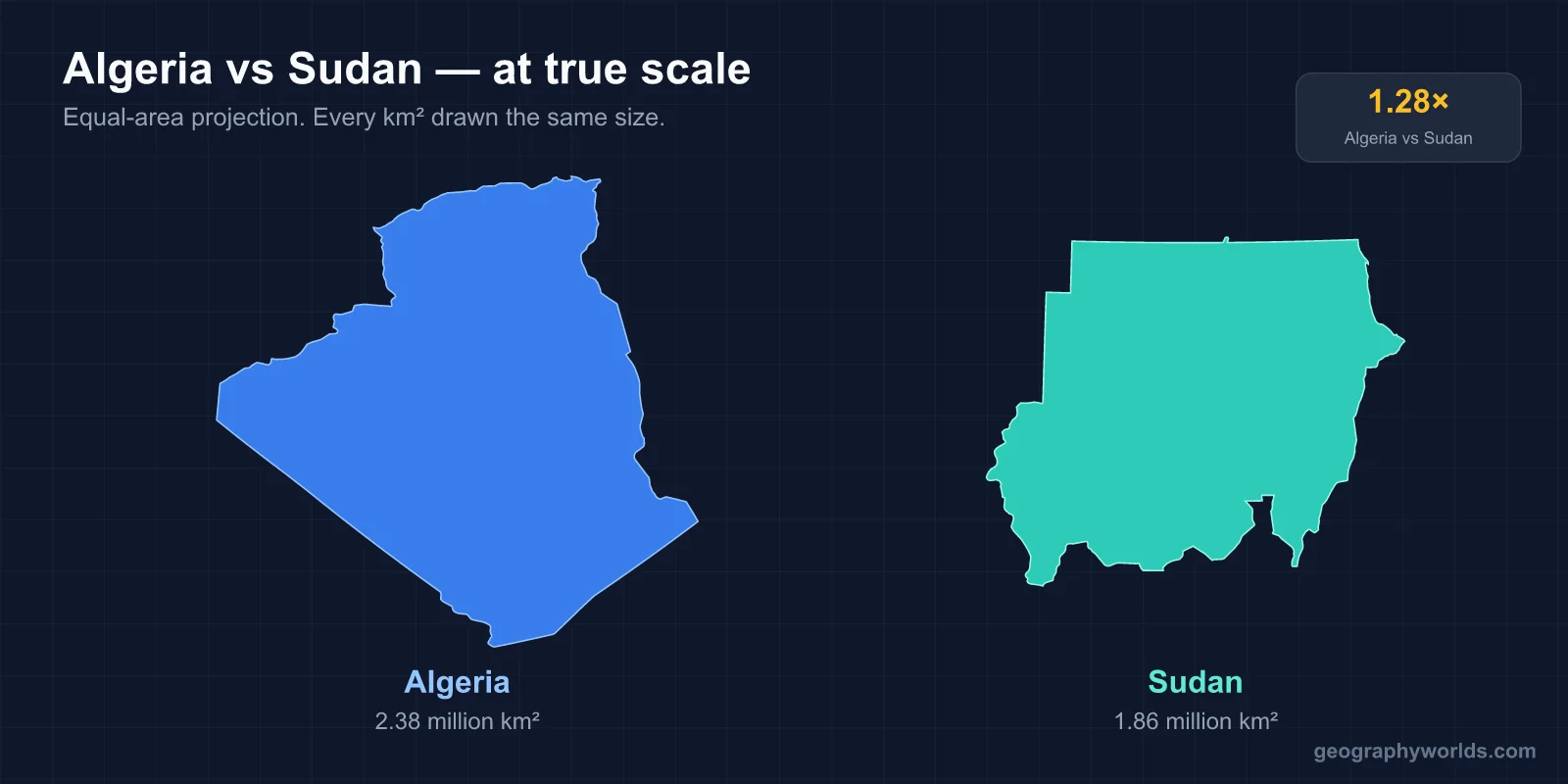
Yes. Algeria is larger than Sudan. Algeria covers 2,381,741 km², while Sudan covers 1,861,484 km². Algeria is about 1.28 times the size of Sudan — larger by 520,257 km², which is about the size of Spain. Algeria is the largest country in Africa; Sudan is the 3rd-largest (after Algeria and the Democratic Republic of the Congo).
The Short Answer
Algeria has been the largest country in Africa since 2011, when Sudan split into Sudan and South Sudan. Before that, Sudan was the largest. Algeria covers most of central North Africa, while Sudan occupies northeastern Africa along the Nile and the Red Sea. Both are enormous countries by world standards — Algeria ranks 10th globally, Sudan 15th.
The two countries share many characteristics: both are mostly desert (Algeria is largely Sahara; Sudan is mostly Saharan and semi-arid), both have populations concentrated in specific regions (along the Mediterranean and Nile respectively), and both are Arab-Muslim majority countries with complex modern political histories.

The Real Numbers
- Algeria total area: 2,381,741 km² (919,595 sq mi)
- Sudan total area: 1,861,484 km² (718,723 sq mi)
- Difference: 520,257 km² — about the size of Spain
- Ratio: Algeria is about 1.28× the size of Sudan
Population
Both countries have similar populations:
- Algeria population: ~46,000,000
- Sudan population: ~48,000,000
- Algeria density: ~19 people per km²
- Sudan density: ~26 people per km²
Sudan has slightly more people than Algeria (about 4% more), packed into less land — making Sudan more densely populated overall. But both have low population densities by global standards — most of the land in both countries is desert and sparsely inhabited.
Geography
Algeria is dominated by the Sahara Desert:
- Atlas Mountains: Along the Mediterranean coast, including Algeria's populated region
- Mediterranean coast: 1,622 km along the Mediterranean, home to most of Algeria's population
- Sahara Desert: Covers about 80% of Algerian territory
- Hoggar Mountains: In the southern Sahara, peaks reach 2,918 m
- The Algerian Steppe: Semi-arid grasslands between the Atlas and the Sahara
Sudan is also largely desert and semi-arid:
- The Nile River: Runs north through Sudan, the country's lifeline
- Sahel region: Semi-arid grasslands south of the Sahara
- Nubian Desert: Part of the Sahara in northeastern Sudan
- The Red Sea coast: About 670 km along the Red Sea
- The Sudd: Vast swampland (was previously in southern Sudan, now in South Sudan after partition)
Climate
Algeria has Mediterranean climate in the northern coastal areas (mild winters, hot summers) and desert climate in the rest of the country. Summer temperatures in the Sahara regularly exceed 45°C. Winter nights can drop below freezing in the desert.
Sudan has tropical to desert climate. The north is true Sahara (hot and arid). The south is more tropical (Sahel and savanna). Sudan experiences a rainy season from June to September that brings significant precipitation to southern regions.
Economy
Algeria has the larger economy:
- Algeria GDP: ~$195 billion
- Sudan GDP: ~$50 billion
- Algeria per capita GDP: ~$4,250
- Sudan per capita GDP: ~$1,000
Algeria's economy is about 4× larger than Sudan's in absolute terms, and about 4× richer per capita. Algeria is the world's 5th-largest natural gas exporter and 18th-largest oil exporter. Hydrocarbons account for about 60% of government revenue. Sudan's economy depends on agriculture (livestock, sorghum, sesame), gold mining, and oil (though most reserves are in South Sudan).
Political History
Algeria was a French colony from 1830 until independence in 1962 — won through a brutal 8-year war that killed an estimated 1-1.5 million people. The country has been ruled by the National Liberation Front (FLN) since independence, with occasional protests and reforms. Algeria experienced a civil war in the 1990s between the government and Islamist groups.
Sudan has had a turbulent recent history. The country was ruled by the British and Egyptians from 1899 until 1956. Long civil wars (1955-1972 and 1983-2005) led to South Sudan's independence in 2011. Sudan has experienced military coups (most recently 2021), civil war (currently 2023-present), and the Darfur conflict (2003-2020). The current civil war between the Sudanese Armed Forces and the Rapid Support Forces has displaced millions.
Religion and Culture
Both countries are overwhelmingly Sunni Muslim. Algeria is about 99% Sunni Muslim, with small Christian and Jewish minorities. Sudan is about 90% Sunni Muslim, with a Christian minority. Both speak Arabic as the official language, with regional variations. Algeria also has significant Berber (Amazigh) populations who speak Berber languages.
Key Facts
- Algeria is about 1.28× the size of Sudan.
- Algeria is the largest country in Africa.
- Sudan is the 3rd-largest country in Africa.
- Both countries are mostly desert with concentrated populations.
- Sudan experienced major partition (South Sudan independence) in 2011.
Fun Facts
- The Sahara Desert covers about 80% of Algeria and a large portion of Sudan.
- Algeria has 7 UNESCO World Heritage Sites; Sudan has 3.
- The Algerian Sahara has produced exceptional rock art dating back 10,000 years, found at sites like Tassili n'Ajjer.
- Sudan's pyramids — at Meroe and other sites — number more than Egypt's pyramids, though they're smaller and less famous.
- Both countries have benefited from oil/gas reserves, though political instability has affected their economies.
Tourism
Algeria has remarkable tourism potential but receives relatively few international visitors — about 3 million annually. The country's Sahara landscapes, Roman ruins (Timgad, Djemila, Tipasa), Mediterranean coast, and Casbah of Algiers are major attractions. Algeria has been slowly opening to tourism in recent years.
Sudan's tourism industry has been devastated by years of conflict. Major sites like the Pyramids of Meroe (UNESCO World Heritage Site), the ancient Nubian capital of Napata, the Sufi shrines of Khartoum, and Red Sea diving destinations could attract more visitors with greater stability.
Languages and Heritage
Both countries have rich linguistic and cultural heritages. Algeria's indigenous Berber (Amazigh) population represents one of the oldest continuous cultures in North Africa, predating Arab influence by thousands of years. Berber languages (Kabyle, Chaouia, Tachelhit) are spoken by about 30% of Algerians and are now constitutional national languages alongside Arabic.
Sudan is linguistically diverse with over 70 indigenous languages, although Arabic dominates. The Nubian languages, spoken in northern Sudan and southern Egypt, are descended from the ancient Nubian language of the Kingdom of Kush — one of Africa's ancient civilizations contemporary with Egypt. Sudan also has significant Beja (in the east) and other minority groups.
Environment and Climate Change
Both countries face severe environmental challenges. Algeria experiences desertification pushing the Sahara northward into its agricultural zones. Water scarcity is a major concern — the country has been investing in desalination and dam projects to secure water supplies for its growing population.
Sudan also faces desertification and unpredictable rainfall affecting agriculture. The country's Sahel region is vulnerable to drought, and climate change is making rainfall more erratic. Combined with political instability, climate change has contributed to food insecurity and conflict over resources in places like Darfur.
The Bottom Line
Algeria is bigger than Sudan by about 28%, and Algeria is the largest country in Africa. Both are massive, mostly-desert countries with populations concentrated in specific habitable zones. Algeria has a larger and more developed economy, more political stability, and more developed infrastructure. Sudan faces severe challenges from ongoing conflict and instability. Both countries have significant potential for development if they can manage their respective political and resource challenges. The geographic similarities — vast desert, concentrated populations, ancient civilizations — make their comparison instructive for understanding North African geography and history. Both also play important roles in their respective regional groupings: Algeria in the Arab Maghreb Union and African Union; Sudan straddles East and North Africa with influences from both regions. The Saharan desert that dominates both countries is itself changing — climate models suggest the Sahara may continue to expand southward, but also that some areas may receive more rainfall in coming decades as climate patterns shift. The geographic and political futures of Algeria and Sudan are intertwined with broader trends in the Sahel and North Africa. Both countries continue to face significant economic challenges related to youth unemployment, climate change, and political instability — issues that will shape their developmental trajectories in the coming decades. The size comparison is interesting trivia, but the demographic and economic comparisons may matter more for understanding what these two countries actually represent in modern Africa. Climate change, water scarcity, and migration will continue to define how both countries develop in the coming decades. Continued progress will depend on stability, investment, and international support in both countries — both of which face significant challenges related to governance and economic diversification.