
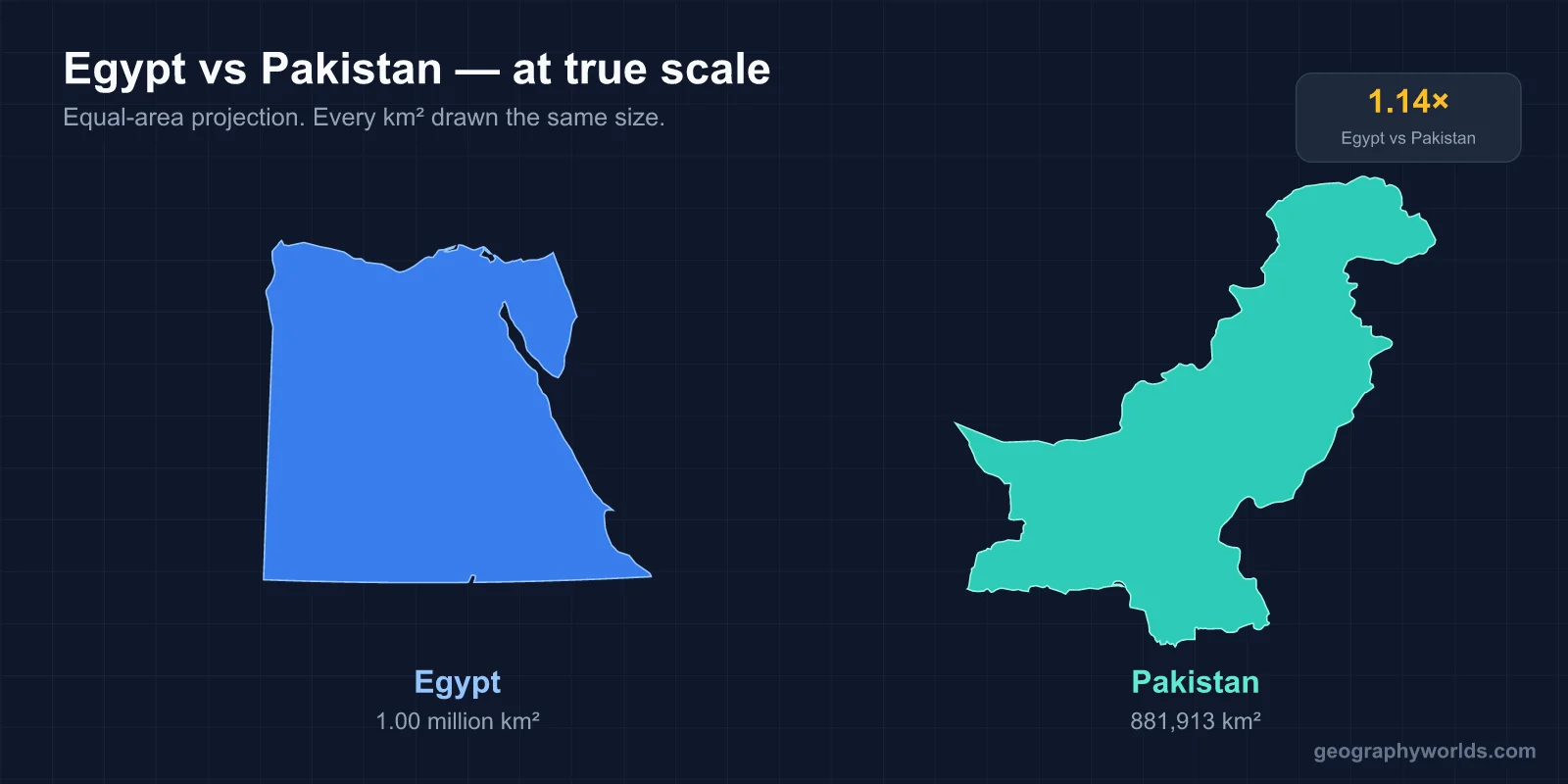
Egypt and Pakistan are two of the most populous Muslim-majority countries, both with civilizations going back thousands of years. Both occupy strategically important positions at the crossroads of major regions. So which one is bigger?
The Short Answer
Yes, Egypt is bigger than Pakistan. Egypt covers 1,001,450 km². Pakistan covers 881,913 km². Egypt is approximately 13.6% larger than Pakistan.
Side-by-Side Numbers
- Egypt area: 1,001,450 km² (386,662 sq mi)
- Pakistan area: 881,913 km² (340,509 sq mi)
- Difference: Egypt is ~120,000 km² larger
- Ratio: Egypt is ~1.14× the size of Pakistan
- Egypt population: ~111 million
- Pakistan population: ~241 million
Egypt
Egypt is in northeast Africa, with its Sinai Peninsula extending into Asia. It borders Libya to the west, Sudan to the south, and Israel and the Gaza Strip to the east. Egypt has coastlines on the Mediterranean Sea to the north and the Red Sea to the east. The country is the 30th largest in the world by area but contains the most populous country in the Arab world with about 111 million people.
Egypt is overwhelmingly defined by the Nile River. About 95% of Egyptians live within a few kilometers of the Nile or its delta, occupying only about 4% of the country's land area. The rest of Egypt is desert — the Western Desert (part of the Sahara), the Eastern Desert (between the Nile and the Red Sea), and the Sinai Desert. Cairo, the capital, has about 22 million people in its metro area, the largest in Africa and the Arab world.
Pakistan
Pakistan is in South Asia, bordered by India to the east, Afghanistan to the northwest, Iran to the southwest, and China to the north. It has a coastline along the Arabian Sea. The country is the 5th most populous in the world. Pakistan came into existence in 1947 when British India was partitioned into India and Pakistan, with East Pakistan becoming Bangladesh in 1971 after a war of independence.
Pakistan's geography is varied. The Indus River, flowing the length of the country, is the agricultural and historical heart — the Indus Valley Civilization (3300–1300 BCE) was one of the world's earliest urban civilizations. The Punjab and Sindh plains contain most of the population and farmland. The Hindu Kush, Karakoram, and Himalayan ranges in the north contain K2 (8,611 m), the world's second-highest mountain. The Thar Desert occupies the southeast.
Population Contrast
Pakistan has much more than twice Egypt's population — 241 million vs 111 million. This makes Pakistan one of the most densely populated large countries (273 people per km²) while Egypt is moderately populated by raw figures (about 111 per km²). However, because 95% of Egypt's population lives along the Nile, the effective population density of inhabited Egypt is dramatically higher — over 1,500 per km² in the Nile Valley and Delta. Both countries face significant demographic pressures from rapid population growth.
Climate
Both have hot, mostly dry climates but with regional variations. Egypt is mostly hot and dry. Coastal Mediterranean Egypt has the most temperate climate with mild winters and warm summers. Cairo and the Nile Delta have hot summers (30–35°C) and mild winters (10–20°C). Upper Egypt is hotter and drier. The Western and Eastern Deserts are some of the most arid places on Earth, with annual rainfall under 25 mm.
Pakistan's climate is generally hot and dry, with extreme temperatures in summer (often above 45°C in the Punjab and Sindh). The monsoon brings rain to the eastern and southern parts in July–September. The northern mountains have alpine and high-altitude climates with significant snowfall. Pakistan also experiences frequent flooding — the 2022 floods affected 33 million people, one of the worst climate disasters in recent history.
Economy
Pakistan has a larger economy than Egypt despite being smaller geographically — Pakistan's GDP is about $375 billion (PPP about $1.6 trillion), making it the 27th largest economy in the world. Egypt's GDP is about $400 billion (PPP about $1.7 trillion). Major industries in Pakistan include textiles (the largest export), agriculture (cotton, wheat, rice, sugarcane), and increasingly information technology. Egypt's economy is dominated by services (tourism), agriculture (cotton, rice, wheat), manufacturing, the Suez Canal (which collects significant transit fees), and oil and gas.
History
Egypt has one of the deepest documented histories in the world. Ancient Egypt — with its pyramids, pharaohs, hieroglyphic writing, and elaborate religious system — flourished for over 3,000 years (about 3100 BCE to 30 BCE). After centuries of Greek, Roman, Byzantine, Arab, Ottoman, and British rule, Egypt became fully independent in 1953. The country was the cultural and political center of the Arab world for much of the 20th century, especially under Gamal Abdel Nasser.
Pakistan, as a modern state, is much younger. The land it occupies has a much longer history — the Indus Valley Civilization predates ancient Egypt and Mesopotamia in some respects. The region was part of the Persian Empire, conquered by Alexander the Great, ruled by the Mauryan Empire, the Kushan Empire, various Hindu and Buddhist kingdoms, the Delhi Sultanate, the Mughals, the Sikh Empire, and the British Raj before becoming an independent Muslim-majority state in 1947.
Strategic Importance
Both occupy strategically critical positions. Egypt controls the Suez Canal — one of the world's most important shipping chokepoints, carrying about 12% of global trade. Egypt is also a major US ally, the largest Arab military force, and a key mediator in Middle Eastern conflicts including the ongoing Israeli-Palestinian conflict. Pakistan sits at the confluence of South Asia, Central Asia, and the Middle East. It has nuclear weapons, the world's 6th largest military by personnel, deep ties to China (the China-Pakistan Economic Corridor is a flagship of China's Belt and Road Initiative), and a complex relationship with the US, India, Afghanistan, and Iran.
Religion
Both are overwhelmingly Muslim. Egypt is about 90% Sunni Muslim, with the largest Christian minority in the Middle East: roughly 10% of Egyptians are Coptic Christians, an ancient indigenous Christian community. Pakistan is about 96% Muslim, with the majority being Sunni and a Shia minority of roughly 10–15%. Pakistan is officially the Islamic Republic of Pakistan, with Islam as the state religion. Egypt is officially Islamic but with stronger secular institutions and a significant Christian minority.
Cultural Influence
Both have outsized cultural influence in their respective regions. Egypt has been the cultural capital of the Arab world for over a century — Egyptian films, music, television, and dialect (Egyptian Arabic) are widely understood and consumed across the Arabic-speaking world. Cairo's Al-Azhar is one of the oldest universities in the world and a leading center of Sunni Islamic scholarship. Pakistan's cultural influence is felt across South Asia and in its global diaspora (about 9 million Pakistanis abroad). Pakistani music (Sufi qawwali, classical music, Urdu pop), cricket, food (especially in the diaspora), and Urdu literature have global audiences.
Climate Change Vulnerability
Both face significant climate change vulnerabilities. Egypt's biggest climate risk is to the Nile Delta, where about 40 million people live in low-lying agricultural land. Rising sea levels and saltwater intrusion threaten to displace millions and reduce agricultural productivity. Egypt also faces water security challenges from the Grand Ethiopian Renaissance Dam upstream on the Nile. Pakistan faces extreme climate vulnerabilities — the 2022 floods affected 33 million people and submerged a third of the country. Glacial melt in the Karakoram and Himalayas threatens water security for the Indus basin. Heat waves in southern Pakistan regularly produce temperatures over 50°C, threatening human health and agriculture.
Key Facts
- Egypt is about 14% larger than Pakistan by area.
- Pakistan has over 2× more people than Egypt.
- Both are major Muslim-majority countries.
- Egypt controls the Suez Canal; Pakistan has nuclear weapons.
- Both have ancient civilizations going back 5,000+ years.
Fun Facts
- About 95% of Egyptians live near the Nile.
- K2 in Pakistan is the world's 2nd highest mountain.
- The Suez Canal generates about $9 billion per year in transit fees.
- Pakistan's textile exports total over $19 billion annually.
- Egypt and Pakistan are both regional military powers.
- Both countries have populations approaching or exceeding 100 million.
- The Nile and the Indus are two of the world's most historically significant rivers.
- Egypt is the world's largest Arabic-speaking country; Pakistan is one of the world's largest Urdu-speaking countries.
- Both have populations growing significantly faster than most countries.
The Bottom Line
Egypt is bigger than Pakistan — by about 14%. But Pakistan has more than double Egypt's population. Both nations have outsized regional and global influence relative to their size, both have civilizations stretching back over 5,000 years, and both will continue to shape Middle Eastern and South Asian geopolitics for the foreseeable future.
Quiz Muslim Nations!
Test your knowledge of Egypt, Pakistan, and great Muslim nations.
Play Geography Games →