
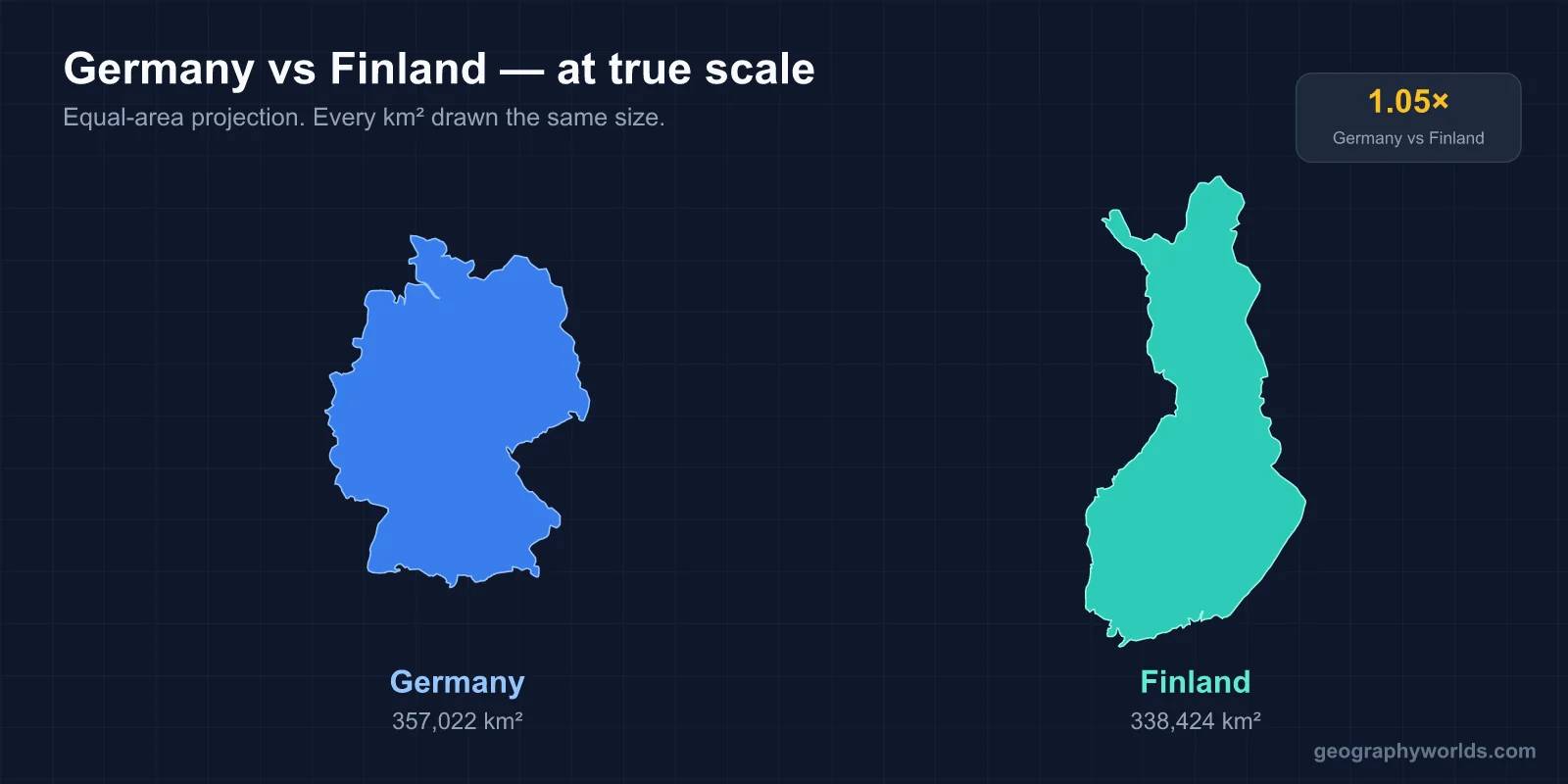
Finland and Germany are both major European countries with very different geographies, populations, and economies. Finland is a sparsely-populated Nordic nation famous for its forests, lakes, and saunas; Germany is the powerhouse of the European Union. So which one is bigger by area? Germany — but only barely.
The Short Answer
No, Germany is bigger than Finland — but only by about 5%. Germany covers 357,022 km². Finland covers 338,424 km². Germany is approximately 5.5% larger than Finland. The two countries are nearly the same size.
Side-by-Side Numbers
- Finland area: 338,424 km² (130,666 sq mi)
- Germany area: 357,022 km² (137,847 sq mi)
- Difference: Germany is ~18,600 km² larger
- Ratio: Germany is ~1.05× the size of Finland
- Finland population: ~5.6 million
- Germany population: ~84 million
Finland
Finland is a Nordic country in northern Europe, bordered by Sweden to the west, Norway to the north, Russia to the east, and the Baltic Sea (specifically the Gulf of Bothnia and Gulf of Finland) to the south and southwest. About a quarter of Finland's territory lies above the Arctic Circle, including the region of Lapland. The country is famous for its forests (covering about 75% of the land), lakes (about 188,000 of them), and long, dark winters.
Helsinki, the capital, is the largest city with about 1.5 million in its metro area. Other major cities include Espoo, Tampere, Vantaa, Turku, and Oulu. Finland gained independence from Russia in 1917, fought two wars against the Soviet Union during World War II, maintained a careful neutral foreign policy during the Cold War, and joined NATO in 2023 after Russia's invasion of Ukraine.
Germany
Germany is in central Europe, bordered by Denmark, Poland, Czechia, Austria, Switzerland, France, Luxembourg, Belgium, and the Netherlands — nine neighbors, the most of any European country. Germany has the largest population in the European Union and the largest economy in Europe. It is the 4th largest economy in the world by GDP.
Germany's geography is varied. The North German Plain in the north transitions to the Central Uplands (Mittelgebirge), and the Bavarian Alps in the south. The Black Forest, the Harz Mountains, the Rhine Valley, and Lake Constance are notable features. The country has 16 federal states (Bundesländer), each with significant autonomy. Berlin (3.7 million) is the largest city, followed by Hamburg, Munich, Cologne, and Frankfurt.
Population Density
Germany has about 15 times more people than Finland (84 million vs 5.6 million) in only slightly more land area. This gives Germany one of the higher population densities in Western Europe (about 235 per km²) and Finland one of the lowest in the EU (about 17 per km²). Most of Finland's population is concentrated in the south; Lapland and the central forests are nearly empty. Germany is densely populated throughout.
Climate
Finland has a subarctic to temperate climate. Winters are long, dark, and cold — Helsinki averages −4°C in January, and northern Finland can drop below −40°C. Summers are short but pleasantly mild. Northern Finland experiences the midnight sun in summer and polar night in winter. About 75% of Finland is covered by forest, mostly boreal coniferous (pine and spruce) and birch.
Germany has a temperate oceanic to continental climate. Western Germany has milder, wetter weather influenced by the Atlantic. Eastern Germany has more pronounced continental seasonality. Summers are mild (20–25°C), winters cool to cold (often freezing inland). Germany is well-watered with rainfall distributed across the year. Major rivers — Rhine, Danube, Elbe, Weser — are critical for transport and historic settlement.
Economy
Germany has the world's 4th largest economy at about $4.5 trillion GDP. It is Europe's manufacturing powerhouse — automotive (Volkswagen, BMW, Mercedes-Benz, Audi, Porsche), chemicals (BASF, Bayer), machinery (Siemens), and pharmaceuticals. Finland has a much smaller economy at about $290 billion. Major industries include technology (Nokia historically; Supercell now leads in mobile games), forestry products, heavy machinery, and increasingly clean technology. Finland's GDP per capita is high (about $52,000) and quality of life rankings consistently place Finland among the world's happiest and best-governed countries.
Education and Society
Both countries are known for strong education systems. Finland's education system has become world-famous for emphasizing equity, teacher autonomy, less standardized testing, and strong outcomes despite (or because of) less intensive schooling than many comparable nations. Finnish students consistently rank near the top of PISA international assessments. Germany has a strong dual-track education system that combines academic and vocational training, particularly through its apprenticeship system. The country produces many of the world's top engineers and skilled technicians.
Forests and Lakes
Finland has about 188,000 lakes — more than any country its size. Lake Saimaa is the largest, covering about 4,400 km². Forests cover about 75% of Finland, making it the most forested country in Europe by percentage. The boreal forest supports significant wildlife including brown bears, wolves, lynx, wolverines, elk, reindeer in the north, and over 250 bird species. Germany has fewer lakes and less forest cover (about 33%) but is famous for its Black Forest, the Bavarian Forest, and the Harz Mountains.
Culture
Germany has shaped global culture profoundly — classical music (Bach, Beethoven, Brahms, Wagner), philosophy (Kant, Hegel, Nietzsche, Marx), science (Einstein, Planck, Heisenberg), and literature (Goethe, Schiller, Mann). Modern German cultural exports include automobiles, beer, soccer (the Bundesliga is one of the world's top leagues), and electronic music (Kraftwerk, Berlin's techno scene).
Finland has a smaller but distinctive cultural footprint. The sauna is essentially a Finnish invention and a deep part of Finnish identity — there are estimated 2 million saunas in Finland for 5.6 million people. Finnish design (Marimekko, Iittala, Alvar Aalto) is globally recognized. Finland produces more heavy metal bands per capita than any other country.
Politics and EU Role
Germany is the political and economic anchor of the European Union, leading on policy in trade, climate, refugee management, and the response to Russia's invasion of Ukraine. Finland joined the EU in 1995 and has been an active member, particularly on climate and security issues. Finland's 2023 NATO membership represented a major shift — abandoning a longstanding policy of neutrality in response to Russia's aggression. Both countries are now full NATO members on the eastern flank of the alliance, with Finland sharing a 1,340 km border with Russia.
Tourism
Germany welcomes about 38 million international visitors per year — among the top destinations in Europe. Top draws include Berlin (the Brandenburg Gate, Berlin Wall sites, Museum Island), Munich (Oktoberfest, the Marienplatz, nearby Neuschwanstein Castle), the Romantic Road, the Rhine Valley, the Black Forest, Hamburg, and Heidelberg. Finland's tourism is smaller but growing rapidly — about 3 million international visitors per year. Top destinations include Helsinki, Lapland (especially Rovaniemi, the "official hometown" of Santa Claus), the Northern Lights, Finnish saunas and lakes, and increasingly architecture and design tourism in major cities.
History
Both countries have intertwined modern histories shaped by 20th-century wars and reconstruction. Germany's 20th century brought two devastating world wars, the Holocaust, division into East and West (1949–1990), and reunification in 1990. Modern Germany has emerged as Europe's economic and political anchor. Finland was part of Sweden for over 600 years, then a Grand Duchy of Russia from 1809, gaining independence in 1917 amid the Russian Revolution. The country fought two wars against the Soviet Union during World War II — the Winter War (1939–40) and the Continuation War (1941–44) — and maintained delicate independence throughout the Cold War despite sharing a long border with the USSR.
Key Facts
- Germany is about 5% larger than Finland by area.
- Germany has 15× more people than Finland.
- Finland has about 188,000 lakes.
- Both joined NATO — Germany in 1955, Finland in 2023.
- Both are major members of the European Union.
Fun Facts
- Finland has more saunas than cars.
- Germany has 16 federal states with significant regional autonomy.
- About a quarter of Finland is above the Arctic Circle.
- Germany has more breweries than any other country in the world.
- Finland is consistently ranked the happiest country in the world by the World Happiness Report.
- Finland produces more heavy metal bands per capita than any other country.
- Germany's autobahn has some sections with no speed limit.
- Finland and Germany both made universal basic income experiments — Finland's ran from 2017–2018.
- Germany has the largest population in the European Union.
- Finland's Suomi name reflects deep linguistic roots distinct from Indo-European languages.
The Bottom Line
Germany is bigger than Finland — but only by about 5%. The two countries are nearly the same size geographically but dramatically different in population, density, climate, and economic structure. Germany is the economic powerhouse of Europe; Finland is one of its most consistently well-governed and successful smaller members.
Quiz European Nations!
Test your knowledge of Finland, Germany, and great European countries.
Play Geography Games →