
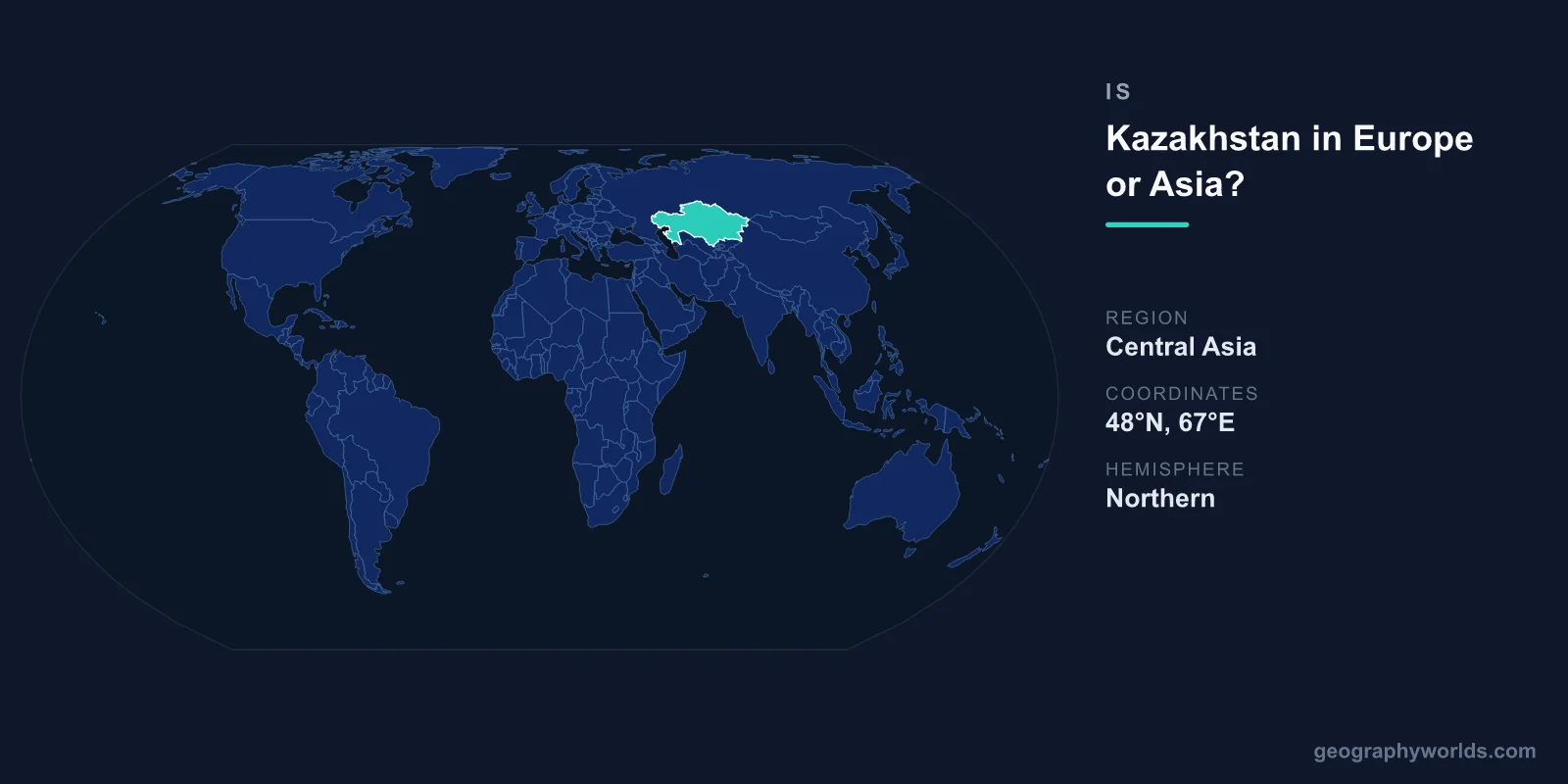
Kazakhstan is a transcontinental country that lies in both Europe and Asia, though roughly 90 percent of its territory sits in Asia and only a small western sliver crosses into Europe. Because it straddles the conventional boundary between the two continents, Kazakhstan is one of a handful of nations — alongside Russia, Turkey, Georgia, and Azerbaijan — that genuinely belong to two continents at once.
Where Exactly Does the Continental Boundary Fall?
The traditional dividing line between Europe and Asia runs down the Ural Mountains, follows the Ural River, and then crosses the northern shore of the Caspian Sea. In western Kazakhstan, the Ural River flows through the city of Oral (Uralsk) and empties into the Caspian near Atyrau. Everything west of that river is considered part of Europe.
This means the European portion of Kazakhstan includes parts of the West Kazakhstan and Atyrau regions. It is a relatively small area compared with the country's enormous landmass, but it is enough to make Kazakhstan officially transcontinental. The vast majority of the country — its steppes, deserts, mountains, and major cities — lies east of the line, firmly in Asia.
Why Most People Call Kazakhstan an Asian Country
Despite its European foothold, Kazakhstan is almost always described as a Central Asian nation, and for good reason. The country covers an area of 2,724,900 km², making it the ninth-largest country in the world and the largest landlocked state on Earth. Around 90 percent of that territory falls on the Asian side of the boundary.
The capital, Astana, sits deep in the Asian interior, as do the largest city Almaty and nearly all of the population of roughly 19 million. Kazakhstan also shares long borders with Asian neighbours — China to the east and Kyrgyzstan, Uzbekistan, and Turkmenistan to the south — while only its northern frontier touches Russia, itself a transcontinental country. Geographically, demographically, and culturally, the centre of gravity is overwhelmingly Asian.
A Landscape That Spans a Continent
Kazakhstan's terrain helps explain why the country feels so distinctly Asian. It stretches from the Caspian Sea in the west to the Altai Mountains in the east, crossing the immense Central Asian steppe along the way. Within its borders you find flat deserts such as the Betpak-Dala and the sands of the Kyzylkum, semi-arid grasslands that once supported nomadic herders, and high alpine peaks in the Tien Shan range near the Chinese border.
This is also the country that contains much of what remains of the Aral Sea, once the fourth-largest lake in the world before it shrank dramatically during the twentieth century. The sheer scale of the landscape — larger than all of Western Europe combined — reinforces just how much of Kazakhstan lies far from any European frontier.
Culture, Politics, and a Dual Identity
Kazakhstan's history gives it a genuinely mixed character. Its people descend largely from Turkic nomadic peoples, and Kazakh, a Turkic language, is the state language. Decades within the Russian Empire and the Soviet Union added a strong Russian influence, and Russian is still widely spoken as a language of business and everyday life.
That dual heritage shows up in surprising places. Kazakhstan's football and other sporting bodies belong to European organisations such as UEFA rather than the Asian Football Confederation, a choice that reflects its desire to engage closely with Europe. At the same time, it is a leading member of Central Asian regional groups and maintains deep ties with both China and Russia. The country effectively chooses different continental "homes" depending on the context — sport, trade, or diplomacy. You can learn more in our kazakhstan country guide.
Frequently Asked Questions
Is Kazakhstan in Europe or Asia?
It is in both. Kazakhstan is a transcontinental country: a small western portion lies in Europe, but around 90 percent of its territory — including the capital and almost all of its people — is in Asia.
What part of Kazakhstan is in Europe?
The area west of the Ural River and north of the Caspian Sea is considered European. This includes parts of the West Kazakhstan and Atyrau regions, a comparatively small slice of the country's total landmass.
Is Kazakhstan part of Central Asia?
Yes. Kazakhstan is one of the five Central Asian republics, along with Uzbekistan, Turkmenistan, Kyrgyzstan, and Tajikistan. It is by far the largest of them in both area and economy.
Why does Kazakhstan play in European competitions?
Although most of the country is in Asia, Kazakhstan joined European sporting bodies such as UEFA in the 2000s to compete against nearby European nations and strengthen its ties with Europe, highlighting its transcontinental identity.
