
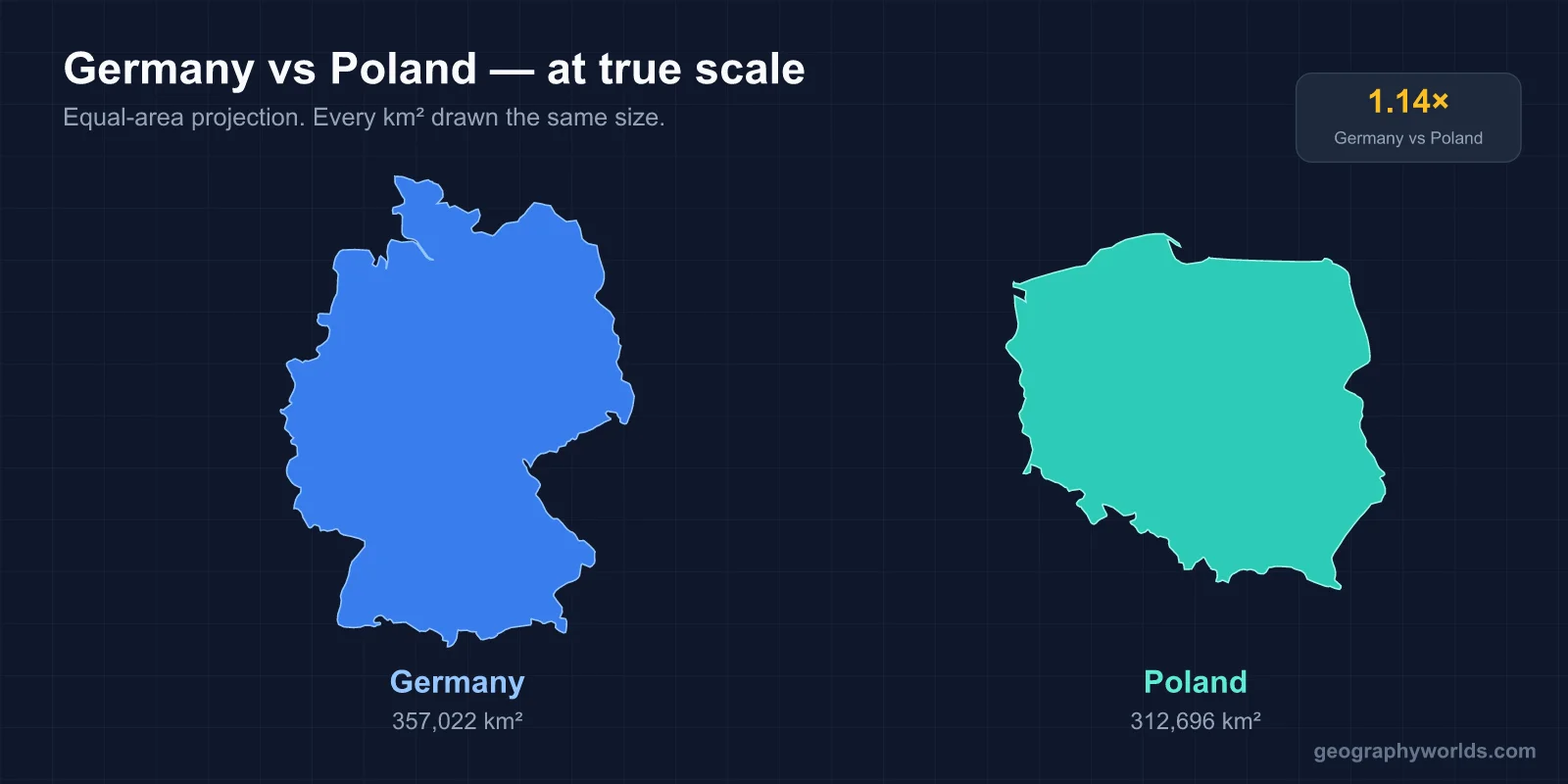
Poland and Germany are direct neighbors with intertwined and often tragic histories. They share a 467 km border, the cities along their frontier (Frankfurt an der Oder/Słubice, Görlitz/Zgorzelec) often blur the line between them, and both are major European economies. But which one is bigger? Germany — but Poland is closer than people often assume.
The Short Answer
No, Germany is bigger than Poland. Germany covers 357,022 km². Poland covers 312,696 km². Germany is approximately 14.2% larger than Poland. They are in the same league but Germany has a clear lead.
Side-by-Side Numbers
- Poland area: 312,696 km² (120,733 sq mi)
- Germany area: 357,022 km² (137,847 sq mi)
- Difference: Germany is ~44,000 km² larger
- Ratio: Germany is ~1.14× the size of Poland
- Poland population: ~37 million
- Germany population: ~84 million
Poland
Poland sits in Central Europe, bordered by Germany to the west, Czechia and Slovakia to the south, Ukraine and Belarus to the east, Lithuania and the Russian exclave of Kaliningrad to the northeast, and the Baltic Sea to the north. The country has roughly 528 km of coastline. It is the 6th most populous country in the European Union and one of the largest by area within the EU.
Most of Poland is low and flat, especially the Northern European Plain that dominates the central part of the country. The Sudetes and Carpathian Mountains run along the southern border with Czechia and Slovakia, with Rysy (2,499 m) as the highest peak. The Vistula River, Poland's longest, flows from the Carpathians north through Kraków and Warsaw to the Baltic at Gdańsk. Major cities include Warsaw (the capital, 1.8 million), Kraków, Łódź, Wrocław, Poznań, and Gdańsk.
Germany
Germany is in central Europe and borders nine countries, more than any other European nation: Denmark, Poland, Czechia, Austria, Switzerland, France, Luxembourg, Belgium, and the Netherlands. It has coastlines on both the North Sea and the Baltic Sea. With about 84 million residents, it is the most populous country in the EU and the third most populous in Europe (after Russia).
Germany's geography ranges from the North German Plain (similar to Poland's landscape) in the north, through the Central Uplands (Mittelgebirge), to the Bavarian Alps in the south. The Zugspitze (2,962 m) is the highest peak. Major rivers include the Rhine, the Danube (which originates in the Black Forest), the Elbe, and the Weser. Berlin, with 3.7 million people, is the largest city, followed by Hamburg, Munich, Cologne, and Frankfurt.
Economy
Germany has the largest economy in Europe and the 4th largest in the world by GDP, at roughly $4.5 trillion. It is famous for manufacturing — automotive (Volkswagen, BMW, Mercedes-Benz, Audi, Porsche), chemicals (BASF, Bayer), machinery (Siemens), and pharmaceuticals. Frankfurt is the financial capital and home to the European Central Bank.
Poland's economy has grown rapidly since the fall of communism in 1989. Today it is the 6th largest in the EU and the 21st largest in the world, with a GDP of around $850 billion. It is one of the most consistent growth stories in the EU — Poland avoided recession even during the 2008 global financial crisis, partly due to a flexible currency and a large domestic market. Major industries include manufacturing, retail, IT services, mining (Poland is a major coal producer), and agriculture.
History
Poland's history is one of the most dramatic in Europe. The country was a major power during the Polish-Lithuanian Commonwealth (1569–1795), one of the largest and most populous countries in Europe at its peak. But the late 18th century brought the partitions of Poland by Russia, Prussia, and Austria — by 1795, Poland disappeared from the map for 123 years. It was reestablished in 1918, only to be invaded by Nazi Germany in 1939 (the start of World War II) and the Soviet Union shortly after. Six million Polish citizens (about 17% of the population, including 3 million Jews) died in WWII — proportionally the highest death toll of any country in the war.
Germany's history follows a different but equally complex arc. The Holy Roman Empire dominated central Europe for centuries; modern Germany was unified by Otto von Bismarck in 1871. The 20th century brought the catastrophes of two world wars, the Holocaust, division into East and West (1949–1990), and reunification. Modern Germany has emerged as Europe's economic and political anchor, anchoring the EU and NATO.
Cultural Achievements
Both nations have enormous cultural footprints. Germany has shaped classical music (Bach, Beethoven, Brahms, Wagner, Schubert), philosophy (Kant, Hegel, Nietzsche, Marx, Heidegger), science (Einstein, Planck, Heisenberg), and literature (Goethe, Schiller, the Brothers Grimm, Mann). Poland has produced Nobel laureates in literature (Wisława Szymborska, Czesław Miłosz, Henryk Sienkiewicz, Olga Tokarczuk), iconic composers (Chopin, Penderecki), revolutionary scientists (Copernicus, Marie Skłodowska-Curie), and film directors (Polanski, Kieślowski, Wajda).
Climate
Both Poland and Germany have temperate climates, transitioning from oceanic in the west to continental in the east. Western Germany has milder, wetter weather influenced by the Atlantic. Eastern Germany and Poland have more pronounced continental seasonality — colder winters with reliable snow, warmer and drier summers. The southern Carpathian foothills in Poland and the Bavarian Alps in Germany have proper alpine climates with significant snowfall.
Politics and EU Role
Both Poland and Germany are EU and NATO members and major regional players. Germany is the EU's informal political leader, anchoring the bloc's economic policy, climate ambitions, and recent responses to crises (the eurozone crisis, the migration crisis, the war in Ukraine). Poland joined the EU in 2004 and has become one of its largest economies and most populous members. Polish-German relations have at times been tense over historical grievances and EU rule-of-law disputes, but cooperation on Ukraine and security has been strong in recent years.
Population Density and Urbanization
Germany has 84 million people in 357,022 km² (235 per km²), Poland has 37 million people in 312,696 km² (118 per km²). Germany is roughly twice as densely populated as Poland. Both countries are highly urbanized, but Germany has more major metro areas — the Rhine-Ruhr, Munich, Hamburg, Berlin, and Frankfurt-Wiesbaden all exceed 2 million people. Poland has Warsaw, Kraków, the Tri-City (Gdańsk-Sopot-Gdynia), and Upper Silesia as its main population centers.
Food and Drink Traditions
Both countries have hearty food traditions shaped by long, cold winters and agricultural landscapes. German cuisine is famous for sausages of every kind (bratwurst, weisswurst, currywurst, blutwurst), pretzels, sauerkraut, schnitzel, spätzle, pork roasts, and one of the world's most varied bread cultures with over 3,000 named varieties. German beer is iconic — the country has more breweries than any other on Earth and the 500-year-old Reinheitsgebot purity law still influences brewing. Polish cuisine shares some Central European DNA but has its own distinct identity: pierogi (filled dumplings), bigos (hunter's stew), żurek (sour rye soup), kielbasa, oscypek (smoked sheep cheese), and golden beer brewed in centuries-old breweries. Vodka, not beer, is Poland's national drink — Polish vodka is among the world's oldest documented distilled spirits.
Migration Patterns
Poland and Germany have one of the most dynamic labor migration relationships in Europe. After Poland joined the EU in 2004, roughly 2 million Poles moved abroad for work, mostly to the UK, Germany, and the Netherlands. Many have since returned as the Polish economy has grown. Today, Germany is home to about 2.2 million people of Polish origin or descent — the largest such population in Western Europe — and Polish labor remains important to German construction, agriculture, and care sectors. The flow has also reversed in some ways: Ukrainian refugees fleeing the 2022 invasion overwhelmingly first arrived in Poland, with Germany hosting the second-largest Ukrainian refugee population.
Key Facts
- Germany is about 14% larger than Poland by area.
- Germany has 2.3× more people than Poland.
- Both are EU and NATO members with intertwined history.
- Germany's economy is roughly 5× larger than Poland's.
- Both have coastlines on the Baltic Sea.
Fun Facts
- Germany borders 9 countries — the most in Europe.
- Poland was wiped off the map from 1795 to 1918.
- The largest castle in the world by area is in Malbork, Poland (the Teutonic castle).
- Germany has more than 20,000 castles and palaces.
- Both countries drive on the right and use the Euro... wait, only Germany does. Poland still uses the złoty.
The Bottom Line
Germany is bigger than Poland — by about 14%. But Poland is much closer in size than most people realize, and Poland is one of the largest countries in the European Union. Germany has a vastly larger economy and population, but Poland has been one of Europe's most consistent growth stories since the fall of communism. Both countries are central to the European project, both have deep historical scars from the 20th century, and both face shared challenges around energy, immigration, and the war in Ukraine in the years ahead.
Quiz European Nations!
Test your knowledge of Poland, Germany, and the great nations of Europe.
Play Geography Games →