
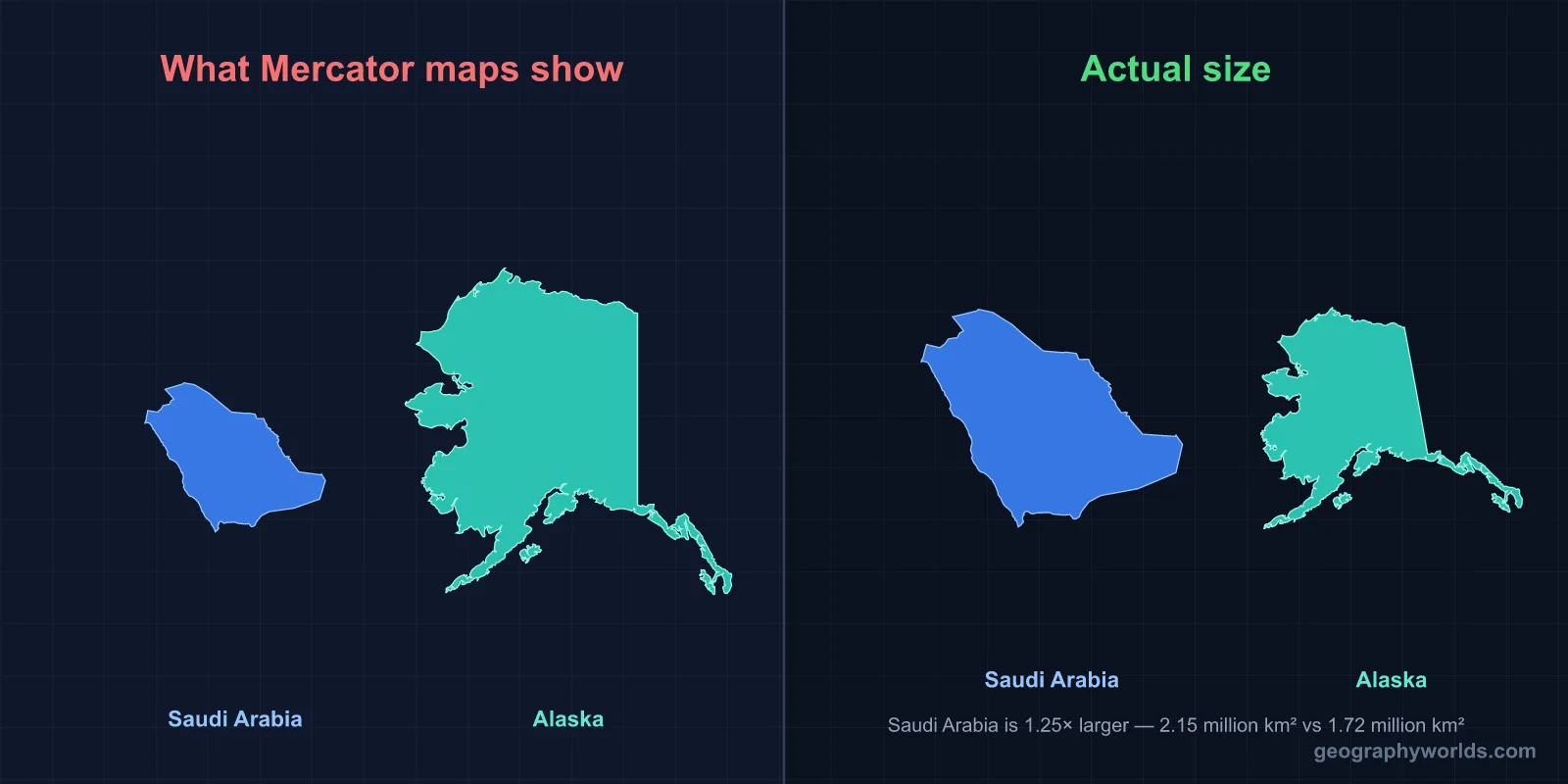
Saudi Arabia and Alaska sit at opposite ends of the climatic spectrum — searing desert vs frozen subarctic — but they're both vast, mostly empty places of strategic importance. Saudi Arabia is by far the largest country in the Middle East; Alaska is by far the largest US state. Their sizes are surprisingly comparable.
The Short Answer
Yes, Saudi Arabia is bigger than Alaska — by about 25%. Saudi Arabia covers 2,149,690 km². Alaska covers 1,723,337 km². The difference is 426,353 km² — roughly the size of California. Despite their wildly different climates, the two places are within striking distance of each other in pure area.
Side-by-Side Numbers
- Saudi Arabia area: 2,149,690 km² (830,000 sq mi)
- Alaska area: 1,723,337 km² (665,384 sq mi)
- Difference: Saudi Arabia is 426,353 km² larger
- Ratio: Saudi Arabia is ~1.25× the size of Alaska
- Saudi Arabia population: ~36.4 million
- Alaska population: ~733,000
- Saudi Arabia density: ~17 people/km²
- Alaska density: ~0.5 people/km²
Saudi Arabia
Saudi Arabia occupies most of the Arabian Peninsula, the world's largest peninsula. It borders Jordan, Iraq, Kuwait, Bahrain (via causeway), Qatar, the United Arab Emirates, Oman, and Yemen, plus has coastlines on the Red Sea and the Persian Gulf. The country is dominated by deserts: the Rub al Khali ("Empty Quarter") in the south is the largest contiguous sand desert in the world at 650,000 km². The Najd plateau covers the central interior, and the Hejaz mountains run parallel to the Red Sea coast.
Saudi Arabia has been an oil power since the 1930s discovery of vast petroleum reserves. The country holds about 17% of global proven oil reserves and is the world's largest oil exporter. Riyadh, the capital, has about 7.7 million people; Jeddah on the Red Sea coast has about 4.7 million; Mecca and Medina, the two holiest cities of Islam, draw millions of pilgrims each year. The country's Vision 2030 plan, led by Crown Prince Mohammed bin Salman, aims to diversify the economy beyond oil through massive infrastructure projects like Neom and the Red Sea tourism corridor.
Alaska
Alaska is the largest US state by far — more than twice the size of Texas (the second largest at 695,662 km²). It occupies the northwestern corner of North America, bordering Canada's Yukon Territory and British Columbia, with coastlines on the Arctic Ocean, the Bering Sea, and the Pacific Ocean. The state includes the Alaska Range with Denali (6,190 m), the highest peak in North America. The Aleutian Islands extend about 1,900 km out into the Pacific.
The United States bought Alaska from Russia in 1867 for $7.2 million — about 2 cents per acre, considered an extraordinary bargain in retrospect. Alaska became a state in 1959, the 49th. The state is rich in resources: oil (Prudhoe Bay is North America's largest oil field), natural gas, gold, coal, fish (Alaska accounts for about half of all US fish caught), and timber. About one-third of Alaska is above the Arctic Circle. The state has just 733,000 people — fewer than Boston — spread across an area about 21% the size of the entire contiguous United States.
Climate
Saudi Arabia's climate is hot desert — temperatures regularly exceed 50°C in summer, with parts of the Empty Quarter going years without rain. The Hejaz mountains and the southwestern highlands of Asir are slightly milder, but most of the country is among the hottest and driest inhabited places on Earth. Average annual rainfall is under 100 mm across most of the country.
Alaska's climate ranges from subarctic in the interior (which has the largest annual temperature ranges in the world — Fairbanks can swing from -40°C in winter to +30°C in summer) to maritime in the southern coast (where Sitka is rainy but mild) to true Arctic in the far north (where Utqiagvik has 67 days of polar night each winter). Most of Alaska is covered in boreal forest (taiga), tundra, or glaciers.
Population Distribution
Both places are sparsely populated overall but with major concentrations in specific areas. Saudi Arabia's population is heavily concentrated in the Hejaz (Mecca, Medina, Jeddah, Taif), the central region around Riyadh, and the oil-producing Eastern Province (Dhahran, Dammam, Khobar). The Empty Quarter has fewer than 1,000 residents across an area larger than France. The country's population grew rapidly from about 4 million in 1960 to 36 million today, partly through high birth rates and partly through immigration of foreign workers (who make up about 38% of the population).
Alaska's population is concentrated in Anchorage (about 290,000), Fairbanks (32,000), and Juneau (32,000 — the state capital). Vast areas of Alaska are essentially unpopulated. The North Slope Borough covers 245,000 km² (bigger than the UK) but has only about 11,000 residents. Alaska Native populations are concentrated in specific regions: Iñupiat in the north, Yup'ik in the west, Tlingit in the southeast, Aleut in the islands.
Natural Resources
Saudi Arabia's economy is dominated by oil, which provides about 70% of government revenue. The country also has large reserves of natural gas, gold, copper, phosphates, and bauxite. Recent diversification has invested heavily in mining, tourism, technology, and entertainment. Saudi Aramco is the world's largest oil company by revenue and one of the most valuable companies of any kind.
Alaska's economy is also resource-driven. Oil and gas account for about 25% of state GDP and the bulk of state government revenue (Alaska is one of only seven US states with no income tax, thanks to oil money). Fishing, mining, timber, and tourism (about 2 million visitors per year) round out the economy. Alaska has the Alaska Permanent Fund, which pays each resident an annual dividend from oil revenues — about $1,300 per person in 2024.
Wildlife
Saudi Arabia's wildlife is adapted to extreme desert conditions: Arabian oryx (reintroduced after near-extinction), Arabian leopards (critically endangered, fewer than 200 remaining), Arabian sand cats, Nubian ibex, dorcas gazelles, and many bird species. The Red Sea coast hosts spectacular coral reefs with diverse marine life.
Alaska's wildlife is in a different league: grizzly bears, polar bears, black bears, moose, caribou (which migrate in herds of hundreds of thousands), Dall sheep, mountain goats, gray wolves, lynx, wolverines, beavers, sea otters, walruses, bowhead whales, beluga whales, humpback whales, orcas, and bald eagles. Alaska has more bald eagles than the rest of the United States combined. The state's salmon runs are among the largest wild fish populations on Earth.
Strategic Importance
Both regions have outsized strategic importance for their size. Saudi Arabia is the world's largest oil exporter and the spiritual center of Islam (with Mecca and Medina). Its alliances, oil policy, and regional influence are major factors in global geopolitics. The country has been a key US ally since 1945.
Alaska's strategic importance comes from its position near Russia (the Bering Strait is only 88 km wide), its vast resources, and its role in early-warning radar and missile defense systems. During the Cold War, Alaska was the front line; today it remains a major military presence with Eielson Air Force Base, Fort Greely, and others.
Key Facts
- Saudi Arabia is about 25% bigger than Alaska by area.
- Saudi Arabia has about 50× the population of Alaska.
- Both regions are major oil and gas producers.
- Saudi Arabia contains the world's largest sand desert; Alaska contains North America's tallest peak.
- Both are below 20 people per km² in population density.
Fun Facts
- Alaska has more shoreline than the rest of the US combined.
- Saudi Arabia is the only country named after a royal family (House of Saud).
- If superimposed, Saudi Arabia would stretch from Mexico to Canada at the Pacific coast width.
- Alaska bought from Russia in 1867 was widely mocked as "Seward's Folly" — until gold was found.
- Saudi Arabia banned cinemas from 1980 to 2018 as part of conservative religious policy.
Energy Production
Both are critical energy producers but in opposite categories. Saudi Arabia is the world's largest oil exporter and a founding member of OPEC. Saudi Aramco is the most valuable oil company on Earth by some measures, with daily production around 10 million barrels. The kingdom holds about 17% of proven global oil reserves and uses oil revenues to fund Vision 2030's diversification plans. Alaska's North Slope, particularly Prudhoe Bay, is North America's largest oil field. The Trans-Alaska Pipeline carries about 500,000 barrels per day from Prudhoe Bay to Valdez. Alaska also has substantial natural gas reserves and emerging interest in rare earth elements and lithium. Alaska's oil revenue funds the Alaska Permanent Fund, which pays an annual dividend to every state resident — usually $1,000–$2,000 per person.
The Bottom Line
Saudi Arabia is meaningfully bigger than Alaska — by about a quarter — but they're in the same order of magnitude. Both are huge, sparsely populated, resource-rich regions of strategic global importance. One is hot desert, the other is frozen subarctic. Both will continue to shape global energy markets and geopolitics for the foreseeable future.
Quiz Vast Places!
Test your knowledge of Saudi Arabia, Alaska, and the world's biggest regions.
Play Geography Games →