
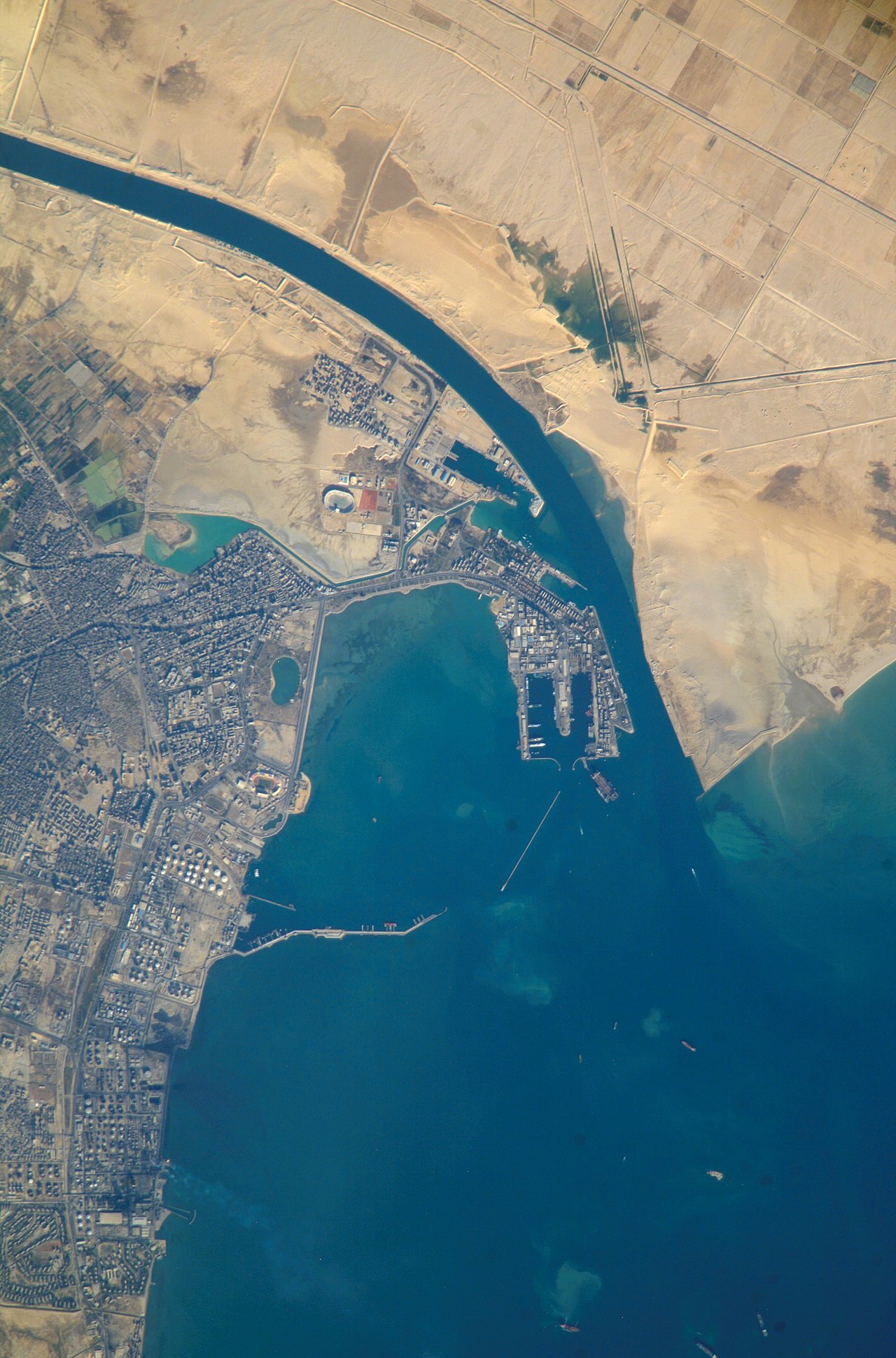
The Suez Canal and the Panama Canal are the two most strategically important artificial waterways in the world, together handling a significant share of global trade. They're often compared, but in size and structure they're very different. So which is longer?
The Short Answer
Yes, the Suez Canal is much longer than the Panama Canal. The Suez Canal is about 193 km long. The Panama Canal is about 82 km long. The Suez is roughly 2.4 times longer than the Panama Canal.
Side-by-Side Numbers
- Suez Canal length: 193 km (120 mi)
- Panama Canal length: 82 km (51 mi)
- Difference: Suez is 111 km longer
- Ratio: Suez is ~2.4× longer than Panama
- Suez transit time: 11–16 hours
- Panama transit time: 8–10 hours
The Suez Canal
The Suez Canal is an artificial waterway in Egypt connecting the Mediterranean Sea to the Red Sea via the Isthmus of Suez. It allows ships to travel between Europe and Asia without sailing around the southern tip of Africa, saving roughly 7,000 km on routes from Europe to South Asia. The canal was opened in 1869 after about 10 years of construction by the Suez Canal Company, a joint French-Egyptian venture. The project was led by French engineer Ferdinand de Lesseps and is widely considered one of the great engineering accomplishments of the 19th century.
Unlike the Panama Canal, the Suez Canal has no locks — the Mediterranean and Red Sea are essentially at the same elevation. Ships sail through the canal in a single direction at a time on much of its length, though parts have been expanded for two-way traffic. The 2014–2015 New Suez Canal project added a parallel channel for about 35 km of the route. The canal handles about 12% of global trade and about 30% of the world's container shipping. The 2021 Ever Given grounding — which blocked the canal for 6 days — disrupted global supply chains and demonstrated just how critical the waterway is.
The Panama Canal
The Panama Canal is an artificial waterway across the Isthmus of Panama, connecting the Atlantic Ocean (via the Caribbean Sea) to the Pacific Ocean. It allows ships to avoid the lengthy route around Cape Horn at the southern tip of South America. The canal was originally attempted by a French company under Ferdinand de Lesseps (the same engineer who built Suez), but the French effort failed due to disease (yellow fever and malaria killed about 22,000 workers) and engineering challenges. The United States took over the project in 1904 and completed it in 1914. The US administered the canal until 1999, when full control was transferred to Panama under the Torrijos-Carter Treaties of 1977.
Unlike Suez, the Panama Canal uses an elaborate lock system. Ships rise 26 m above sea level to Gatun Lake (one of the largest artificial lakes in the world when it was built), then descend back to sea level on the other side. The original locks (Miraflores, Pedro Miguel, Gatun) were complemented by an expansion completed in 2016 that added a third set of larger locks, allowing "New Panamax" ships up to about 366 m long and 49 m wide. The canal handles about 5% of global trade.
Trade Volume
The Suez Canal handles about 12% of global trade by volume, or about 30,000 ship transits per year. The Panama Canal handles about 5% of global trade, or about 14,000 transits per year. The Suez is significantly busier and earns more in transit fees — about $9 billion in 2023 — than the Panama Canal's roughly $4 billion. Both canals are major sources of revenue for their host countries, especially Egypt and Panama.
Engineering Differences
The two canals showcase very different approaches to building artificial waterways. Suez is essentially a sea-level cut through the desert — no locks, no significant elevation changes. Construction involved digging through soft sand and sediments, with some hard rock. The biggest challenges were the scale of earthmoving (about 75 million m³ removed) and the human cost (estimates of deaths during construction range from 30,000 to over 120,000, with disease, accidents, and forced labor all major factors).
Panama required far more sophisticated engineering. The canal had to climb over the Continental Divide, which meant building locks, creating an artificial lake to feed water to those locks, and tunneling through hard rock at the Culebra Cut (now the Gaillard Cut). Disease was a massive obstacle until US engineers under William Gorgas implemented mosquito control programs that essentially eliminated yellow fever and dramatically reduced malaria. The total US death toll during construction (1904–1914) was about 5,600 — far lower than the French failure.
Politics and Sovereignty
Both canals have been politically fraught. Suez has been a flashpoint of Middle Eastern geopolitics — the 1956 Suez Crisis (when Britain, France, and Israel attacked Egypt over Nasser's nationalization of the canal) effectively ended British and French global dominance. The canal was closed from 1967 to 1975 due to the Arab-Israeli wars, with ships trapped in the middle ("the Yellow Fleet") for the duration. Panama's sovereignty over its canal was contested for most of the 20th century before the 1977 treaties returned control to Panama. The US handed over the canal at the end of 1999. Recent statements by US officials about potentially reclaiming the canal have caused diplomatic tensions.
Modernization and Capacity
Both canals have been expanded recently. The New Suez Canal project (2014–2015) added a 35 km parallel channel to allow two-way traffic on part of the route, reducing wait times. The Panama Canal expansion (2007–2016) added a third set of larger locks, allowing much bigger "New Panamax" ships (capable of carrying about 13,000 TEU containers vs. the old Panamax limit of about 4,400 TEU). Climate change is now affecting both canals — Panama has faced drought-induced water shortages that have forced reductions in daily transits, while Suez may face changes in shipping patterns as Arctic routes become more viable.
Alternative Routes
Both canals provide shortcuts that have made global shipping faster and cheaper. The Suez Canal alternative is sailing around the Cape of Good Hope at the southern tip of Africa, adding about 7,000 km (and about 10 days) to most Asia-Europe routes. The Panama Canal alternative is the long way around Cape Horn at the southern tip of South America, or alternatively the Strait of Magellan or Drake Passage, adding about 12,000 km (and about 14 days) to most Atlantic-Pacific routes. The Northern Sea Route, opening up as Arctic ice retreats, could become a third major shipping shortcut between Europe and Asia, but it's currently usable only seasonally and at higher risk.
Environmental Impact
Both canals have significant ongoing environmental impacts. The Suez Canal allows marine species from the Red Sea to migrate into the Mediterranean (the so-called "Lessepsian migration"), introducing hundreds of invasive species that have transformed Mediterranean ecosystems. Predatory rabbitfish, lionfish, and silver-cheek toadfish have all become problematic invaders. The 2014–2015 New Suez Canal made the problem worse by reducing salinity barriers. The Panama Canal's biggest environmental issue is water — each transit uses about 200 million liters of fresh water from Gatun Lake, which is also the drinking water source for Panama City. Drought-driven water shortages have forced the Panama Canal Authority to reduce daily transits in recent years, with major implications for global shipping schedules.
Key Facts
- The Suez Canal is about 2.4× longer than the Panama Canal.
- The Panama Canal uses locks; the Suez Canal does not.
- The Suez handles 12% of global trade; the Panama handles 5%.
- The Panama Canal's construction killed about 5,600 workers (US era).
- The Suez Canal Crisis of 1956 redrew the post-colonial world order.
Fun Facts
- The Panama Canal saves ships about 12,000 km versus going around Cape Horn.
- The Suez Canal Authority sets transit fees based on tonnage and cargo type.
- The 2021 Ever Given grounding cost the global economy an estimated $9 billion per day.
- The Panama Canal's water is fresh, not salty.
- Ferdinand de Lesseps built Suez but failed at Panama.
- The Suez Canal's opening in 1869 was attended by Empress Eugénie of France.
- The Panama Canal's Gatun Lake was the largest artificial lake in the world when built.
The Bottom Line
The Suez Canal is significantly longer than the Panama Canal — about 2.4 times longer. But the Panama Canal is engineering-wise more complex with its lock system. Both are among the most strategically and economically important pieces of infrastructure on Earth, and both face challenges from climate change, geopolitics, and increasing ship sizes. Together they have made global trade dramatically faster and cheaper for over a century.
Quiz Global Trade!
Test your knowledge of the Suez, Panama, and great world waterways.
Play Geography Games →