
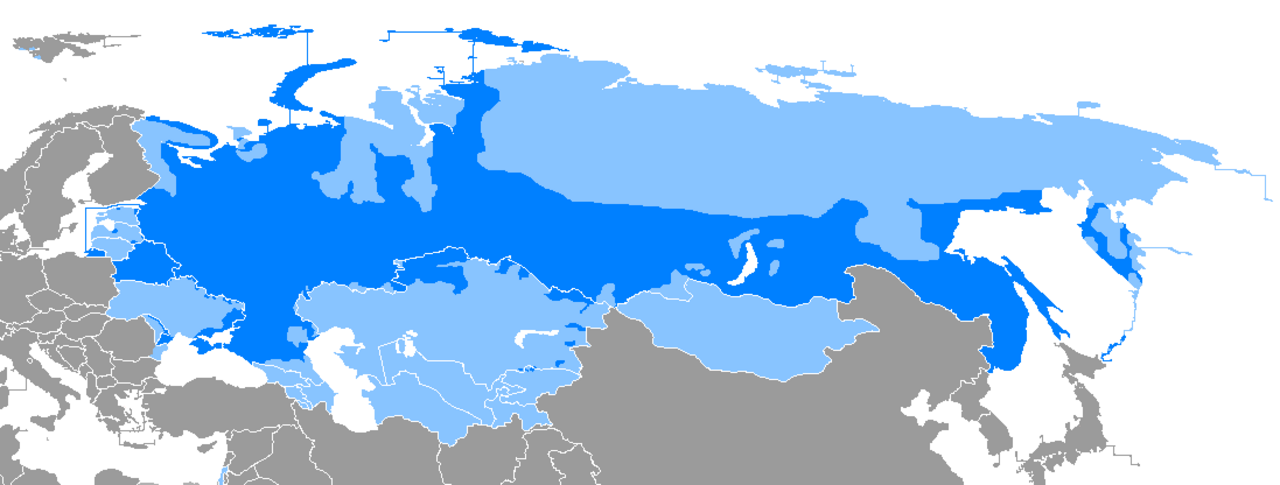
The official language of Russia is Russian, spoken as a first language by roughly 150 million people and written in the Cyrillic alphabet of 33 letters. It is the most widely spoken Slavic language and the most spoken native language in Europe, but Russia is also one of the most linguistically diverse countries on Earth, with more than 100 other languages woven through its vast territory.
Russian: The State Language
Russian is the sole official language at the federal level, used in government, courts, the military, national media, and schooling across the Russian Federation. Beyond its 150 million native speakers, it is understood by an estimated 260 million people worldwide, partly because it served as the common tongue throughout the Soviet Union. That legacy keeps Russian widely spoken across former Soviet states such as Kazakhstan, Belarus, Ukraine, and the Central Asian republics.
It is one of the six official working languages of the United Nations, alongside English, French, Spanish, Arabic, and Chinese. As an East Slavic language, Russian is closely related to Ukrainian and Belarusian, and more distantly to Polish, Czech, and Bulgarian.
How the Language Works
Russian grammar can feel intricate to English speakers because meaning is carried largely by word endings rather than word order. Nouns, adjectives, and pronouns change form across six grammatical cases (nominative, genitive, dative, accusative, instrumental, and prepositional), and every noun belongs to one of three genders: masculine, feminine, or neuter.
The verb system is built around aspect, distinguishing whether an action is completed or ongoing rather than relying on a long list of tenses. Because case endings do so much work, word order is relatively flexible and is used for emphasis. One feature English speakers often welcome: Russian has no articles, so there is no equivalent of "a," "an," or "the." Specificity is understood from context instead.
The Cyrillic Alphabet
Russian is written in Cyrillic, a script of 33 letters. Its roots trace to the early Cyrillic alphabet attributed to the 9th-century missionaries Saints Cyril and Methodius, who devised a way to write Old Church Slavonic. The alphabet was streamlined by Peter the Great in the early 18th century, and a reform soon after the 1917 Revolution removed several letters that had become redundant.
Cyrillic is far from unique to Russia. Variants are used to write Ukrainian, Belarusian, Bulgarian, Serbian, Macedonian, Mongolian, and many languages across the Caucasus and Central Asia. For most English speakers, learning to read Cyrillic takes only a few hours, since letters such as A, K, M, O, and T look and often sound familiar, while others like Я (ya), Ж (zh), and Ф (f) are new.
A Country of Many Languages
Russia is home to well over 100 minority and indigenous languages drawn from several distinct families, including Turkic, Finno-Ugric, Caucasian, Mongolic, and the small Paleo-Siberian groups. Many of Russia's republics designate their own official languages alongside Russian. The largest minority languages include:
- Tatar — around 5.3 million speakers, the most spoken minority language
- Chechen — roughly 1.4 million speakers in the North Caucasus
- Bashkir — about 1.2 million speakers
- Chuvash — close to 1 million speakers in the Volga region
The picture is not uniformly healthy. Turkic languages such as Tatar and Bashkir and the Finno-Ugric languages of the Volga have sizeable communities but face steady pressure from Russian-dominated education and media. Meanwhile, dozens of indigenous Siberian and Far Eastern languages are critically endangered, some down to a handful of elderly speakers. For a wider look at the country itself, see our russia country guide.
Useful Phrases for Travelers
A few words of Russian go a long way, especially outside major tourist areas where English is less common. Handy expressions include Zdravstvuyte (hello, formal), Spasibo (thank you), Pozhaluysta (please / you're welcome), Da and Nyet (yes and no), Skolko stoit? (How much does it cost?), Vy govorite po-angliyski? (Do you speak English?), and Pomogite! (Help!). Pronunciation can be tricky thanks to dense consonant clusters and the "soft sign," which softens the consonant before it, but locals tend to appreciate any effort.
Frequently Asked Questions
Is Russian the only official language of Russia?
Russian is the only official language at the federal level, but many of Russia's republics grant co-official status to local languages such as Tatar, Chechen, and Bashkir within their own borders.
How many people speak Russian worldwide?
About 150 million people speak Russian as a first language, and an estimated 260 million understand it overall, making it the most spoken Slavic language and the largest native language in Europe.
Is Russian hard to learn for English speakers?
The Cyrillic alphabet can be learned in a few hours, but the grammar, with six cases and verb aspect, takes longer to master. The lack of articles and tenses simplifies some areas, balancing the challenge.
What alphabet does Russian use?
Russian uses the Cyrillic alphabet, which has 33 letters and descends from the script developed for Old Church Slavonic in the 9th century. The same alphabet, in adapted forms, is used for many other languages.