
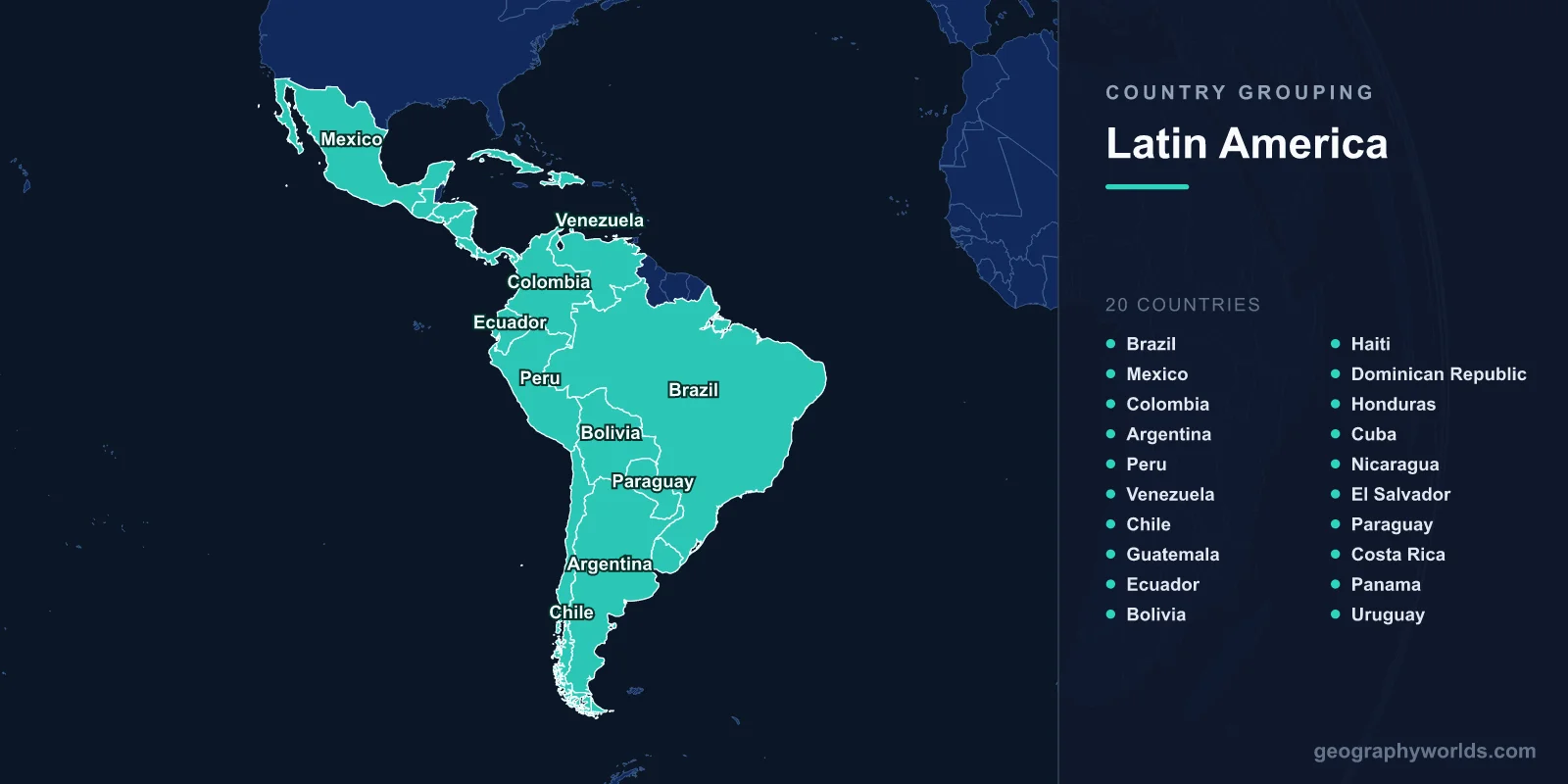
There are 20 Latin American countries: the independent states of the Americas where Spanish, Portuguese or French is the main language. Eighteen are Spanish-speaking, from Mexico to Argentina, along with Portuguese-speaking Brazil and French-speaking Haiti. Together they have about 660 million people on some 20 million km². English- and Dutch-speaking countries such as Jamaica, Guyana and Suriname are not included, and neither are territories like Puerto Rico and French Guiana, although some wider definitions count them.
The 20 Countries
| Country | Capital | Main language | Population |
|---|---|---|---|
| Brazil | Brasília | Portuguese | ~212 million |
| Mexico | Mexico City | Spanish | ~131 million |
| Colombia | Bogotá | Spanish | ~53 million |
| Argentina | Buenos Aires | Spanish | ~46 million |
| Peru | Lima | Spanish | ~34 million |
| Venezuela | Caracas | Spanish | ~28 million |
| Chile | Santiago | Spanish | ~20 million |
| Guatemala | Guatemala City | Spanish | ~18 million |
| Ecuador | Quito | Spanish | ~17 million |
| Bolivia | Sucre / La Paz | Spanish | ~12 million |
| Haiti | Port-au-Prince | French, Haitian Creole | ~11.8 million |
| Dominican Republic | Santo Domingo | Spanish | ~11.4 million |
| Honduras | Tegucigalpa | Spanish | ~10.8 million |
| Cuba | Havana | Spanish | ~10 million |
| Nicaragua | Managua | Spanish | ~7 million |
| El Salvador | San Salvador | Spanish | ~6.3 million |
| Paraguay | Asunción | Spanish, Guaraní | ~6.1 million |
| Costa Rica | San José | Spanish | ~5.1 million |
| Panama | Panama City | Spanish | ~4.5 million |
| Uruguay | Montevideo | Spanish | ~3.4 million |
By region, that is ten countries in South America, six in Central America, three in the Caribbean and Mexico in North America. Only Guyana and Suriname in South America are left out, and French Guiana, which is part of France. Mexico's place in North America, which many people find surprising, is explained in our article on whether Mexico is in North or South America.
Who Counts, and Why the Answer Varies
"Latin America" is a cultural definition, so the count depends on the rule used. The usual rule, independent countries whose main language comes from Latin, gives 20. Narrower terms give smaller numbers. Hispanic America means only the 18 Spanish-speaking countries. Ibero-America adds Brazil to make 19, and the Ibero-American summits also include Spain, Portugal and Andorra. Wider terms give larger numbers. The UN's regional grouping "Latin America and the Caribbean", and the political bloc CELAC, include all 33 independent states south of the United States, among them English-speaking Jamaica, Barbados and Guyana and Dutch-speaking Suriname.
Territories are a separate question. Puerto Rico is Spanish-speaking and culturally Latin American but is a US territory. French Guiana, Guadeloupe and Martinique are French-speaking parts of France. French-speaking Quebec is never included, which shows the definition is about history in the Americas as much as language.
Where the Name Came From
The term dates from the 1850s. In 1856 the Colombian writer José María Torres Caicedo used "América latina" in a poem, "Las dos Américas", and the Chilean Francisco Bilbao used it in a Paris lecture the same year. Both were setting Spanish-speaking America apart from the English-speaking United States, which had just taken half of Mexico's territory in the war of 1846–48. French writers adopted the idea too. Napoleon III used a pan-Latin rhetoric to justify France's intervention in Mexico in the 1860s. By the twentieth century the term had become standard in both Spanish and English.
One Generation of Independence
Haiti came first. Its enslaved population rose against France in 1791 and declared independence on 1 January 1804, making it the second independent country in the Americas after the United States. Most of Spanish America followed in a single generation, in wars fought between 1810 and 1826 under leaders including Simón Bolívar, José de San Martín and Bernardo O'Higgins. Mexico won its independence in 1821. Brazil took a different route. The Portuguese royal court had fled to Rio de Janeiro in 1808 to escape Napoleon, and in 1822 the king's son, Pedro, declared Brazil independent and made himself its emperor, so Brazil became a monarchy rather than a republic until 1889.
The new states did not all hold together. Bolívar's Gran Colombia, which joined present-day Colombia, Venezuela, Ecuador and Panama, broke apart in 1830–31, and the Federal Republic of Central America split into five countries by 1841. The last few came later. The Dominican Republic broke away from Haiti in 1844, and the Spanish-speaking Caribbean states are compared with their English-speaking neighbours in our list of Caribbean countries. Cuba became formally independent in 1902, after the Spanish–American War, and Panama separated from Colombia in 1903.
Languages Beyond Spanish and Portuguese
Spanish and Portuguese dominate, and Spanish is the world's second most widely spoken native language after Mandarin Chinese, but they are far from the only languages. In Paraguay, Guaraní is an official language alongside Spanish and is spoken by most of the population, the only Indigenous American language used by a majority of a country's people, most of whom are not Indigenous. Bolivia's 2009 constitution recognises Spanish and 36 Indigenous languages. Quechua, the language of the Inca state, is still spoken by around 8 to 10 million people across Peru, Bolivia and Ecuador, more than any other Indigenous language in the Americas. Mexico recognises 68 Indigenous languages, and in Guatemala about two-fifths of the population is Maya, speaking more than twenty Mayan languages.
Haiti's everyday language is Haitian Creole, spoken by nearly everyone, while French is used mainly in government, education and the press. Brazil, with more than 200 million people, is by far the largest Portuguese-speaking country, about twenty times the population of Portugal.
Faith and Society
Latin America has more Catholics than any other region, and Brazil alone has the largest Catholic population of any country in the world. In 2013 the Argentine cardinal Jorge Mario Bergoglio became Pope Francis, the first pope from the Americas, and he led the Church until his death in April 2025. The religious map has changed quickly, though. Evangelical and Pentecostal churches have grown rapidly since the 1970s, and in Brazil and much of Central America evangelicals now make up roughly a quarter or more of the population. Uruguay is the exception at the other end. It separated church and state in its 1918 constitution, soon afterwards renamed Christmas "Family Day" by law, and is among the least religious countries in the Americas.
Cities and Economies
Latin America is one of the most urbanised regions in the world, with about four in five people living in towns and cities. Greater São Paulo, Mexico City and Buenos Aires are among the largest urban areas in the Western Hemisphere, and in many countries a single primate city dominates: Lima holds about a third of Peru's population and Montevideo about half of Uruguay's. Brazil even built a new capital from scratch: Brasília, laid out in the shape of an aeroplane by Lúcio Costa and Oscar Niemeyer, was inaugurated in 1960 to draw development inland. Brazil and Mexico have the region's two largest economies, each around 2 trillion US dollars. Chile, Uruguay and Panama are among the richest countries per person, and Haiti is the poorest. Natural resources shape many of the economies: Venezuela has the world's largest proven oil reserves, Chile produces about a quarter of the world's copper, and Brazil is the largest exporter of both soybeans and coffee.
A Region of Natural Extremes
Six Latin American countries, Brazil, Colombia, Ecuador, Mexico, Peru and Venezuela, are among the 17 "megadiverse" countries that together hold most of the world's plant and animal species. Brazil holds about 60 per cent of the Amazon rainforest. Colombia has more bird species than any other country, and Ecuador's Galápagos Islands gave Charles Darwin key evidence for his theory of evolution. The region also holds some of the planet's physical extremes: the Atacama in Chile, the driest non-polar desert on Earth; Angel Falls in Venezuela, at 979 m the highest uninterrupted waterfall; Lake Titicaca on the Peru–Bolivia border, one of the highest large navigable lakes at about 3,800 m; and Aconcagua in Argentina, at 6,961 m the highest mountain outside Asia.
Borders Still in Dispute
Several Latin American borders are still contested. Venezuela claims about two-thirds of neighbouring Guyana, the Essequibo region, and held a referendum on the claim in December 2023 while the case sat before the International Court of Justice. Guatemala claims much of Belize, and both countries have referred the dispute to the same court. Bolivia lost its coastline to Chile in the War of the Pacific of 1879–84 and still seeks access to the sea, although the ICJ ruled in 2018 that Chile has no obligation to negotiate. Argentina continues to claim the Falkland Islands, the Islas Malvinas, which it fought Britain over in 1982.
Two Giants and Eighteen Others
Latin America is dominated by two countries. Brazil covers about 42 per cent of the region's land, and Brazil and Mexico together hold roughly half its people. Brazil borders every South American country except Chile and Ecuador. Mexico, with 131 million people, is the world's largest Spanish-speaking country. At the other end, Uruguay has only about 3.4 million people, and El Salvador, at about 21,000 km², is the smallest in area. The ten South American members are covered one by one in our guide to the countries of South America.