
Introduction
Myanmar 🇲🇲 and Cambodia 🇰🇭 are both mainland Southeast Asian nations shaped by great rivers, monsoon rains and centuries of Buddhist civilization — yet one is a sprawling, mountain-rimmed country of more than 55 million, and the other a compact lowland of 18 million built around a single remarkable lake. This comparison sets them side by side across area, population, capitals, language and natural features.
Whether you are revising geography, planning a trip through the region, or simply curious about how these two neighbors differ, the figures below cover the essentials.
Size & Geography
| Feature | Myanmar 🇲🇲 | Cambodia 🇰🇭 |
|---|---|---|
| Area | 676,578 km² | 181,035 km² |
| Continent | Asia | Asia |
| Region | Southeast Asia | Southeast Asia |
| Land Borders | Bangladesh, India, China, Laos, Thailand | Thailand, Laos, Vietnam |
| Landscape | central lowlands ringed by steep mountains | mostly low, flat plains; Tonle Sap Basin |
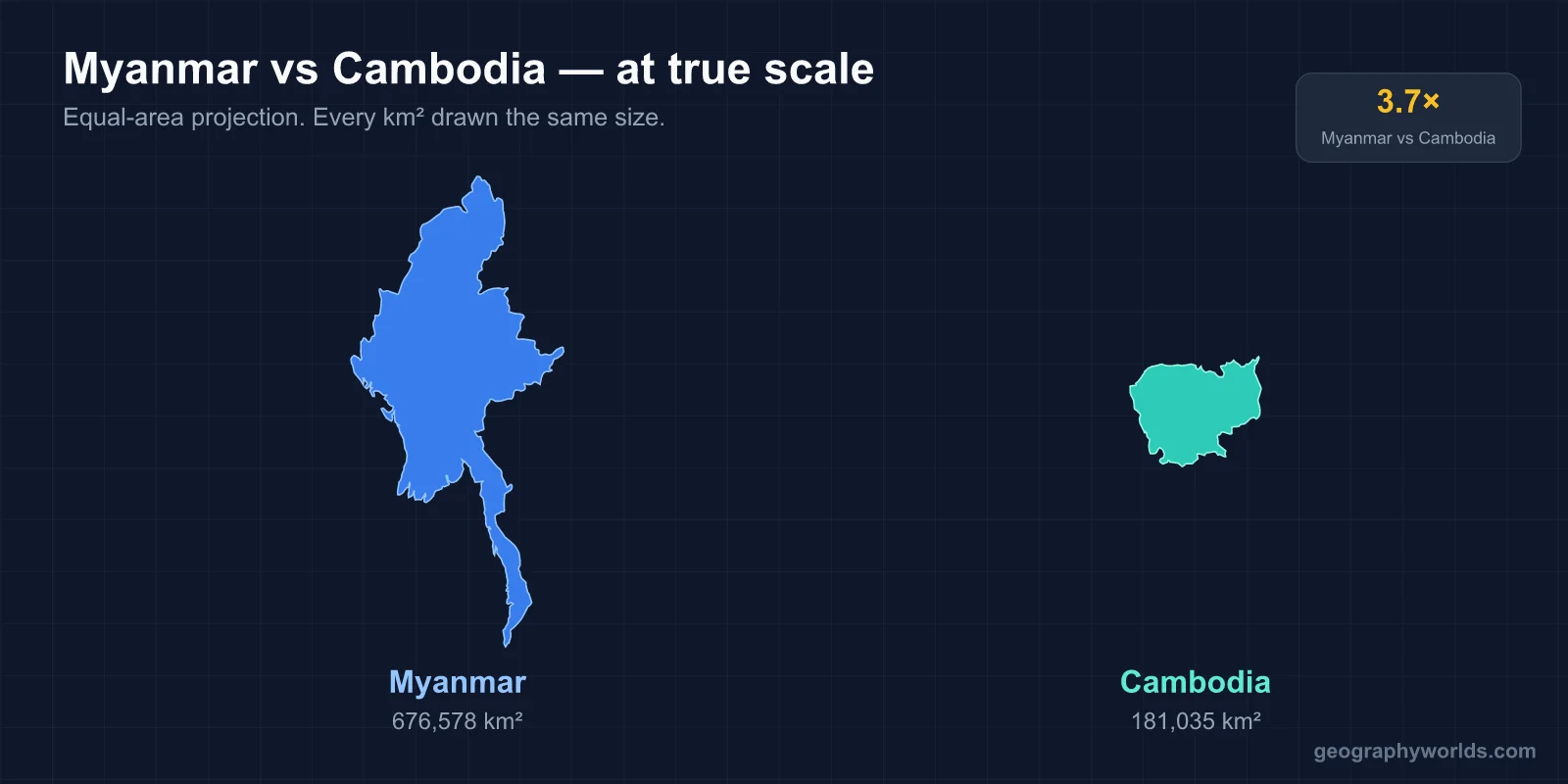
Myanmar is the larger country by a wide margin — its 676,578 km² are roughly 3.7 times Cambodia's 181,035 km². The two also have very different shapes on the map. Myanmar is a horseshoe of central lowlands ringed by steep mountains, with five neighbors pressing in from India and Bangladesh in the west to China, Laos and Thailand in the east. Cambodia is flatter and more contained, a low plain organized around the Tonle Sap Basin, sharing borders with just Thailand, Laos and Vietnam.
Population & Demographics
| Metric | Myanmar 🇲🇲 | Cambodia 🇰🇭 |
|---|---|---|
| Population | 55.2 million | 18.1 million |
| Population Density | 81.6 per km² | 99.7 per km² |
With 55.2 million people, Myanmar has about 3.1 times Cambodia's 18.1 million. Yet here the numbers spring a small surprise: Cambodia is actually the more crowded of the two on a per-kilometer basis, at 99.7 people per km² against Myanmar's 81.6 — a difference of roughly 18.1. The reason is that Cambodia's population concentrates on fertile, flat plains, while much of Myanmar's land is taken up by sparsely settled mountains.
Capital Cities
Myanmar is governed from Naypyidaw, a purpose-built capital established inland in the mid-2000s to replace Yangon as the seat of government. Cambodia's capital is Phnom Penh, its largest city, set where the Mekong and Tonle Sap rivers meet. Both lie in the Southeast Asia region, but their origins could hardly be more different — one a planned modern capital, the other a historic river port.
Language, Currency & Culture
| Aspect | Myanmar 🇲🇲 | Cambodia 🇰🇭 |
|---|---|---|
| Languages | Burmese (official) | Khmer (official) |
| Currency | Myanmar Kyat (MMK) | Cambodian Riel (KHR), USD widely used |
Each country has its own national language — Burmese in Myanmar, Khmer in Cambodia — and the two belong to entirely different language families, a reminder that "Southeast Asian" covers great linguistic diversity. On money, Myanmar uses the Myanmar Kyat (MMK), while Cambodia's official currency is the Cambodian Riel (KHR), though the US dollar circulates widely alongside it in everyday transactions.
Climate & Natural Features
| Aspect | Myanmar 🇲🇲 | Cambodia 🇰🇭 |
|---|---|---|
| Climate | tropical monsoon; rainy, hot, and humid summers | tropical; rainy monsoon season |
| Key Features | Irrawaddy River, Inle Lake, Bagan temples, Chin Hills | Angkor Wat, Tonle Sap, Mekong River, Cardamom Mountains |
| Economy | agriculture, natural gas, mining, textiles | garments, tourism, agriculture, construction |
Both countries live by the monsoon. Myanmar has a tropical monsoon climate with rainy, hot and humid summers, and its geography is written by the Irrawaddy River, the temple plain of Bagan, Inle Lake and the Chin Hills. Cambodia's tropical climate revolves around its own rainy monsoon season, which swells the Tonle Sap and feeds the Mekong, near landmarks that include the Cardamom Mountains and the temples of Angkor Wat. Economically, Myanmar draws on agriculture, natural gas, mining and textiles, whereas Cambodia leans on garments, tourism, agriculture and construction.
What Makes Each Country Unique
Myanmar is famous for the ancient temple field of Bagan, the golden Shwedagon Pagoda, the floating gardens of Inle Lake and countless gilded stupas. Bagan alone contains over 2,000 surviving Buddhist temples and pagodas built between the 11th and 13th centuries, spread across a vast plain.
Cambodia is best known for Angkor Wat, the heart of the medieval Khmer Empire, along with its resilient culture and deep historical legacy. Angkor Wat is the world's largest religious monument, covering more than 162 hectares — an area larger than Vatican City.
Key Differences at a Glance
- Area: Myanmar (676,578 km²) vs Cambodia (181,035 km²) — Myanmar is 3.7x larger
- Population: Myanmar (55.2 million) vs Cambodia (18.1 million) — Myanmar is 3.1x more populous
- Capitals: Naypyidaw vs Phnom Penh
- Currency: Myanmar Kyat (MMK) vs Cambodian Riel (KHR), USD widely used
- Continents: Asia vs Asia
- Density: Cambodia is more densely populated (difference of ~18.1 people per km²)
- Languages: Burmese (official) vs Khmer (official)
Verdict
Myanmar and Cambodia share a region, a monsoon rhythm and a Buddhist heritage, but they sit at different scales. Myanmar is the larger and more populous nation — about 3.7 times the area and 3.1 times the people — yet Cambodia is the more densely settled, its flat plains concentrating population where Myanmar's mountains thin it out.
In identity, Myanmar is defined by its tropical monsoon climate and river-and-mountain geography, with the Irrawaddy and Bagan as touchstones, while Cambodia is anchored by the Tonle Sap, the Mekong and above all Angkor Wat. Their economies point in different directions too, from Myanmar's resource-and-agriculture base to Cambodia's garment-and-tourism growth.
Placed together, the two countries fill out the picture of mainland Southeast Asia. Whether you are planning a visit, studying world geography, or simply satisfying your curiosity, understanding their differences makes the region come into sharper focus.
Test Your Knowledge!
Think you know your countries? Try our interactive geography quiz!
Play Geography Games →